Listen to this article
Table of Contents
- Introduction: Navigating the Complex World of Concealed Carry
- The Growing Interest in Concealed Carry
- Purpose of This Guide: Your Comprehensive State-by-State Resource
- Importance of Understanding State-Specific Laws
- What is Concealed Carry? Definitions and Distinctions
- The Diverse Landscape of Concealed Carry Laws in the U.S.
- General Requirements for Obtaining a Concealed Carry Permit
- Your State-by-State Guide to Concealed Carry Laws & Licensing
- Navigating the State-Specific Information:
- [ALABAMA] Concealed Carry Laws
- [ALASKA] Concealed Carry Laws
- [ARIZONA] Concealed Carry Laws
- [ARKANSAS] Concealed Carry Laws
- [CALIFORNIA] Concealed Carry Laws
- [COLORADO] Concealed Carry Laws
- [CONNECTICUT] Concealed Carry Laws
- [DELAWARE] Concealed Carry Laws
- [DISTRICT OF COLUMBIA] Concealed Carry Laws
- [FLORIDA] Concealed Carry Laws
- [GEORGIA] Concealed Carry Laws
- [HAWAII] Concealed Carry Laws
- [IDAHO] Concealed Carry Laws
- [ILLINOIS] Concealed Carry Laws
- [INDIANA] Concealed Carry Laws
- [IOWA] Concealed Carry Laws
- [KANSAS] Concealed Carry Laws
- [KENTUCKY] Concealed Carry Laws
- [LOUISIANA] Concealed Carry Laws
- [MAINE] Concealed Carry Laws
- [MARYLAND] Concealed Carry Laws
- [MASSACHUSETTS] Concealed Carry Laws
- [MICHIGAN] Concealed Carry Laws
- [MINNESOTA] Concealed Carry Laws
- [MISSISSIPPI] Concealed Carry Laws
- [MISSOURI] Concealed Carry Laws
- [MONTANA] Concealed Carry Laws
- [NEBRASKA] Concealed Carry Laws
- [NEVADA] Concealed Carry Laws
- [NEW HAMPSHIRE] Concealed Carry Laws
- [NEW JERSEY] Concealed Carry Laws
- [NEW MEXICO] Concealed Carry Laws
- [NEW YORK] Concealed Carry Laws
- [NORTH CAROLINA] Concealed Carry Laws
- [NORTH DAKOTA] Concealed Carry Laws
- [OHIO] Concealed Carry Laws
- [OKLAHOMA] Concealed Carry Laws
- [OREGON] Concealed Carry Laws
- [PENNSYLVANIA] Concealed Carry Laws
- [RHODE ISLAND] Concealed Carry Laws
- [SOUTH CAROLINA] Concealed Carry Laws
- [SOUTH DAKOTA] Concealed Carry Laws
- [TENNESSEE] Concealed Carry Laws
- [TEXAS] Concealed Carry Laws
- [UTAH] Concealed Carry Laws
- [VERMONT] Concealed Carry Laws
- [VIRGINIA] Concealed Carry Laws
- [WASHINGTON] Concealed Carry Laws
- [WEST VIRGINIA] Concealed Carry Laws
- [WISCONSIN] Concealed Carry Laws
- [WYOMING] Concealed Carry Laws
- Understanding Interstate Reciprocity: Carrying Across State Lines
- Prohibited Locations: Where You Cannot Carry a Concealed Firearm
- Your Rights and Responsibilities as a Concealed Carry Permit Holder
- Permit Denials and the Appeal Process
- What to Do If Your Permit Application is Denied
- The Evolving Legal Landscape of Concealed Carry
- Glossary of Key Concealed Carry Terms
- Conclusion: Empowering Responsible Concealed Carry
- FAQs
Introduction: Navigating the Complex World of Concealed Carry
The ability to carry a concealed firearm is a right exercised by millions of Americans, yet the legal landscape surrounding it is notoriously complex and varies dramatically from state to state. For many, the decision to obtain a concealed carry permit is driven by a desire for personal safety, a commitment to constitutional rights, or a combination of both. Navigating the intricate web of regulations, application processes, and legal responsibilities can be a daunting task. This comprehensive guide is designed to serve as your authoritative resource, demystifying the process and providing clear, actionable information for understanding concealed carry permits, their legal underpinnings, how to apply, and the diverse laws that govern them across the United States.
The Growing Interest in Concealed Carry
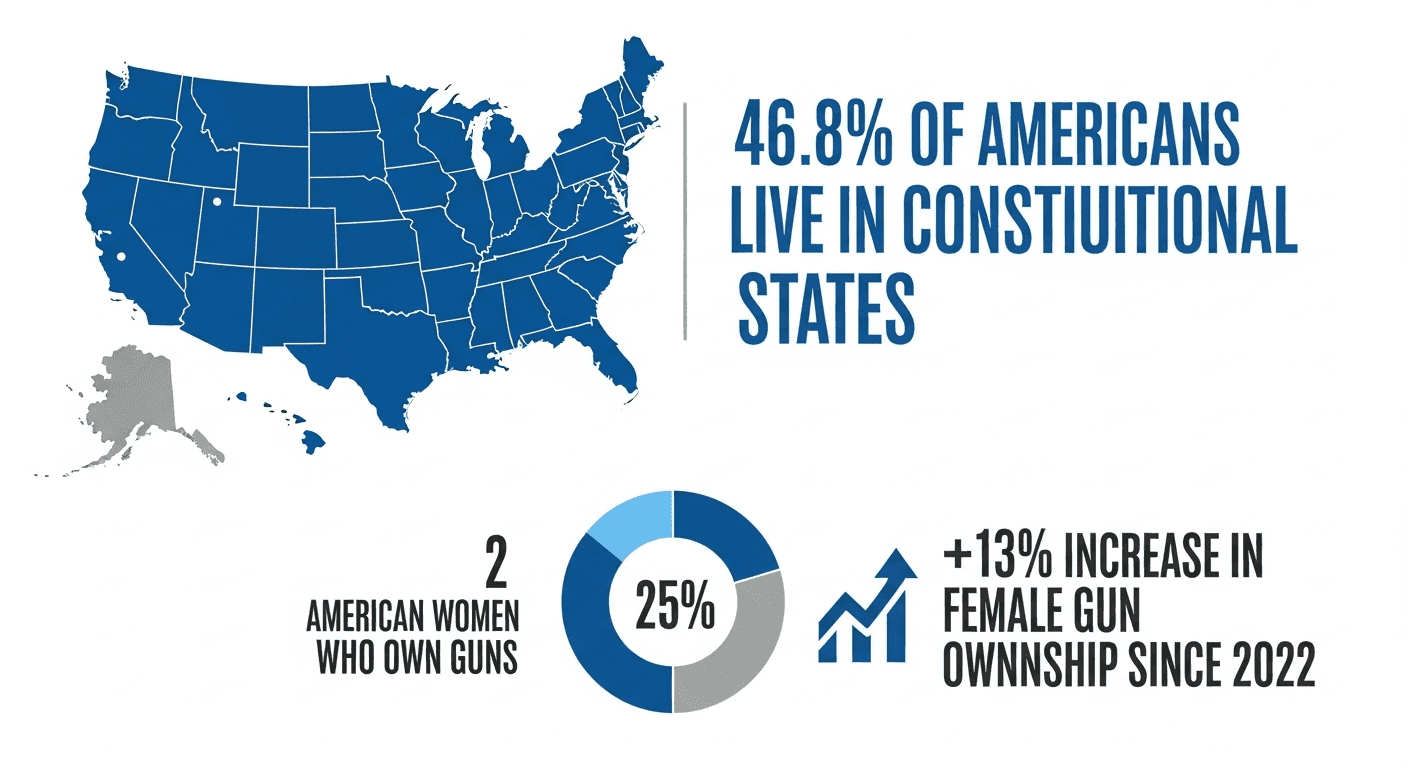 The landscape of concealed carry is evolving, with nearly half of Americans in constitutional carry states and a significant rise in gun ownership among women.
The desire for personal security and the assertion of Second Amendment rights have fueled a significant and sustained increase in concealed carry permit applications and ownership across the nation. This trend is not confined to specific demographics; it reflects a broader societal awareness of personal responsibility for safety. In 2024, for instance, a substantial portion of the American population resided in states recognizing constitutional carry, with 46.8% of Americans, or approximately 157.6 million people, living in such areas according to the Crime Prevention Research Center constitutional carry states. This statistic underscores the evolving landscape of firearm rights. Furthermore, the demographic of gun owners is broadening, with a notable increase among women. In 2024, 25% of American women, roughly 42 million individuals, owned guns, representing a 13% increase from 2022 women gun owners. This rise in ownership, particularly among women, suggests a growing interest in personal protection and the means to achieve it, including concealed carry. The reasons are multifaceted, often stemming from a desire for enhanced self-defense capabilities in an unpredictable world and a deeply held belief in the fundamental right to bear arms for personal protection.
Purpose of This Guide: Your Comprehensive State-by-State Resource
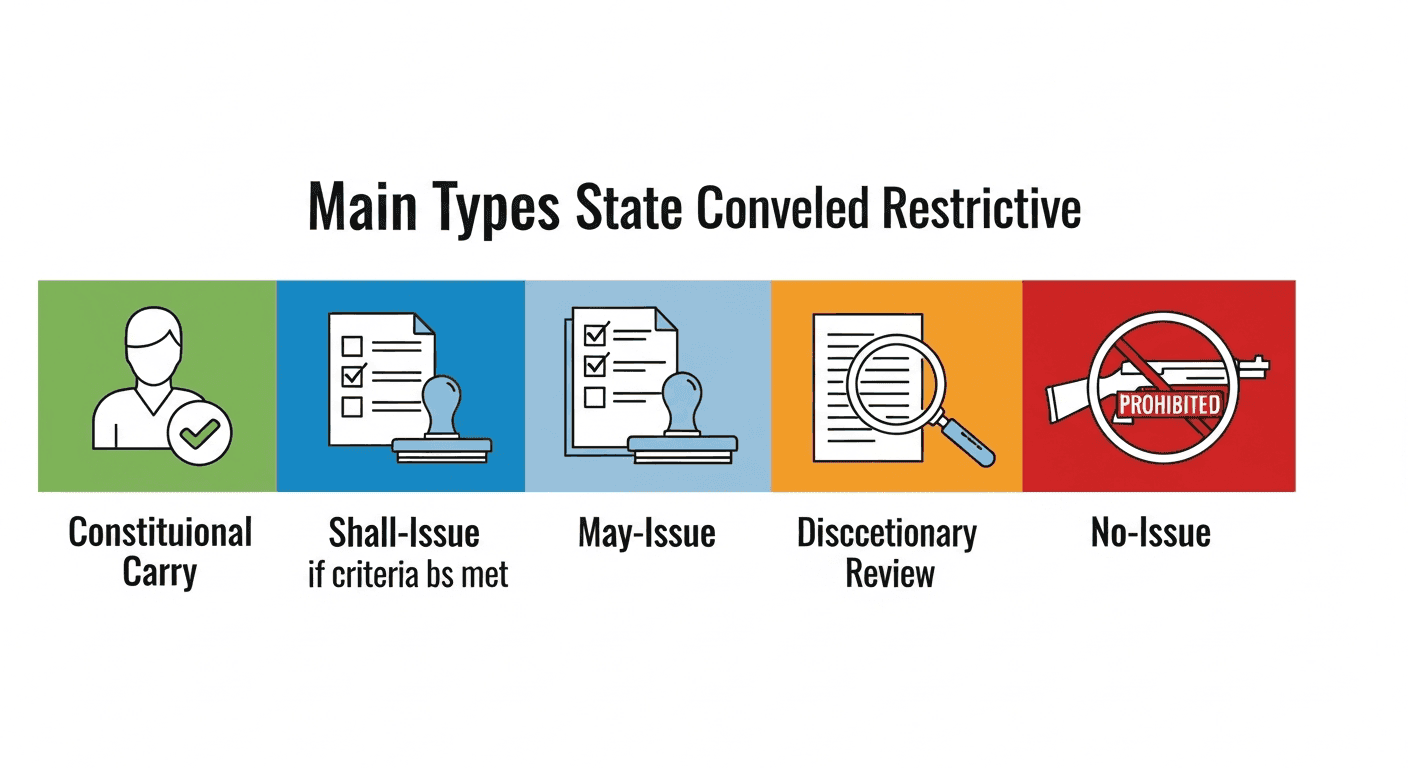 State concealed carry laws generally fall into four categories, ranging from permitless carry to highly restrictive systems.
This guide aims to consolidate the essential information needed to understand concealed carry permits, from fundamental definitions to the granular details of state-specific laws. We will break down the eligibility criteria, the application journey, and the crucial legal frameworks that govern firearm carry. Our objective is to empower individuals with the knowledge necessary to make informed decisions, ensure legal compliance, and exercise their rights responsibly. By providing a structured overview and a detailed state-by-state breakdown, this resource seeks to eliminate confusion and serve as a definitive point of reference for anyone interested in obtaining or understanding a concealed carry permit.
Importance of Understanding State-Specific Laws
Firearms laws in the United States are a complex mosaic of federal statutes and, more significantly, fifty distinct state legal systems, plus local ordinances. What is legal and permissible in one state can be a serious criminal offense in another. This jurisdictional fragmentation means that a thorough understanding of the specific laws governing the state in which you reside and any state you plan to travel through is not merely advisable but absolutely critical. Ignorance of the law is rarely a valid defense, and violations can carry severe penalties, including hefty fines, loss of firearm rights, and imprisonment. Therefore, this guide emphasizes the paramount importance of consulting official state resources and understanding the nuances of your local jurisdiction before carrying a concealed firearm.
What is Concealed Carry? Definitions and Distinctions
Understanding the terminology and legal frameworks surrounding the carrying of firearms is foundational to comprehending concealed carry permits. This section clarifies the core concepts and provides historical context.
Defining Concealed Carry vs. Open Carry
Concealed carry refers to the practice of transporting a firearm in a manner that is not openly visible to others. This typically involves carrying the firearm under clothing, in a bag, or within a vehicle in a way that it is not readily apparent. In contrast, open carry involves openly displaying a firearm, usually in a holster on the belt. While some states permit open carry without a permit, others require specific permits for both concealed and open carry, or have outright restrictions. The legal distinction between these two methods of carrying is significant, impacting where and how firearms can be transported.
The Second Amendment and Individual Gun Rights (Brief Context)
The Second Amendment to the United States Constitution states, "A well regulated Militia, being necessary to the security of a free State, the right of the people to keep and bear Arms, shall not be infringed." For decades, the interpretation of this amendment has been a subject of considerable legal and political debate. However, landmark Supreme Court decisions, most notably District of Columbia v. Heller (2008) and McDonald v. City of Chicago (2010), affirmed that the Second Amendment protects an individual's right to keep and bear arms for traditionally lawful purposes, such as self-defense in the home. More recently, the Supreme Court's decision in New York State Rifle & Pistol Association, Inc. v. Bruen (2022) further clarified and expanded upon these individual rights, significantly impacting the legal framework for carrying firearms in public. This decision has prompted states to re-evaluate their licensing regimes, moving away from subjective "good cause" requirements towards a more objective, rights-based approach.
Historical and Evolving Perspectives on Carrying Firearms
The right to bear arms and its regulation have a long and complex history in the United States. From the early days of the nation, when firearms were essential for self-defense, hunting, and militia service, to the modern era, perspectives on carrying firearms have evolved significantly. Early American laws often permitted citizens to carry firearms openly or concealed, with relatively few restrictions. However, as society industrialized and urbanized, concerns about public safety led to the gradual implementation of firearm regulations. The 20th century saw a rise in restrictions, and the late 20th and early 21st centuries have witnessed a resurgence of advocacy for expanded firearm rights, leading to the adoption of "shall-issue" and "constitutional carry" laws in many states. The Bruen decision represents a pivotal moment in this ongoing evolution, reinforcing the constitutional right to carry firearms for self-defense in public.
The Diverse Landscape of Concealed Carry Laws in the U.S.
The most striking characteristic of concealed carry regulation in the U.S. is its diversity. There is no single federal permit that allows for concealed carry nationwide. Instead, each state operates under its own set of laws, creating a complex system of differing requirements, permissions, and restrictions.
Understanding Permit Types:
The primary frameworks for concealed carry permits can be broadly categorized as follows:
- Shall-Issue: In these states, if an applicant meets all the specified legal requirements, the issuing authority is mandated by law to grant the permit. The issuing agency has little to no discretion to deny a permit if all criteria are met.
- May-Issue: In these states, applicants must demonstrate a "good cause" or a specific need for carrying a firearm, beyond general self-defense. The issuing authority has significant discretion in deciding whether to grant a permit. The Bruen decision has significantly challenged the legality of "may-issue" systems that rely on subjective standards for "good cause."
- Constitutional Carry (Permitless Carry): In these states, law-abiding citizens who are legally eligible to possess a firearm are generally permitted to carry a concealed handgun without needing a specific permit. While no permit is required, individuals must still adhere to laws regarding prohibited locations and other firearm regulations. It's important to note that residents and non-residents may have different rules in some constitutional carry states.
Key Legal Frameworks: Federal and State Laws
While federal law sets some baseline standards for firearm possession (e.g., prohibitions for felons), it largely defers to states regarding the regulation of carrying firearms. Key federal statutes include the National Firearms Act of 1934 (NFA), the Gun Control Act of 1968 (GCA), and the Brady Handgun Violence Prevention Act of 1993, which mandates federal background checks through the National Instant Criminal Background Check System (NICS). However, the specifics of who can carry a firearm, where, and under what conditions are primarily governed by individual state laws. These state laws dictate everything from eligibility criteria and training requirements to the types of firearms that can be carried and the places where carrying is prohibited.
General Requirements for Obtaining a Concealed Carry Permit
While each state has its unique set of rules, there are common eligibility criteria and procedural steps that most applicants for a concealed carry permit must navigate. These requirements are designed to ensure that individuals who carry firearms are responsible, law-abiding citizens.
Eligibility Criteria (Common Across States)
Prospective permit holders typically must meet several core eligibility requirements, which often include:
- Age: Most states require applicants to be at least 21 years old. Some may have lower age limits for specific circumstances or for non-resident permits.
- Residency: Applicants usually must be legal residents of the state in which they are applying. Specific residency duration requirements can vary.
- Criminal History: A clean criminal record is paramount. Most states prohibit individuals with felony convictions, certain misdemeanor convictions (especially those involving domestic violence or violent crimes), and those with outstanding warrants from obtaining a permit.
- Mental Health: Applicants must generally demonstrate sound mental health and not have been adjudicated as mentally defective or involuntarily committed to a mental institution.
- Substance Abuse: A history of drug or alcohol abuse that renders an individual a danger to themselves or others can lead to disqualification.
- Legal Status: Applicants must be U.S. citizens or legal resident aliens in good standing.
- Other Prohibitions: This can include being subject to certain restraining orders or protection orders, or having been dishonorably discharged from the military.
Training Requirements
A significant number of states mandate that applicants complete a firearms safety and training course from a certified instructor. These courses are designed to teach:
- Safe firearm handling and storage
- Firearm mechanics and operation
- Marksmanship fundamentals
- The laws governing the use of deadly force
- State-specific laws regarding carrying firearms
The nature of the required training varies widely. Some states accept a variety of courses (e.g., NRA-certified, law enforcement-led), while others require specific, state-approved curriculum. The debate over online versus in-person training continues, with many states requiring at least some portion of the training, particularly range qualification, to be conducted in person. Public support for mandatory training remains strong, with 74% of Americans in 2021 supporting the requirement of a test demonstrating safe and lawful firearm use before obtaining a concealed carry permit public support for training.
Background Checks: The Application Process Component
A comprehensive background check is a cornerstone of the concealed carry permit application process. This typically involves:
- National Instant Criminal Background Check System (NICS): This system, managed by the FBI, checks federal databases for disqualifying criminal history, mental health adjudications, and other prohibitors.
- State Databases: Applicants will also be screened against state-specific criminal history records and other relevant databases.
- Fingerprinting: Most states require applicants to submit fingerprints, which are used for the background check and to help identify the applicant.
The background check aims to ensure that only law-abiding citizens who meet all eligibility requirements are granted the privilege of carrying a concealed firearm.
Your State-by-State Guide to Concealed Carry Laws & Licensing
This section provides an overview of concealed carry regulations in select U.S. states. It is crucial to remember that laws are subject to change, and this information should be used as a starting point. Always consult the official website of your state's law enforcement agency or licensing authority for the most current and accurate details.
Navigating the State-Specific Information:
When researching a specific state, look for information on:
- Permit Type: Is the state Shall-Issue, May-Issue, or Constitutional Carry?
- Issuing Authority: Which state agency is responsible for issuing permits (e.g., State Police, Sheriff's Office, Department of Public Safety)?
- Specific Eligibility: Any unique age, residency, or disqualification factors.
- Training: Mandated courses, accepted providers, online vs. in-person requirements.
- Application Process: Required forms, fees, where to apply, and processing times.
- Prohibited Locations: Specific places where carrying is forbidden.
- Duty to Inform: Whether you are legally obligated to inform law enforcement you are carrying when lawfully stopped.
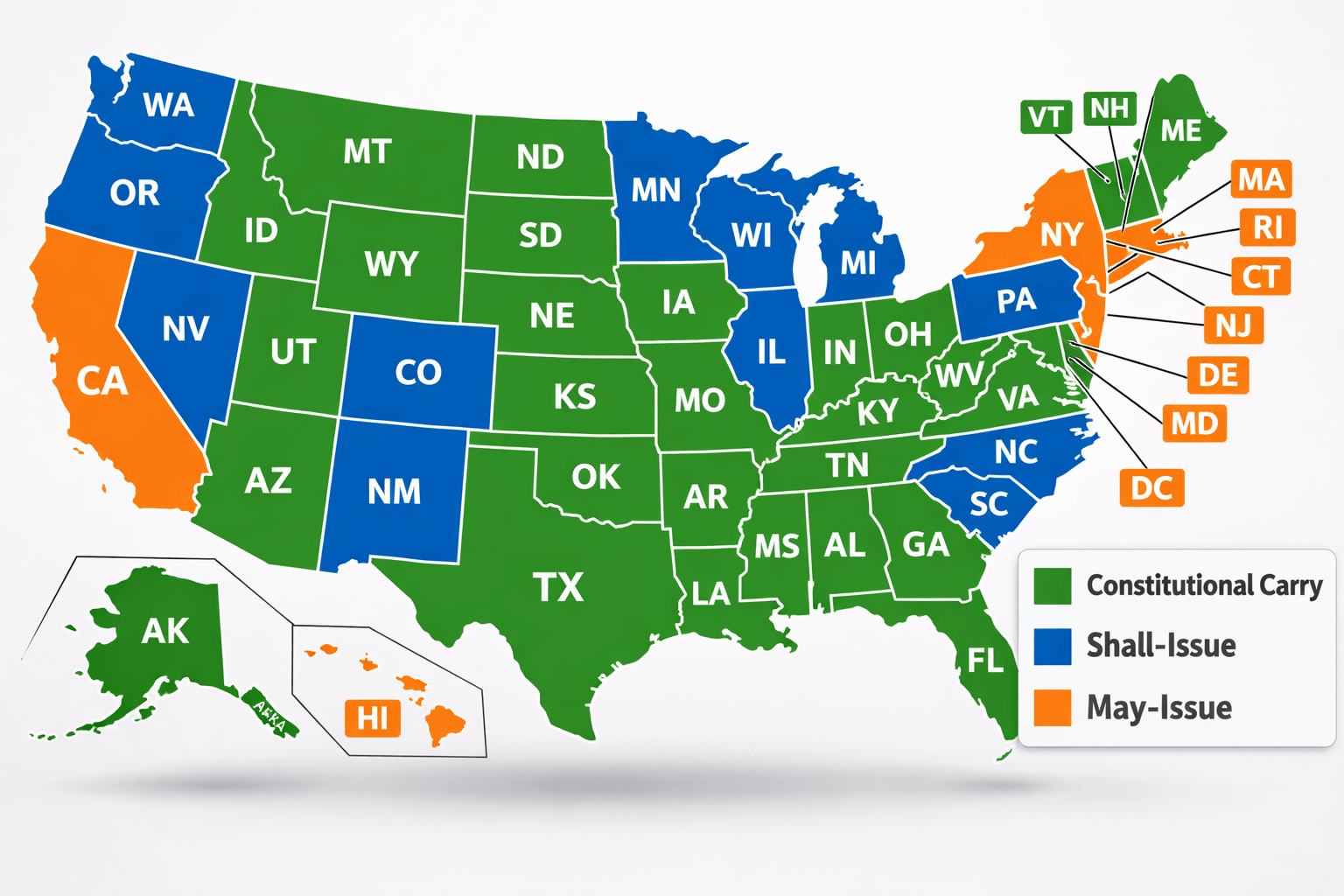
[ALABAMA] Concealed Carry Laws
Alabama is a Shall-Issue state for concealed carry permits. Permits are issued by the sheriff of the applicant's county of residence. Applicants must be 21 years of age (or 18 for active military personnel or veterans), be a U.S. citizen or lawful permanent resident, and demonstrate competence with a pistol through an approved training course. Alabama does not have a "duty to inform" requirement, but it is generally considered good practice to inform law enforcement if you are lawfully carrying.
[ALASKA] Concealed Carry Laws
Alaska is a Constitutional Carry state, meaning that most individuals 21 years of age or older who are legally permitted to possess a firearm may carry a concealed handgun without a permit. Non-residents aged 21 and older who are legally permitted to carry in their home state may also carry concealed in Alaska. Alaska also offers an optional Concealed Handgun Permit (CHP) for those who wish to carry in reciprocity states or simply for identification purposes.
[ARIZONA] Concealed Carry Laws
Arizona is a Shall-Issue state and also allows for Constitutional Carry for residents aged 21 and older who are legally allowed to possess a firearm. Those carrying under Constitutional Carry must be aware of all applicable laws, including prohibited locations. An optional Concealed Weapon Permit (CWP) is available for residents, which can facilitate reciprocity with other states. The CWP requires specific training and a background check.
[ARKANSAS] Concealed Carry Laws
Arkansas is a Shall-Issue state. The Arkansas State Police issues Enhanced Carry Permits. Applicants must be 21 years of age, a resident of Arkansas, and complete an approved firearms safety course. There is also a basic handgun license available for those 18 and older. The Enhanced Carry Permit provides reciprocity with more states than the basic license.
[CALIFORNIA] Concealed Carry Laws
California is a May-Issue state, which has historically made obtaining a concealed carry permit (CCW) very difficult, especially in more populated areas. Applicants must demonstrate "good cause," which is typically defined as a specific, articulable reason beyond general self-defense that sets them apart from the general public. The Sheriff or Chief of Police in the applicant's jurisdiction has discretion in issuing permits. The Bruen decision has led to legal challenges and adjustments in how "good cause" is interpreted and applied, but California's system remains one of the most restrictive.
[COLORADO] Concealed Carry Laws
Colorado is a Shall-Issue state. Permits are issued by the sheriff of the applicant's county of residence. Applicants must be 21 years of age and demonstrate competence with a handgun, often through an approved training course. Colorado has reciprocity agreements with many other states.
[CONNECTICUT] Concealed Carry Laws
Connecticut is a Shall-Issue state. Permits are issued by local police departments or state police. Applicants must be 21 years of age, demonstrate competence with a pistol through an approved course, and pass a background check. Connecticut has specific regulations regarding the types of firearms that can be carried.
[DELAWARE] Concealed Carry Laws
Delaware is a May-Issue state, and obtaining a permit can be challenging. Applicants must demonstrate a "reasonable and justifiable need" to carry a firearm. Permits are issued by the state Police. The process involves a thorough background investigation and interview.
[DISTRICT OF COLUMBIA] Concealed Carry Laws
The District of Columbia has very strict firearm regulations. Following legal challenges, DC now issues permits to qualified individuals who can demonstrate they meet stringent eligibility criteria, including demonstrating a "proper reason" to carry a firearm for self-defense. This involves a comprehensive application process, extensive background checks, and specific training requirements.
[FLORIDA] Concealed Carry Laws
Florida is a Shall-Issue state. The Florida Department of Agriculture and Consumer Services issues Concealed Weapon Licenses. Applicants must be 21 years of age, a U.S. citizen or lawful permanent resident, and complete a firearms safety course. Florida has reciprocity with numerous other states.
[GEORGIA] Concealed Carry Laws
Georgia is a Shall-Issue state. Permits are issued by the Probate Court of the applicant's county of residence. Applicants must be 21 years of age, a resident of Georgia, and demonstrate basic proficiency with a firearm. Georgia has reciprocity with many other states.
[HAWAII] Concealed Carry Laws
Hawaii is a May-Issue state with very stringent requirements. Permits are issued by county police chiefs, and applicants must demonstrate a compelling reason for needing to carry a firearm, such as a credible threat to life or property. The process is rigorous and often difficult to navigate.
[IDAHO] Concealed Carry Laws
Idaho is a Constitutional Carry state for residents aged 18 and older who are legally permitted to own a firearm. Idaho also offers an optional Concealed Weapon License (CWL), which can be obtained by completing an approved training course and passing a background check. This permit is primarily useful for reciprocity with other states.
[ILLINOIS] Concealed Carry Laws
Illinois is a Shall-Issue state. The Illinois State Police issue Firearm Owner's Identification (FOID) cards, which are required to possess firearms, and Concealed Carry Licenses (CCL). Applicants for a CCL must be 21 years of age, complete a minimum of 16 hours of approved firearms training, and pass a background check.
[INDIANA] Concealed Carry Laws
Indiana is a Shall-Issue state and also recognizes Constitutional Carry for residents. Individuals 18 years of age and older who are legally eligible to possess a handgun can carry it concealed without a license. Indiana offers an optional Handgun License (both On-Premise and Lifetime) for reciprocity purposes and convenience.
[IOWA] Concealed Carry Laws
Iowa is a Shall-Issue state and also recognizes Constitutional Carry for residents aged 21 and older. Permits are issued by the sheriff of the applicant's county of residence. An optional Permit to Carry Weapons is available for those who wish to carry in states with reciprocity agreements.
[KANSAS] Concealed Carry Laws
Kansas is a Constitutional Carry state for residents aged 21 and older. The Kansas Attorney General issues Concealed Handgun Licenses (CHLs) for those who wish to carry in states with reciprocity agreements. Applicants must be 21 and pass a background check.
[KENTUCKY] Concealed Carry Laws
Kentucky is a Shall-Issue state. Permits are issued by the Kentucky Department of State Police. Applicants must be 21 years of age, a resident of Kentucky, and complete an approved firearms training course.
[LOUISIANA] Concealed Carry Laws
Louisiana is a Shall-Issue state. Permits are issued by the Louisiana State Police. Applicants must be 21 years of age, a resident of Louisiana, and complete an approved handgun safety course.
[MAINE] Concealed Carry Laws
Maine is a Constitutional Carry state for residents and non-residents aged 21 and older who are legally eligible to possess a firearm. Maine also issues Permits to Carry Concealed Handguns, which are useful for reciprocity. Applicants must be 21 and demonstrate proficiency.
[MARYLAND] Concealed Carry Laws
Maryland is a May-Issue state with strict requirements. Permits are issued by the Secretary of State Police, and applicants must demonstrate a "sufficiently strong" reason to carry a firearm, which is interpreted very narrowly. The process is highly discretionary and difficult.
[MASSACHUSETTS] Concealed Carry Laws
Massachusetts is a May-Issue state. Permits are issued by local licensing authorities (police chiefs), and applicants must demonstrate a "proper need" for self-defense. The process is highly discretionary and often challenging, with strict eligibility requirements.
[MICHIGAN] Concealed Carry Laws
Michigan is a Shall-Issue state. Permits are issued by the county clerk upon recommendation of the sheriff. Applicants must be 21 years of age and complete an approved pistol safety course. Michigan also has reciprocity with many states.
[MINNESOTA] Concealed Carry Laws
Minnesota is a Shall-Issue state. Permits are issued by the sheriff of the applicant's county of residence. Applicants must be 21 years of age, demonstrate competence with a handgun through an approved course, and pass a background check.
[MISSISSIPPI] Concealed Carry Laws
Mississippi is a Shall-Issue state and also recognizes Constitutional Carry for residents aged 21 and older (or 18 for active duty military). The Mississippi Firearms Permit is issued by the Mississippi Department of Public Safety and is primarily for reciprocity.
[MISSOURI] Concealed Carry Laws
Missouri is a Shall-Issue state and also recognizes Constitutional Carry for residents aged 19 and older who are legally eligible to possess a firearm. Permits are issued by the sheriff of the applicant's county of residence. An optional Concealed Carry Endorsement is available.
[MONTANA] Concealed Carry Laws
Montana is a Constitutional Carry state for residents aged 18 and older who are legally eligible to possess a firearm. Montana also issues concealed carry permits for reciprocity purposes, which are available through the sheriff's office.
[NEBRASKA] Concealed Carry Laws
Nebraska is a Shall-Issue state. Permits are issued by the sheriff of the applicant's county of residence. Applicants must be 21 years of age and complete an approved handgun training and safety course. Nebraska law explicitly states that online training is not sufficient; in-person instruction is required.
[NEVADA] Concealed Carry Laws
Nevada is a Shall-Issue state. Permits are issued by the sheriff or chief of police of the applicant's county of residence. Applicants must be 21 years of age and demonstrate competence with a handgun through an approved training course.
[NEW HAMPSHIRE] Concealed Carry Laws
New Hampshire is a Shall-Issue state. Permits are issued by the local police chief or county sheriff. Applicants must be 18 years of age and demonstrate competence with a firearm. New Hampshire has broad reciprocity.
[NEW JERSEY] Concealed Carry Laws
New Jersey is a May-Issue state with extremely restrictive laws and a high burden of proof for obtaining a permit. Applicants must demonstrate a "justifiable need" to carry a handgun, which is typically interpreted to mean a credible threat to life or property that cannot be addressed by other means. This is one of the most challenging states in the U.S. for obtaining a concealed carry permit.
[NEW MEXICO] Concealed Carry Laws
New Mexico is a Shall-Issue state. Permits are issued by the New Mexico Department of Public Safety. Applicants must be 21 years of age and complete an approved firearms training course.
[NEW YORK] Concealed Carry Laws
New York is a May-Issue state. While the Bruen decision mandated changes to handgun licensing, obtaining a concealed carry permit (known as a pistol license) generally still requires demonstrating "proper cause" for the license, which is interpreted by licensing authorities. The process is complex and varies by county. Outside of New York City, licenses are issued by county judges or licensing officers.
[NORTH CAROLINA] Concealed Carry Laws
North Carolina is a Shall-Issue state. Permits are issued by the sheriff of the applicant's county of residence. Applicants must be 21 years of age and complete an approved firearms safety and training course.
[NORTH DAKOTA] Concealed Carry Laws
North Dakota is a Constitutional Carry state for residents aged 18 and older. The state also issues Concealed Weapon Licenses for reciprocity purposes, requiring an approved training course and background check.
[OHIO] Concealed Carry Laws
Ohio is a Shall-Issue state and has also implemented Constitutional Carry. Residents aged 21 and older who are legally permitted to possess a firearm can carry concealed without a permit. Ohio issues Concealed Handgun Licenses (CHLs) for reciprocity. In the year following the implementation of its constitutional carry law (June 2022 - June 2023), Ohio's eight largest cities collectively saw less gun crime, and six of them individually, indicating no increase in gun crime in these urban areas Ohio crime rates.
[OKLAHOMA] Concealed Carry Laws
Oklahoma is a Shall-Issue state and also recognizes Constitutional Carry for residents aged 21 and older. The Oklahoma Self-Defense Act (SDA) requires training for a handgun license, which allows for reciprocity with other states.
[OREGON] Concealed Carry Laws
Oregon is a Shall-Issue state. Permits are issued by the sheriff of the applicant's county of residence. Applicants must be 21 years of age, and requirements for demonstrating competence with a firearm vary by county, often requiring an approved course. Oregon's laws have recently faced legal challenges related to the Bruen decision, impacting how permits are issued.
[PENNSYLVANIA] Concealed Carry Laws
Pennsylvania is a Shall-Issue state. Permits are issued by the sheriff of the applicant's county of residence. Applicants must be 21 years of age and demonstrate qualification for the permit. Pennsylvania has reciprocity with many states.
[RHODE ISLAND] Concealed Carry Laws
Rhode Island is a May-Issue state with restrictive laws. Permits are issued by local licensing authorities (police chiefs or town councils). Applicants must demonstrate a specific reason for needing a permit, and the process is highly discretionary.
[SOUTH CAROLINA] Concealed Carry Laws
South Carolina is a Shall-Issue state. Permits are issued by the South Carolina Law Enforcement Division (SLED). Applicants must be 21 years of age and complete an approved firearms training course.
[SOUTH DAKOTA] Concealed Carry Laws
South Dakota is a Shall-Issue state and also recognizes Constitutional Carry for residents aged 18 and older. Permits are issued by the sheriff of the applicant's county of residence and are primarily for reciprocity.
[TENNESSEE] Concealed Carry Laws
Tennessee is a Shall-Issue state and also recognizes Constitutional Carry for residents aged 21 and older. Tennessee issues Handgun Carry Permits (HCPs) for those who wish to carry in reciprocity states or prefer to have a permit. Applicants must be 21 and complete an approved training course.
[TEXAS] Concealed Carry Laws
Texas is a Shall-Issue state. The Texas Department of Public Safety (DPS) issues License to Carry (LTC) permits. Applicants must be 21 years of age (18 for active duty military) and complete a state-approved LTC course. Texas also recognizes Constitutional Carry for residents aged 21 and older.
[UTAH] Concealed Carry Laws
Utah is a Shall-Issue state and offers two types of permits: a Provisional Permit (for residents under 21) and a standard Permit to Carry a Concealed Weapon. Applicants must be at least 21 years old (18 for provisional), be a U.S. citizen or legal alien, and complete an approved firearms safety course. Utah permits are recognized by many states.
[VERMONT] Concealed Carry Laws
Vermont is a Constitutional Carry state, meaning no permit is required for residents aged 21 and older to carry a handgun openly or concealed, as long as they are legally eligible to possess a firearm. Vermont has no state-issued permit for concealed carry for its residents.
[VIRGINIA] Concealed Carry Laws
Virginia is a Shall-Issue state. Permits are issued by the circuit court in the applicant's county of residence. Applicants must be 21 years of age and demonstrate competence with a handgun through an approved training course. Virginia also recognizes permits from many other states.
[WASHINGTON] Concealed Carry Laws
Washington is a Shall-Issue state for its Concealed Pistol License (CPL). Applicants must be 21 years of age and pass a background check and a firearms safety course. Washington state saw its largest annual increase in concealed carry permits since 2022, with 14,000 newly acquired licenses statewide in 2025 (as of July 31), bringing the total to over 713,000 active permits Washington permit surge.
[WEST VIRGINIA] Concealed Carry Laws
West Virginia is a Shall-Issue state and also recognizes Constitutional Carry for residents aged 21 and older (or 18 for active duty military). The state issues Handgun Permits for reciprocity purposes.
[WISCONSIN] Concealed Carry Laws
Wisconsin is a Shall-Issue state. Permits are issued by the Wisconsin Department of Justice. Applicants must be 21 years of age and complete an approved firearms training course.
[WYOMING] Concealed Carry Laws
Wyoming is a Shall-Issue state and also recognizes Constitutional Carry for residents aged 21 and older. Permits are issued by the county sheriff and are primarily for reciprocity.
Understanding Interstate Reciprocity: Carrying Across State Lines
One of the most significant challenges for concealed carry permit holders is understanding where their permit is valid when traveling outside their home state.
What is Concealed Carry Reciprocity?
Concealed carry reciprocity refers to the recognition by one state of the concealed carry permits issued by another state. When states have reciprocity, a permit holder from State A can legally carry a concealed firearm in State B, provided they abide by State B's laws. Reciprocity can be full (recognizing all permits from the other state) or partial (recognizing only certain types of permits or permits from specific states). It's crucial to understand that not all states have reciprocity agreements with every other state.
The Complexities of Traveling with a Concealed Firearm
Traveling with a concealed firearm involves more than just knowing if your permit is recognized. You must also be aware of:
- State-Specific Laws: Even if your permit is recognized, you are still subject to the laws of the state you are visiting. This includes where you can carry, if you have a duty to inform law enforcement, and any specific firearm restrictions.
- Non-Resident Permits: Some states offer permits to non-residents, which can be essential for establishing reciprocity in states that do not automatically recognize your home state's permit.
- Constitutional Carry States: If you are traveling to a Constitutional Carry state, you may not need a permit to carry concealed as a resident, but non-residents may have different requirements or no recognition at all.
- Federal Laws: Federal regulations may prohibit carrying firearms in certain locations, such as federal buildings, post offices, and national parks, regardless of state laws or permits.
The 'Constitutional Concealed Carry Reciprocity Act of 2023' was introduced as a federal bill aimed at establishing nationwide reciprocity for concealed carry permit holders and residents of constitutional carry states federal reciprocity bill. However, until such federal legislation is passed and enacted, reliance on state-by-state reciprocity agreements remains necessary.
Practical Considerations for Interstate Travel
Before traveling, always:
- Check Official State Resources: Visit the Attorney General's or State Police website for the states you will be traveling through and to. These sites usually have the most up-to-date reciprocity information.
- Understand the Rules of Each State: Do not assume that if your permit is valid in State A and State C, it is automatically valid in State B between them.
- Keep Your Permit Accessible: Always carry your valid concealed carry permit and government-issued identification when carrying a firearm.
- Be Aware of Prohibited Locations: Thoroughly research prohibited locations in every state you will visit.
Prohibited Locations: Where You Cannot Carry a Concealed Firearm
Even with a valid permit, there are many places where carrying a concealed firearm is prohibited by law. These restrictions are in place to maintain safety and order in sensitive areas.
Federal Prohibitions
Federal law prohibits carrying firearms in several locations, including but not limited to:
- Federal buildings (courthouses, post offices, federal agency offices)
- U.S. military installations
- U.S. national parks and refuges (regulations vary)
- Areas within 1,000 feet of a U.S. courthouse or federal building, unless certain conditions are met
- Onboard commercial aircraft or in sterile areas of airports
- Areas where the carrying of firearms is prohibited by federal law.
Common State and Local Prohibitions
In addition to federal prohibitions, states and localities commonly restrict carrying firearms in:
- Courthouses and court facilities
- Polling places on election days
- Schools and educational institutions (often with specific exceptions for licensed individuals or authorized personnel)
- Law enforcement facilities
- Correctional facilities
- Hospitals and mental health facilities (often with specific signage requirements)
- Bars and establishments that derive a significant portion of their income from the sale of alcohol
- Private property where the owner has posted "No Firearms" signage (laws vary on enforceability and signage requirements)
- Places of worship (depending on state law and establishment policy)
Penalties for Carrying in Prohibited Locations
Carrying a concealed firearm in a prohibited location, even with a valid permit, is a serious offense. Penalties can range from significant fines and misdemeanor charges to felony convictions, depending on the jurisdiction and the specific location. These penalties can include the revocation of your concealed carry permit, significant fines, and jail time. It is imperative to err on the side of caution and avoid carrying in any location where there is doubt about the legality of doing so.
Your Rights and Responsibilities as a Concealed Carry Permit Holder
Holding a concealed carry permit is not just about the right to carry; it is also about embracing significant responsibilities and understanding the legal protections and limitations that come with it.
Legal Protections and Limitations
Most states have laws like "Castle Doctrine" or "Stand Your Ground" that provide legal protection to individuals who use justifiable force, including deadly force, in self-defense. These laws generally state that you have no duty to retreat if you are lawfully present in a place and are attacked. However, the specifics and applicability of these doctrines vary widely by state and depend heavily on the circumstances of the incident. It is crucial to understand the self-defense laws in your jurisdiction.
Interactions with Law Enforcement
When lawfully stopped by law enforcement while carrying a concealed firearm, it is vital to remain calm, polite, and cooperative.
- Duty to Inform: Some states require you to inform the officer that you are carrying a concealed firearm as soon as they identify themselves as law enforcement and you are aware of their presence. Other states do not have this requirement. Know the law in your state.
- Presenting Your Permit and ID: You will typically be asked for your driver's license and your concealed carry permit. Follow the officer's instructions regarding how to present these documents safely.
- De-escalation Techniques: Your training should emphasize de-escalation. Avoid sudden movements, keep your hands visible, and clearly communicate your actions.
The Ethical Imperative: Beyond Legal Compliance
Responsible concealed carry extends beyond mere legal adherence. It involves:
- Situational Awareness: Constantly assessing your surroundings to identify potential threats.
- Judgment and Restraint: Understanding when the use of force is justified and exercising restraint when possible. Carrying a firearm is a last resort, not a first response.
- Continuous Training: Regularly practicing your shooting skills and staying updated on firearm laws and self-defense tactics.
- Safe Storage: Ensuring your firearm is safely stored when not on your person, especially in your home, to prevent unauthorized access.
Permit Denials and the Appeal Process
Despite meeting initial requirements, an applicant may still face a denial of their concealed carry permit application. Understanding the reasons for denial and the appeals process is essential.
Typical Disqualifying Factors Leading to Denial (Beyond Initial Requirements)
Even when an applicant fulfills the basic criteria for obtaining a concealed carry permit, certain factors may lead to a denial. These disqualifying factors often relate to an applicant's background or behavior and ensuring public safety is maintained.
Common Reasons for Permit Denial
- Criminal History:
- Felony Convictions: Most states automatically disqualify individuals with felony convictions.
- Misdemeanor Offenses: Specific misdemeanors, such as domestic violence or certain drug-related offenses, can also result in disqualification.
- Active Arrest Warrants: Any outstanding warrants often halt the application process until resolved.
- Mental Health Concerns:
- Involuntary Commitment: Individuals who have been committed to a mental institution involuntarily may be deemed unfit.
- Court Declarations of Mental Incompetence: If a court has adjudicated someone as mentally incompetent, it can be a significant roadblock.
- Substance Abuse:
- Drug or Alcohol Dependence: A history of substance abuse may raise concerns about an applicant's ability to carry responsibly.
- Recent Drug Convictions: Even with treatment and rehabilitation, recent offenses can affect eligibility
What to Do If Your Permit Application is Denied
A rejection of your concealed carry permit application can certainly be disappointing, but there are steps you can take to address this issue. Here's a guide on what actions to consider if your application is denied:
Understanding the Reasons for Denial
The first step is understanding why your application was denied. State agencies typically provide a written explanation outlining the specific reasons for denial. Carefully review this information to identify the areas requiring attention or correction.
Correcting Errors or Omissions
If the denial was due to errors or omissions in your application, you might be able to rectify these issues:
- Review Your Application Details:
- Double-check all the information you provided to ensure accuracy and completeness.
- Correct any clerical errors or omissions that could have led to the rejection.
- Provide Additional Documentation:
- Submit any missing documents or evidence that might support your eligibility, such as proof of completed training or certifications.
Addressing Disqualifying Factors
If the denial is due to more substantial reasons, such as criminal history or mental health concerns, consider these steps:
- Seek Legal Advice:
- Consult with an Attorney: An attorney specializing in firearms or criminal law can provide guidance on navigating complex legal issues that may affect your eligibility.
- Understand Legal Remedies: There might be possibilities for record expungement or relief from firearm disabilities, depending on the situation.
- Appealing the Denial:
- Filing an Appeal: Most states offer an appeals process for denied applications. Carefully follow the instructions provided by the issuing authority to file an appeal.
- Re-submit with Clarifications: In your appeal, provide clarifying evidence or context that addresses the reasons for denial.
- Rehabilitating Your Status:
- Pursuing Rehabilitation: Engage in recognized rehabilitation programs if past substance abuse was a factor. Completion of such programs may enhance future eligibility.
- Addressing Mental Health Issues: Seek professional help, and maintain documentation proving treatment and stability, which may help in future applications.
- Understand the Wait Time:
- Addressing Time-Related Restrictions: Some denials come with mandatory wait periods before reapplication. Be aware of these timelines to avoid premature re-application.
Through these steps, you might navigate the complexities surrounding a denial and improve your chances of a successful concealed carry permit application in the future. Addressing each disqualifying factor with due diligence and appropriate legal counsel can be instrumental in altering an initially unfavorable decision.
The Evolving Legal Landscape of Concealed Carry
The legality and regulations of concealed carry permits are continuously evolving, influenced by changes in legislation, court rulings, and public sentiment. Staying informed about these developments is crucial for both current permit holders and applicants. Below, we explore the key aspects of the changing legal landscape surrounding concealed carry permits.
Impact of Recent Supreme Court Decisions on Gun Rights (e.g., *New York State Rifle & Pistol Association Inc. v. Bruen*)
In recent years, Supreme Court decisions have significantly influenced the landscape of gun rights, including concealed carry regulations. One of the landmark cases is New York State Rifle & Pistol Association Inc. v. Bruen, which has set new precedents affecting gun laws across the nation.
Overview of Bruen Decision
The Bruen case focused on the constitutionality of New York’s strict requirements for obtaining a concealed carry permit. Historically, New York’s law demanded applicants show "proper cause" to carry a firearm concealed in public, which placed a substantial burden on many individuals wishing to exercise their Second Amendment rights. The Supreme Court's ruling in Bruen struck down this requirement, holding that it infringed upon the constitutional right to carry firearms for self-defense outside the home.
Ongoing Legislative Debates and Proposed Changes
As the implications of the Bruen decision ripple across states, legislative bodies nationwide are engaging in vigorous debates and proposing adjustments to their conceal carry laws. These discussions are centered around balancing individual rights with public safety, as well as responding to the judicial guidelines set by recent court decisions.
Emerging Trends in Concealed Carry Legislation
- Shall-Issue vs. May-Issue States:
The distinction between "shall-issue" and "may-issue" states has become a focal point of legislative attention post-Bruen. Many "may-issue" states, which previously granted permits based on discretion or specific qualifications, are now reassessing their policies to align with the "shall-issue" approach. This change typically allows any applicant meeting basic legal requirements to receive a permit.
- Enhanced Background Checks:
In response to concerns about broader access to concealed carry permits, some states are pushing for more stringent background checks. These enhanced checks can focus on mental health evaluations, comprehensive criminal record reviews, and interviews with acquaintances to ensure responsible ownership.
- Training and Competency Requirements:
To ensure public safety, several states are proposing more rigorous training curricula for permit applicants. Suggested changes include mandatory firearm handling courses, live-fire exercises, and classes on the legal responsibilities of carrying a concealed weapon. The aim is to ensure that those who choose to carry a firearm are well-prepared to handle it safely and understand the implications of its use. These proposed changes might also involve periodic refresher courses to keep permit holders informed about any legal changes or advancements in firearm safety techniques.
- Reciprocity Agreements:
Another trend gaining traction is the push for broader reciprocity agreements between states. Many individuals hold concealed carry permits and travel frequently, necessitating a streamlined process for recognizing permits across state lines. Some states are actively seeking to enter reciprocity agreements, making it easier for permit holders to lawfully carry their firearms when crossing state borders.
- Technology and Identification:
As part of the modernization of concealed carry permits, some states are looking into incorporating digital licenses and enhancing identification standards. Digital permits could allow for quick verification by law enforcement and reduce the likelihood of fraudulent documentation. This transition may include the integration of biometric identification to reinforce security measures.
Glossary of Key Concealed Carry Terms
Before navigating the specifics of concealed carry permits, it's essential to familiarize yourself with some key terms that frequently come up in discussions and legal documentation related to concealed carry. Understanding these terms will help you better comprehend the nuances of permit regulations and responsibilities.
Concealed Weapon:
A weapon, typically a firearm, that is hidden from view and carried on one's person or within close proximity. The main idea is that the weapon should not be visible in a way that is easily discernible to others.
Shall-Issue State:
In a shall-issue jurisdiction, authorities are required to issue a concealed carry permit as long as the applicant meets predetermined criteria, such as background checks and completing necessary training. Discretion is minimal, meaning if you qualify, you will get the permit.
May-Issue State:
Contrasting with shall-issue states, may-issue jurisdictions retain discretion in granting concealed carry permits. Even if applicants meet all requirements, issuing authorities may still deny the permit based on subjective criteria or additional considerations.
Reciprocity:
This refers to the recognition of a concealed carry permit from one state by another. Reciprocity agreements can vary widely, with some states having extensive agreements and others very limited or none at all.
Constitutional Carry:
Constitutional carry, sometimes referred to as permitless carry, is a policy within some states allowing individuals to carry a concealed handgun without requiring a license or permit, provided they meet certain legal conditions. The term "constitutional carry" originates from the belief that the Second Amendment gives citizens an inherent right to bear arms without government-imposed restrictions such as permits.
Conclusion: Empowering Responsible Concealed Carry
In conclusion, while the concept of constitutional carry underscores the importance of upholding Second Amendment rights, the broader goal of concealed carry laws and permits is to ensure responsible and safe gun ownership among citizens. Understanding the intricacies of obtaining a concealed carry permit, as well as the variations in state laws, is crucial for anyone considering carrying a concealed firearm.
Each state has crafted its concealed carry laws to balance personal safety with public welfare, reflecting local values and public opinions. Whether you are in a shall-issue or may-issue state, or live in a region with constitutional carry, compliance with local laws is paramount. Staying informed about the requirements and ensuring the appropriate training and background checks not only protects the individual carrier but also the community at large.
Moreover, responsible concealed carry is not just a legal responsibility; it is an ethical one. Permit holders are encouraged to pursue continual education on firearm safety and self-defense laws, keeping abreast of any changes in legislation or reciprocity agreements that might affect their rights and obligations.
Empowering responsible concealed carry starts with education and understanding the diverse landscape of state regulations. By staying informed and compliant, individuals can contribute to a safer society while exercising their constitutional rights.
FAQs
What is a concealed carry permit and why do people need one?
A concealed carry permit is a state-issued license that allows an individual to legally carry a concealed firearm in public. Most states require a permit to ensure the carrier has passed background checks and understands basic firearm safety. Requirements vary widely, but permits help standardize responsible carry practices. For retailers, this definition matters because shoppers often look for compliant holsters, belts, and accessories after receiving their permit.
How do I apply for a concealed carry permit in my state?
You apply for a concealed carry permit by submitting an application to your state or county licensing authority, completing a background check, and meeting any training requirements. Many states require fingerprinting and a certified firearms safety course before approval. Processing times range from a few days to several months depending on the state. Merchants can support applicants by offering compliant training gear, range equipment, and safe-storage products.
What documents do I need to get a concealed carry permit?
Most states require a government-issued ID, proof of residency, fingerprints, and documentation of completed firearms training. Some states also request character references or a recent passport-style photo. Having these documents ready speeds up the application process. Retailers often see increased demand for training classes, range gear, and safety equipment during permit application periods.
What’s the difference between “shall-issue” and “may-issue” concealed carry states?
“Shall-issue” states must approve a concealed carry permit if the applicant meets all legal requirements, while “may-issue” states give authorities discretion to approve or deny permits. Shall-issue states tend to have clearer, more predictable processes. Understanding this distinction helps shoppers and retailers anticipate training needs, gear requirements, and local demand for concealed carry accessories.
Do concealed carry permits work across state lines (reciprocity)?
Concealed carry reciprocity means one state recognizes another state’s permit, allowing lawful carry when traveling. Reciprocity agreements vary widely, and some states only honor permits from states with similar training or background check standards. Travelers should always verify reciprocity maps before crossing state lines. Retailers can support travelers by offering compact holsters, secure vehicle lockboxes, and travel-friendly storage solutions.
How long does a concealed carry permit last and how do I renew it?
Most concealed carry permits are valid for 3–5 years, depending on the state. Renewal typically requires a new background check and sometimes updated training or refresher courses. Renewing early helps avoid lapses that could affect legal carry status. Retailers often see repeat customers during renewal cycles seeking upgraded holsters, belts, and everyday carry gear.
What kind of training is required for a concealed carry permit?
Training requirements vary, but most states mandate a certified firearms safety course covering safe handling, storage, and legal responsibilities. Some states require live-fire qualification or a minimum number of training hours. High-quality training improves safety and confidence, which often leads shoppers to invest in better holsters, belts, and range equipment.
What’s the difference between concealed carry and open carry laws?
Concealed carry involves carrying a hidden firearm, while open carry means the firearm is visible. Some states allow both, some restrict one, and others require separate permits. Understanding the difference helps buyers choose the right holster style, retention level, and clothing for their preferred method of carry.
What type of holster is best for concealed carry permit holders?
The best holster for concealed carry is one that provides secure retention, full trigger protection, and comfortable concealment under everyday clothing. Inside-the-waistband (IWB) holsters are the most popular because they balance concealment and accessibility. Shoppers should consider body type, clothing style, and firearm size when choosing a holster. Retailers can boost conversions by offering fit guides and compatibility filters.
Can I carry in “constitutional carry” states without a permit?
Constitutional carry states allow eligible adults to carry a concealed firearm without a permit, but rules vary and some locations still require permits for reciprocity or restricted areas. Even in permitless states, many carriers still obtain permits for travel or legal protection. Retailers in these states often see strong demand for training gear and holsters despite the lack of a permit requirement.
What happens if my concealed carry permit application is denied?
If your application is denied, you’ll receive a written explanation and instructions for appeal. Common reasons include incomplete paperwork, disqualifying criminal history, or failing background checks. Many states allow applicants to correct errors and reapply. Retailers can help by offering compliant training courses and educational resources that support successful applications.
Do I need a concealed carry permit to buy a handgun or concealed carry gear?
You do not need a concealed carry permit to buy a handgun or accessories in most states, but you must meet federal and state purchasing requirements. A permit only affects your ability to carry the firearm concealed in public. Many shoppers buy holsters, belts, and safes before applying for a permit to prepare for training and everyday carry.