Table of Contents
- What Does BDU Stand For?
- What Are BDU Pants?
- Why Do BDU Pants Have So Many Pockets?
- What Is Ripstop BDU Fabric?
- BDU Pants vs. Tactical Pants: What's the Difference?
- Are BDU Pants Tactical Pants?
- How Should BDU Pants Fit?
- What Are BDU Pants Used For Today?
- Can Civilians Wear BDU Pants?
- BDU Pants vs. Cargo Pants
- BDU Pants vs. ACU Pants
- How to Choose BDU Pants
- BDU or Tactical Pants: Which Should You Choose?
- FAQs
What are BDU pants? BDU pants are the trouser portion of the Battle Dress Uniform, the field uniform introduced by the U.S. Army in the early 1980s. Their recognizable design typically includes a roomy cut, large cargo pockets, reinforced high-wear areas, adjustable features, and fabrics designed for field use.
Although the U.S. military has moved on to newer uniform systems, BDU-style pants are still widely used for security work, outdoor activities, training, workwear, and everyday wear.
If you're comparing traditional BDU pants with today's tactical pants, the biggest difference is simple: BDU pants follow a traditional military field-uniform design, while modern tactical pants have evolved around newer fabrics, fits, mobility features, and specialized storage.
What Does BDU Stand For?
BDU stands for Battle Dress Uniform.
The U.S. Army introduced the Battle Dress Uniform on October 1, 1981, as a field and garrison uniform. The original system included a woodland-camouflage coat, trousers, and field cap. According to the U.S. Army Center of Military History, a hot-weather cotton ripstop version was later developed, and the BDU remained in service until it was replaced by the Army Combat Uniform.
Today, the term BDU pants is also commonly used for commercially produced pants based on that traditional military design, including solid black, navy, khaki, OD green, and other colors intended for duty, work, outdoor, or everyday use.
What Are BDU Pants?
If you are asking what are BDU pants in practical terms, they are traditional military-style cargo pants built around a relatively straightforward design: provide room to move, provide useful storage, and reinforce areas likely to experience wear.
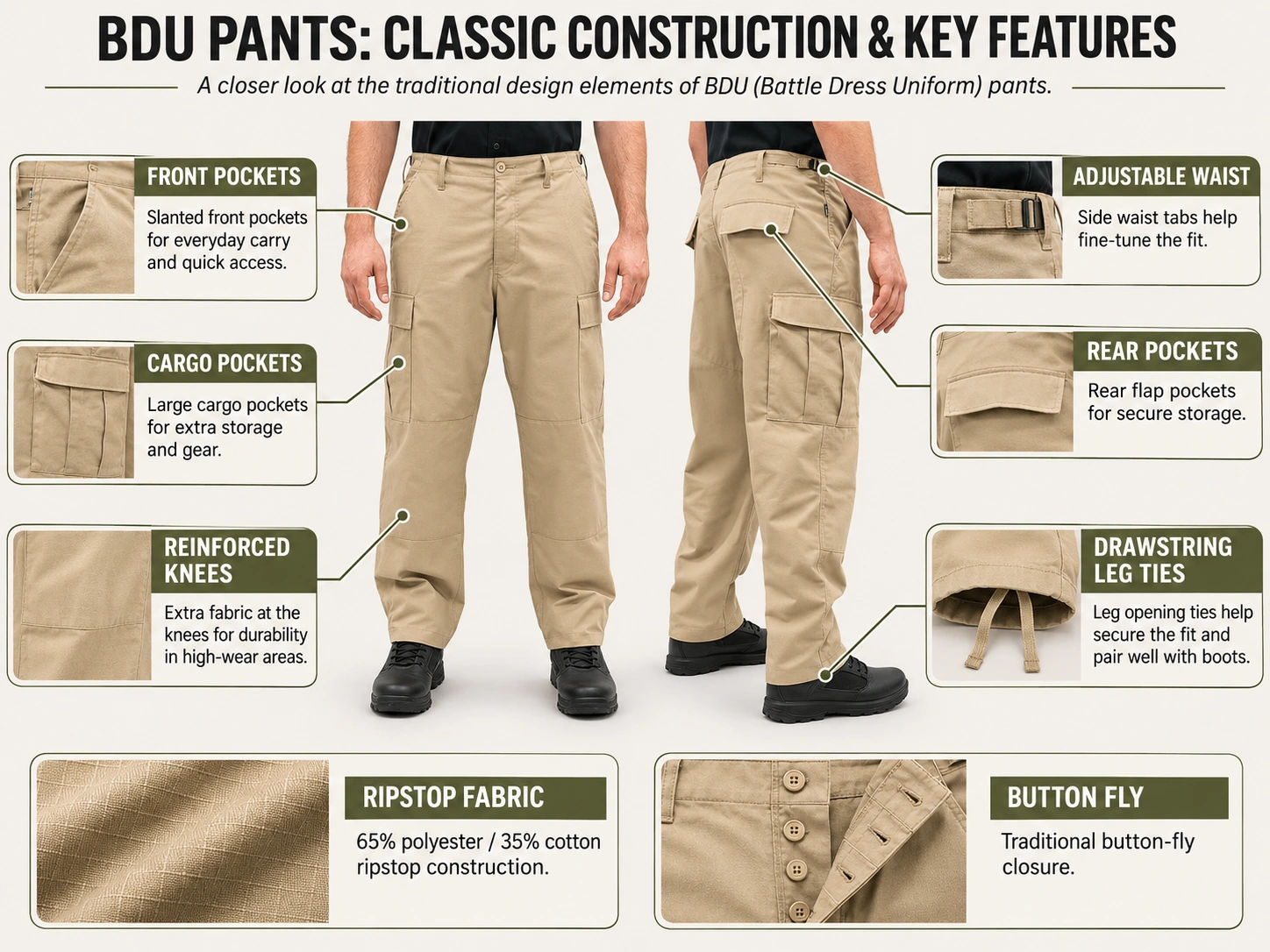
The exact specifications vary between manufacturers, but traditional BDU-style pants commonly include:
- Two front hand pockets
- Two large cargo pockets
- Two rear pockets
- A roomy or relaxed fit
- Reinforced knees and seat
- Adjustable waist tabs
- Drawstrings or other adjustment at the leg opening
- Button or similarly simple field-friendly closures
- Ripstop or twill fabric
The LAPG BDU pant lineup includes traditional six-pocket designs with features such as adjustable side tabs, reinforced knees and seat, drawstring leg ties, and 65% polyester/35% cotton ripstop construction.
That basic layout is part of the reason BDU pants remain useful decades after the original military uniform was introduced. It is a simple design without many unnecessary features.
Why Do BDU Pants Have So Many Pockets?
Storage was central to the BDU design.
A traditional six-pocket BDU pant generally gives you two front pockets, two rear pockets, and two larger cargo pockets on the thighs. The cargo pockets allow substantially more storage than ordinary work pants or jeans.
For today's wearer, those pockets may be used for gloves, notebooks, small tools, medical supplies, personal items, or other equipment.
More pockets aren't automatically better, however. If you carry only a phone, wallet, and keys, a modern low-profile tactical pant may feel less bulky. BDU pants make the most sense when you actually benefit from their traditional cargo-pocket layout.
What Is Ripstop BDU Fabric?
Many BDU pants use ripstop, a fabric woven with a visible reinforcing pattern designed to help keep a small tear from spreading as easily through the material.
Ripstop does not mean a pair of pants cannot rip. Fabric weight, fiber blend, stitching, abrasion, and the way the pants are used all affect durability.
Traditional BDU designs have been produced in multiple fabrics. U.S. Army historical records describe the original temperate BDU using a cotton/nylon fabric and later hot-weather BDUs using cotton ripstop. Modern commercial BDU pants may use cotton, polyester/cotton, nylon/cotton, or other blends depending on the manufacturer and intended use.
Ripstop vs. Twill BDU Pants
Neither fabric is automatically better.
Ripstop BDU pants are often a good choice when you want a lighter field-oriented material and resistance to the spread of small tears.
Twill BDU pants generally have a smoother, more traditional uniform-like surface and may feel more substantial depending on the weight of the fabric.
Always check the actual fabric specification on the pant you're considering rather than assuming every BDU is made from the same material.
BDU Pants vs. Tactical Pants: What's the Difference?
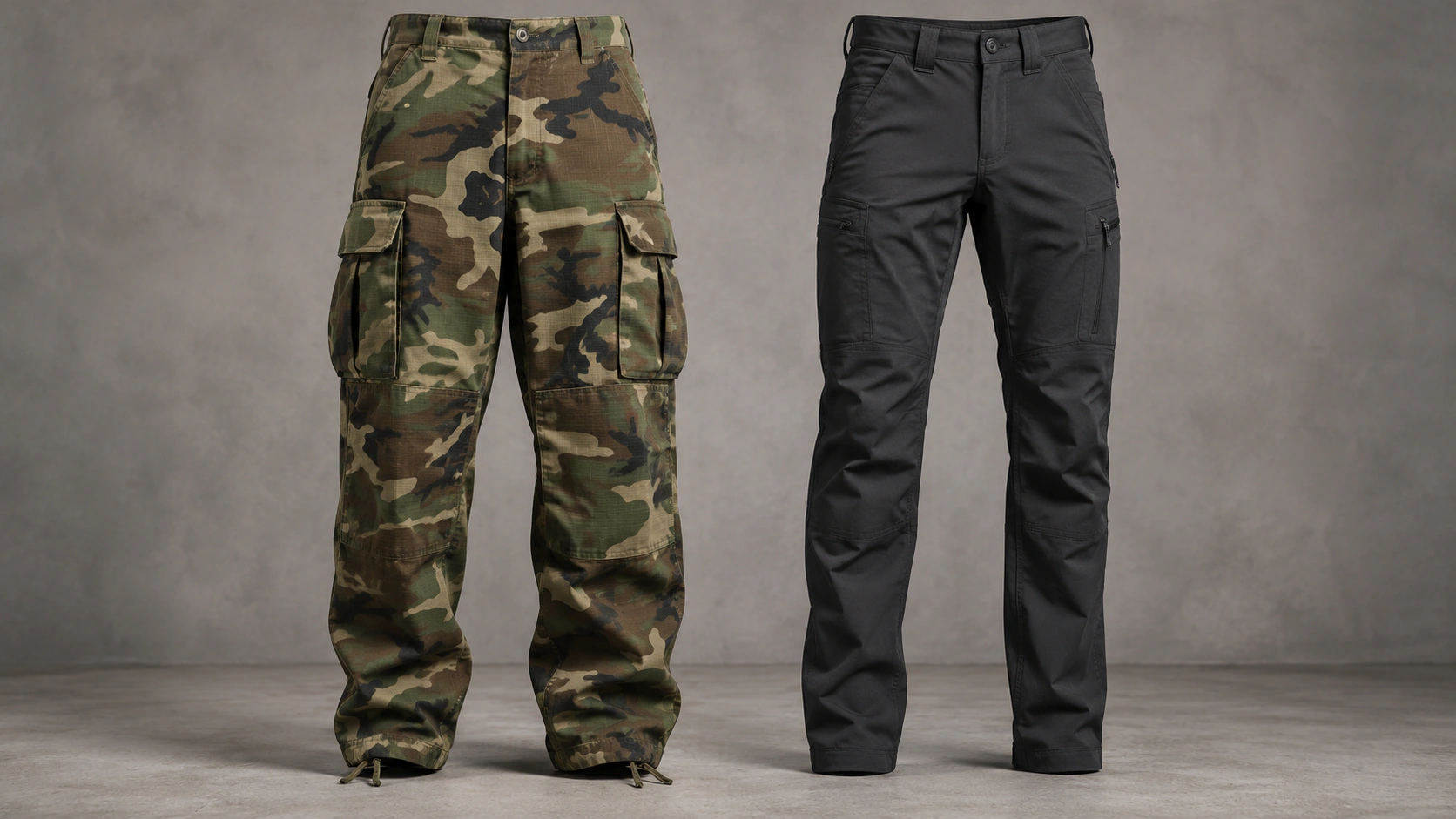
BDU pants helped establish many of the features people now associate with tactical pants, but the two terms are not interchangeable.
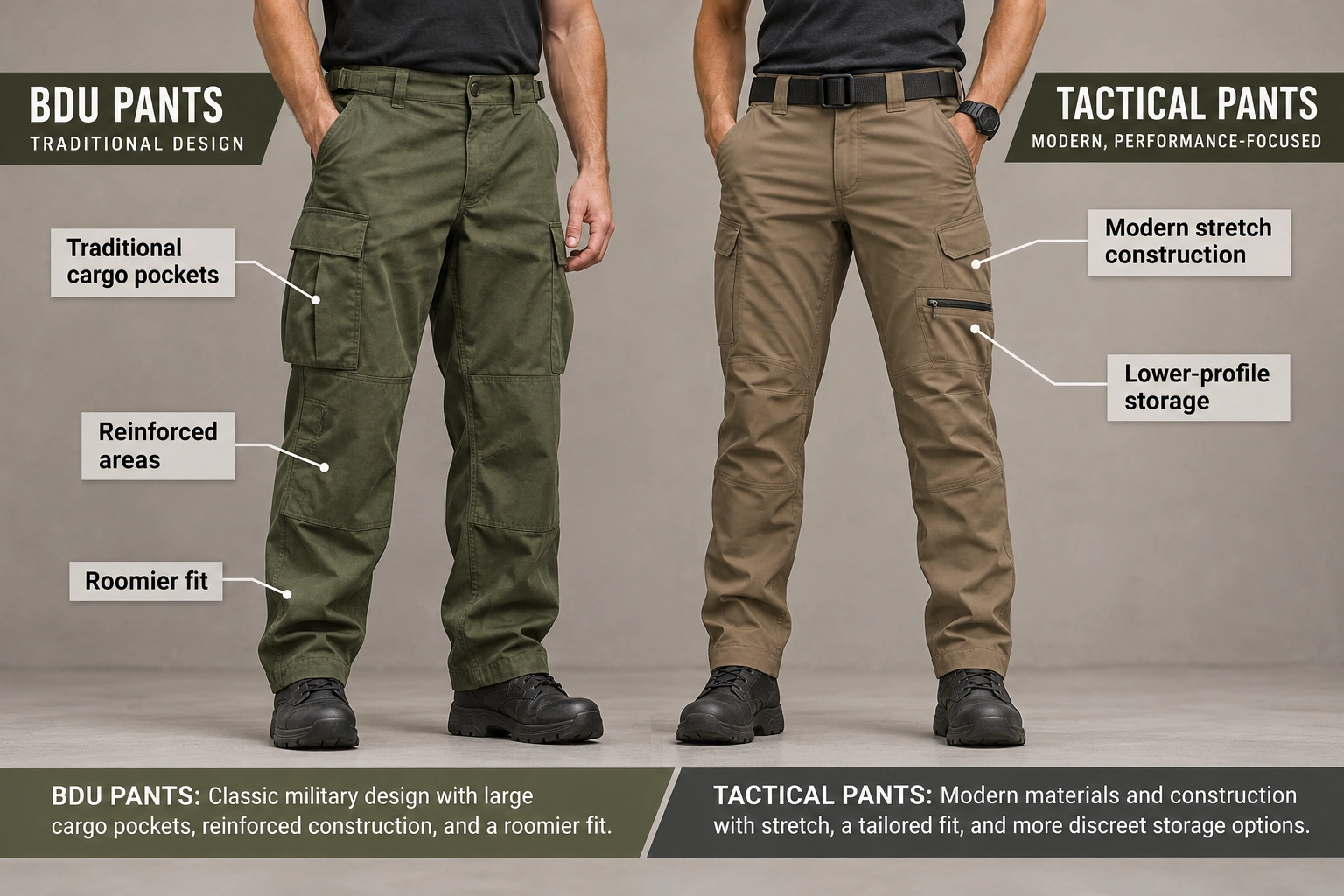
| Feature | Traditional BDU Pants | Modern Tactical Pants |
|---|---|---|
| Design origin | Military field uniform | Duty, range, work, outdoor and EDC |
| Fit | Usually roomy | Relaxed, straight, athletic or slim |
| Cargo pockets | Traditional large cargo pockets | Varies widely by design |
| Stretch | Usually limited in traditional designs | Common in newer styles |
| Knee design | Often reinforced | May be articulated, reinforced or pad-compatible |
| Waist | Traditional side adjustments on many styles | Fixed, elastic, stretch or adjustable |
| Fabric | Ripstop or twill common | Ripstop, stretch woven and other performance fabrics |
| Appearance | Traditional military/utilitarian | Traditional to low-profile |
| Best fit | Classic field, uniform, work and utility use | Duty, range, EDC, active work and outdoor use |
The easiest way to decide between them is to think about how much you value traditional simplicity versus modern mobility and organization.
Choose a traditional BDU-style pant when you prefer a roomy military cut, large cargo pockets, straightforward construction, and classic field-pant styling.
Consider modern tactical pants when stretch, specialized pockets, a more tailored fit, articulated construction, or lower-profile styling is more important.
Are BDU Pants Tactical Pants?
They can fall under the broad tactical-pants category, but a BDU pant is a more specific design.
Think of tactical pants as the larger category.
BDU pants represent one traditional branch of that category. Today's tactical pants have expanded far beyond the original military BDU format and may include stretch panels, zippered pockets, internal organizers, articulated knees, gusseted crotches, elastic waist systems, low-profile cargo pockets, and other features.
That distinction matters when shopping. Someone searching specifically for BDU pants may want the traditional layout. Someone searching simply for tactical pants may be better served by a newer design.
How Should BDU Pants Fit?
Traditional BDU pants generally have a roomier cut than modern slim or athletic tactical pants.
That extra room makes sense for a field garment because the wearer needs to sit, kneel, squat, climb, and move without the pant becoming restrictive.
A good BDU fit should:
- Stay secure at the waist
- Allow comfortable movement through the seat and thighs
- Leave room to bend and kneel
- Provide enough leg room for boots
- Avoid excessive fabric that interferes with movement
BDU sizing can also differ from ordinary jeans. Some styles use alpha sizing such as Small, Medium, and Large rather than exact waist measurements.
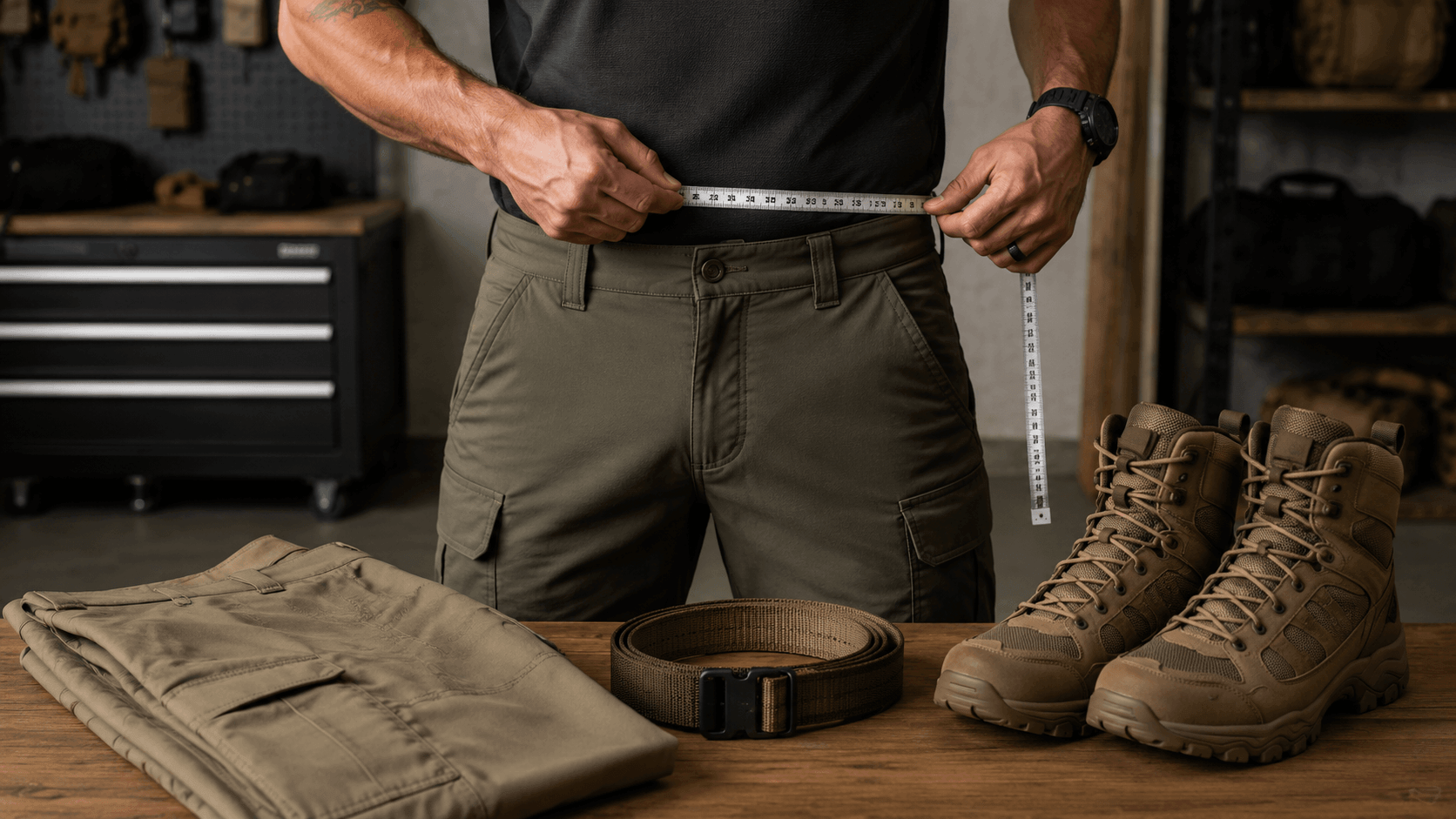
Check the specific manufacturer's size chart before ordering rather than converting directly from your normal jeans size. For more help with pant sizing, see How to Measure Yourself for Tactical Pants in 6 Steps.
What Are BDU Pants Used For Today?
For readers wondering what are BDU pants used for today, the answer extends well beyond their original military role.
Security and Public Safety
The traditional cargo layout and uniform-friendly solid colors can work well for security, corrections, public safety, and certain law-enforcement applications where department policy allows them.
Outdoor Activities
The combination of cargo storage, a roomy fit, and durable fabrics makes BDU pants useful for camping, hiking, hunting, field work, and other outdoor activities.
Work
Large pockets and reinforced areas can make BDU pants practical for jobs where tools, gloves, hardware, or other small items need to remain accessible.
Range and Training
The simple construction and cargo storage also work well for range days and training when a highly specialized pant isn't necessary.
Everyday Wear
Some people simply prefer the traditional military cargo-pant style. Solid-color BDU pants can function as rugged everyday pants without requiring camouflage or a complete uniform appearance.
Can Civilians Wear BDU Pants?
Yes. Commercial BDU-style pants are widely sold as ordinary clothing for outdoor, work, security, tactical, and casual use.
Wearing BDU-style pants is different from representing yourself as a member of the military. If you're using uniform garments in a professional or organizational setting, follow the applicable uniform rules, employer policies, and restrictions on insignia.
BDU Pants vs. Cargo Pants
All BDU pants have cargo-pant characteristics, but not every cargo pant is a BDU pant.
Standard cargo pants primarily refer to pants with additional cargo storage on the legs. Their fit, fabric, pocket design, and construction can vary widely.
BDU pants follow a much more recognizable military-derived layout.
A casual cargo pant may prioritize style and storage. A BDU pant typically places more emphasis on utility, a roomy field fit, reinforcement, and traditional military-inspired construction.
For a broader comparison of pant categories, see Tactical Pants vs. Hiking Pants vs. Cargo Pants vs. Work Pants.
BDU Pants vs. ACU Pants
BDU and ACU refer to different generations of U.S. military uniform systems.
The BDU predates the Army Combat Uniform, or ACU. The newer uniform changed numerous aspects of the complete uniform system, including pocket placement and how the uniform worked with other equipment.
For everyday shoppers, the more useful distinction is usually this:
BDU-style pants represent the older, simpler field-pant design. Newer combat and tactical pants tend to incorporate more specialized features and modern construction.
If you're buying pants for civilian work, outdoor use, security, range use, or EDC, choose according to the features you need rather than assuming the newest military-derived design is automatically the best one.
How to Choose BDU Pants
Before buying, compare these six areas.
1. Fabric
Decide whether you prefer ripstop, twill, cotton-rich material, or a synthetic blend. Climate and activity level matter as much as durability.
2. Fit
Traditional BDUs tend to run roomier than modern tactical pants. Check the actual size chart.
3. Pocket Layout
Make sure you will actually use the large cargo pockets. Extra storage adds utility but can also add bulk.
4. Reinforcement
If you frequently kneel, sit on rough surfaces, or work around equipment, reinforced knees and seat construction may be useful.
5. Color
Black, navy, khaki, OD green, and other solid colors may make more sense for work or security use than camouflage.
6. Intended Use
The most important question is what you expect the pants to do.
A traditional BDU can be an excellent choice for straightforward field utility. For frequent climbing, driving, kneeling, or active movement, a stretch tactical pant may be more comfortable.
BDU or Tactical Pants: Which Should You Choose?
Choose BDU pants when you want:
- Traditional military-inspired construction
- A roomy fit
- Large cargo pockets
- Simple, proven utility
- Reinforced field-pant construction
- Classic BDU styling
Choose modern tactical pants when you want:
- More stretch
- More fit choices
- Specialized pocket layouts
- Zippered or low-profile storage
- Articulated construction
- A cleaner or less military-looking appearance
Neither design is universally better.
The better pant is the one whose fabric, fit, pockets, and construction match what you actually do while wearing it. Once you understand what are BDU pants designed to do, it becomes easier to decide whether the traditional BDU layout or a modern tactical pant better fits your needs.