Listen to this article
Table of Contents
- The Mechanical Reality of Real Police Handcuffs
- What Kind of Handcuffs Do Cops Actually Use?
- Hinged vs. Chain: The Tactical Trade-off
- Specialized Restraints for SWAT and High-Risk Units
- Ergonomics and the Female Police Officer
- The Importance of Agency Identification and Engraving
- Managing Non-Compliant Subjects Safely
- The Bottom Line: What You Need to Know
- Equipping for the Shift: Why LAPG is the Professional Choice
- FAQs
The Mechanical Reality of Real Police Handcuffs
A restraint that fails in the field is not just an equipment problem — it is a critical safety issue. The gap between duty-grade police handcuffs and novelty restraints is not measured in aesthetics; it is measured in tensile strength, locking reliability, and whether an officer goes home at end of shift.
Material composition is the first separator. Genuine duty-grade restraints are machined from carbon steel, stainless steel, or high-strength aluminum alloys — each selected for a specific combination of weight tolerance and corrosion resistance. Novelty items, regardless of how convincing they look in a display case, are typically cast from zinc alloys or lightweight pot metal that will deform under sustained force. That distinction is not a minor specification detail. It is the difference between a controlled arrest and a dangerous escape.
The benchmark that separates professional equipment from everything else is NIJ Standard 0307.01, the National Institute of Justice's compliance requirement for metallic handcuffs. Under this standard, certified restraints must withstand a tensile force of 495 lbs (2,200 N) without mechanical failure. That is mandatory — it is the minimum threshold for equipment authorized in professional law enforcement settings. Any restraint that cannot meet this standard has no place on a duty belt.
Locking mechanism integrity is equally critical. Double-lock functionality — which prevents the cuff from tightening further once engaged — is standard on every legitimate duty restraint. A single-lock-only design creates injury liability during transport and custody, as addressed in most agency use-of-force policies. Failure to double-lock is an officer error; failure to provide a mechanism that double-locks is a manufacturer defect.
Knowing what qualifies as a true duty-grade restraint is foundational for every subsequent purchasing decision — including the specific cuff types that agencies and individual officers are actually issuing and carrying in the field right now.
What Kind of Handcuffs Do Cops Actually Use?
Most agencies issue chain or hinged cuffs in steel or aluminum, but the specific model on an officer's belt reflects department policy, body mechanics, and operational environment in equal measure.
Handcuffing is the most common police use-of-force tactic, accounting for 77% of all restraint incidents. That frequency drives standardization — agencies need cuffs that officers can apply under stress, one-handed if necessary, without fumbling through unfamiliar geometry. Two designs dominate patrol duty across the country:
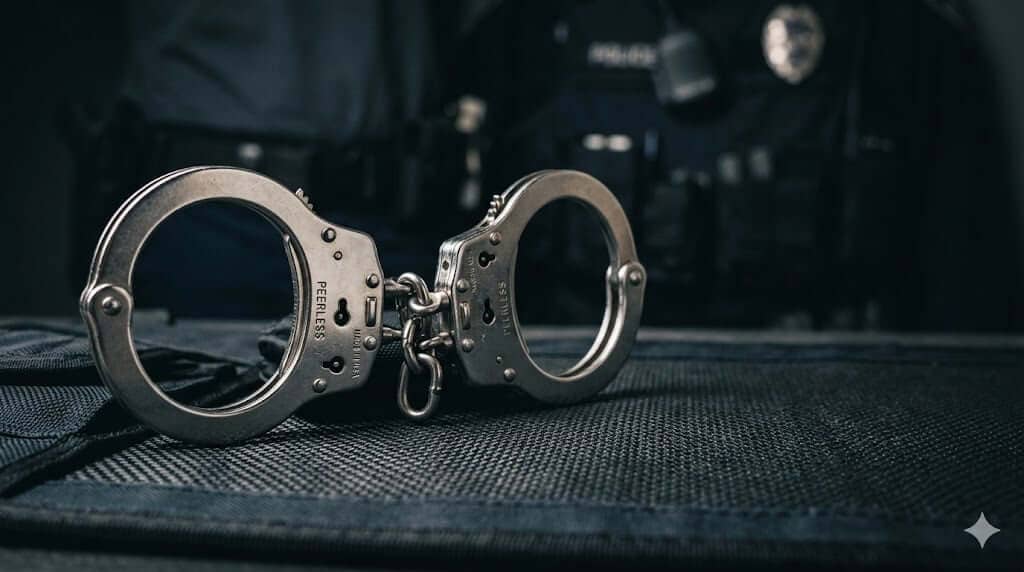
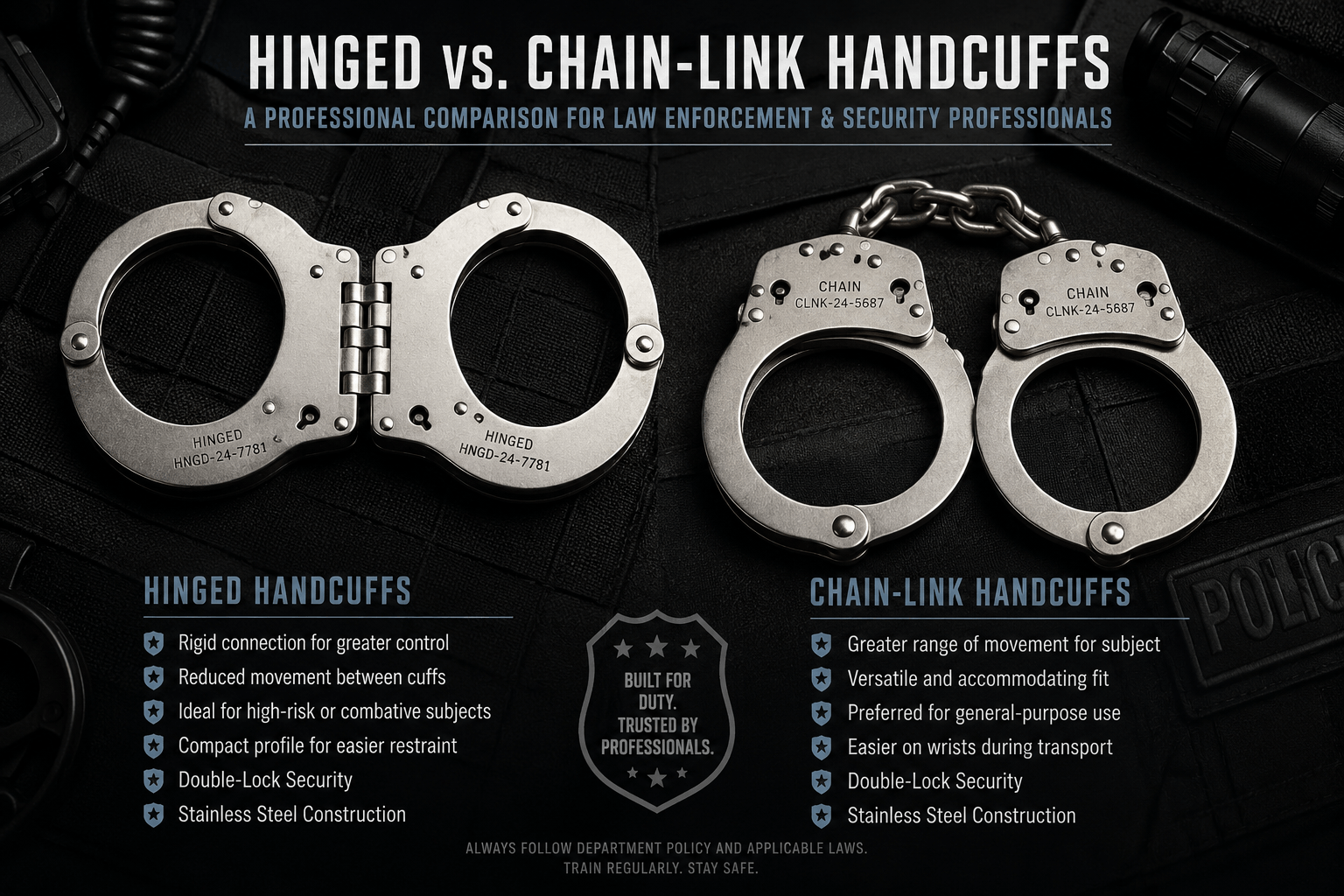 Hinged vs Chain-link Handcuffs
Standard chain cuffs — The most widely issued pattern, featuring two bow-shaped cuffs connected by a short chain link. Their flexibility accommodates a wider range of body types and allows faster application on resistant subjects during dynamic encounters.
Hinged cuffs — A rigid connector replaces the chain, limiting wrist movement and delivering superior leverage for pain compliance. Increasingly common among officers who prioritize subject control in high-risk apprehensions.
Lightweight aluminum frame cuffs — A growing category driven by the realities of long patrol shifts. Officers carrying cuffs for 10 to 12 hours recognize that even small reductions in duty belt weight compound into measurable fatigue reduction over a career.
The "one size fits all" assumption is tactically flawed. Wrist circumference, hand size, and grip strength vary significantly across the officer population. This matters particularly when selecting female police officer handcuffs — smaller frame officers benefit from cuffs with adjusted bow sizing and lighter construction that still meet the same strength and double-lock standards as full-size duty models. Fit is not a comfort preference; it is a retention and safety variable.
Brand prevalence in the field reflects field-tested reliability. ASP and Smith & Wesson account for the majority of cuffs seen on duty belts across federal, state, and local agencies. Both manufacturers produce models in steel and aluminum, covering chain and hinged configurations, and maintain the tight tolerances that duty-grade restraints require.
Knowing what type of cuff belongs on your belt is foundational for the more nuanced question of which configuration best serves your role — a trade-off the next section addresses directly.
Hinged vs. Chain: The Tactical Trade-off
The choice between chain and hinged cuffs shapes every step of an arrest — from initial application to subject transport, and it is a trade-off every officer navigates based on assignment and technique.
Chain cuffs remain the dominant pattern across patrol assignments for a practical reason: flexibility. The pivot between cuffs allows an officer to work around a resistant subject's body mechanics, rotating the bow to find the wrist regardless of how the subject is positioned. That adaptability matters during ground struggles, close-quarters control, or when applying restraints with one hand. Chain cuffs also profile flatter on the duty belt, making carry in a standard pouch straightforward.
Hinged cuffs trade that flexibility for mechanical advantage. The rigid connector between the two bows limits wrist rotation and keeps the subject's hands in a fixed, controlled position. That constraint is intentional.
"Hinged cuffs allow you to use defensive tactics, such as torquing the handcuff at an angle… to persuade a suspect to cooperate." — LA Police Gear
Torquing is the tactical application that defines hinged cuffs' value. By rotating the rigid connector, an officer creates directed pressure on the wrist joint — a pain compliance technique that allows control without strikes or additional officers. In practice, this makes hinged cuffs particularly effective during prisoner transport and cell extraction.
Storage is a genuine consideration. Hinged cuffs require a deeper, purpose-built pouch due to their bulk and fixed geometry. Chain cuffs fit more universally across standard belt pouches. Officers carrying both pattern types — a common practice in units that transition between patrol and tactical roles — configure their belt layout accordingly.
That distinction in role-based carry becomes even sharper when looking at dedicated tactical units. The restraint priorities for SWAT team handcuffs diverge significantly from patrol norms, favoring speed of application and subject immobilization above all else — which is where the next level of specialized restraints enters the picture.
Specialized Restraints for SWAT and High-Risk Units
Specialized tactical units require cop handcuffs engineered for worst-case scenarios — where subject compliance is low, time is critical, and failure is unacceptable.
Rigid cuffs are the defining tool for SWAT and high-risk apprehension teams. Unlike chain or hinged designs, rigid cuffs eliminate virtually all wrist movement, removing the subject's ability to generate leverage or rotate into an attacking position. Rigid restraints are often preferred by specialized units precisely because that near-total immobilization changes the risk calculus of every contact.
Oversized cuffs address a gap that standard-issue hardware cannot fill. Larger subjects, or any individual wearing thick winter outerwear, may exceed the bow clearance of a standard frame. In a dynamic entry or a cold-weather takedown, a cuff that will not close fully is a potential risk. Oversized models with extended bows and wider bow clearance are stocked specifically for this reason, and tactical teams keep them accessible alongside standard frames.
Disposable restraints — flex cuffs and zip-style restraints — serve a distinct operational role that rigid or hinged hardware cannot efficiently cover.
Key callout: In mass-arrest situations, civil disturbance response, or post-breach scenarios where a team may be securing multiple subjects simultaneously, disposable restraints allow rapid application and high-volume deployment without the weight penalty of carrying multiple steel sets.
Speed of application is the governing priority for SWAT teams in a way that differs from patrol. A patrol officer has time to achieve a controlled position and seat the cuff properly. A tactical operator securing a subject in a dynamic, post-breach environment does not. Every component of a tactical kit — including restraint selection — is evaluated on how quickly it can be deployed under stress, with one hand, in low light, and against a non-compliant subject.
That emphasis on speed and physical mechanics does not apply exclusively to tactical operators. The ergonomic demands placed on any officer — including how restraint weight and grip design interact with the body over a full shift — deserve their own focused consideration.
Ergonomics and the Female Police Officer
Smaller-framed officers carry the same operational load as anyone else on the line — but the cumulative physical cost of ill-fitted duty gear falls disproportionately on them.
Weight distribution is the first variable to control. A standard-issue duty belt loaded with radio, firearm, magazine pouches, and cuffs can easily exceed 25 pounds. For officers with narrower hips or shorter torsos, that weight concentrates unevenly, placing sustained stress on the lumbar spine. Choosing real police handcuffs in lightweight aluminum construction is one of the clearest, most immediate interventions available. According to ASP-USA Research, modern lightweight cuffs can reduce duty belt weight by up to 40% compared to traditional carbon steel models — a meaningful reduction across a ten-hour shift.
Hand size and grip texture matter operationally. Smaller hands apply force differently during a cuffing sequence under stress. A frame that fits a larger officer comfortably may create awkward wrist angles or lever points for someone with a smaller grip span. Aluminum-frame cuffs typically run thinner across the cuff body, improving control during single-handed applications. Grip texture on the keyway and along the swinging arm allows officers to maintain purchase even when hands are wet, gloved, or fatigued — conditions that are common, not exceptional.
Carpal tunnel and repetitive stress concerns are legitimate, not peripheral. Prolonged carry of improperly weighted or poorly balanced duty gear contributes to cumulative strain on the wrist and forearm. Female LEOs report these issues at higher rates than their male counterparts, a pattern consistent with ergonomic data across physically demanding occupations. Selecting gear sized and weighted to the individual rather than defaulting to agency-standard issue is a professional decision, not a preference.
Three options worth evaluating for smaller-framed officers:
Aluminum chain cuffs — reduced weight, standard fitment, faster application
Compact hinged models — tighter profile on the belt, reduced lateral swing
Reduced-frame cuffs — engineered for smaller hand spans without sacrificing rated strength
Proper gear fit also extends to how cuffs are marked and tracked within a department — which is where agency identification practices become equally important.
The Importance of Agency Identification and Engraving
Custom engraving isn't a cosmetic upgrade — it's a logistical necessity that prevents gear loss, speeds up evidence recovery, and maintains chain of custody integrity on multi-agency scenes.
When officers from multiple departments converge on a single incident, restraints get applied fast and sorted out later. Without agency-specific identification on each pair, recovering your department's cuffs from a joint operation becomes a time-consuming guessing game. Understanding what kind of handcuffs do cops use in those environments makes it clear why serialized, agency-marked gear isn't optional for professional departments — it's standard protocol.
Laser etching vs. traditional stamping: Laser engraving produces precise, permanent markings that don't compromise the structural integrity of the cuff body. Traditional stamping, while cost-effective, can create micro-stress points on thinner alloys and produces markings that wear down faster under field conditions. For duty-grade restraints, laser etching is the recommended method.
Common engraving types departments order:
Agency badge number or officer ID
Department name and unit designation
Serial numbers for inventory tracking
Agency seal or logo for formal identification
Bulk ordering logistics deserve the same operational discipline as any other supply chain decision. Departments that order in volume benefit from standardized keyways across the entire fleet — meaning any officer's key opens any department cuff. This uniformity matters when cuffing subjects who need to be transferred between units.
Maintaining a warehouse mentality for restraints means keeping replacement parts — primarily keys and swivel components — in adequate supply. A cuff with a lost or worn key becomes a potential risk in the field.
That same operational discipline extends to the arrest itself. How gear holds up under physical stress is a separate challenge entirely — one that becomes critical when a subject isn't cooperating.
Managing Non-Compliant Subjects Safely
Duty-grade restraints earn their cost not during compliant arrests, but during the roughly one-third of encounters where they don't go smoothly. According to StopWatch UK Police Use of Force Statistics, approximately 65% of handcuffing incidents involve compliant subjects — meaning 34% involve active resistance. That minority is where gear integrity becomes a life-safety issue, not a preference.
The mechanical reality of a struggle is unforgiving on restraints. When a non-compliant subject twists, pulls, or drops their body weight against applied cuffs, the bow, frame, and ratchet mechanism absorb forces well beyond static loading. Cheap alloys deform. Ratchet teeth strip. A single compromised component can result in a self-escape mid-transport — a scenario that endangers the officer, the subject, and anyone nearby. NIJ standard handcuffs are rated specifically to resist these dynamic stress loads, which is why NIJ 0307.01 compliance isn't a nice-to-have on the spec sheet — it's the functional threshold between duty-grade and inadequate.
Physical stress on the frame is only part of the equation. During active resistance, improper positioning of the cuff bow increases leverage on the ratchet mechanism and raises the risk of a positional injury to the subject. In practice, officers trained to apply cuffs with the keyhole facing outward and the bow positioned palm-side reduce both escape risk and injury liability. The mechanical design of the cuff works with proper technique — not in spite of it. Hinged models offer additional control in non-compliant situations by limiting wrist articulation and reducing the subject's ability to generate torque.
Double-locking is not optional — it is a mandatory safety protocol. Failure to double-lock exposes the subject to progressive tightening during transport, which constitutes a use-of-force liability regardless of the initial application.
Legal exposure in improper cuffing cases typically centers on excessive force claims tied to injury documentation. Proper technique, combined with NIJ-compliant hardware, creates a defensible record. The next section brings together every critical selection and usage principle covered throughout this guide.
The Bottom Line: What You Need to Know
Duty-grade restraints are mission-critical equipment, and five principles separate a sound purchasing decision from a potential risk waiting to happen.
Professional-grade handcuffs are defined by their ability to withstand nearly 500 lbs of pressure — a threshold that separates purpose-built duty tools from anything marketed as a novelty or a budget alternative. That structural integrity isn't an accident; it's the direct result of meeting NIJ 0307.01 compliance standards.
Here are the five takeaways every officer, department buyer, and tactical professional should carry forward:
Verify NIJ 0307.01 compliance before purchase. This certification isn't paperwork — it's the baseline proof that a restraint has passed independent testing for tensile strength, jaw integrity, and double-lock function. Any cuff that can't demonstrate this certification has no place on a duty belt.
Understand hinged vs chain handcuffs and choose by mission. Hinged cuffs offer superior control and limit wrist articulation, making them the preferred tool for high-risk arrests and transport. Chain cuffs provide the versatility needed for quick applications across varied field conditions. Neither is universally superior — deployment context drives the choice.
Engrave your gear. As covered earlier, proper agency identification protects your professional investment, supports chain of custody, and speeds up recovery in the event of loss or theft.
Prioritize lightweight materials. Aluminum-alloy and polymer-composite frames are the modern standard. Cumulative duty-belt load is a real occupational health consideration, and modern materials eliminate unnecessary weight without sacrificing rated strength.
Treat double-locking as mandatory protocol, not optional procedure. A cuff without an engaged double-lock can cinch under pressure, creating injury liability and potential civil exposure. This single mechanical step is non-negotiable.
These principles apply whether an officer is outfitting for the first time or a department is standardizing its next procurement cycle. The right restraint is a deliberate choice — and the next section outlines where to source professional-grade options built specifically for the demands of real operational use.
Equipping for the Shift: Why LAPG is the Professional Choice
Choosing duty-grade restraints means nothing if you cannot access professional-grade inventory at a price that respects your budget. That is where LA Police Gear's positioning within the LEO community matters. LAPG wbuilt specifically for professional law enforcement and tactical gear needs — not as a general sporting goods retailer that added a "tactical" category as an afterthought. That focus translates directly into product selection, brand relationships, and the ability to source gear that meets actual duty standards.
The closeout model is one of LAPG's most practical advantages for individual officers purchasing their own equipment. Departments do not always fund every piece of gear, and officers sourcing restraints out-of-pocket need access to professional-grade products without paying distributor markup. LAPG's closeout inventory regularly surfaces duty-grade restraints — same specifications, same steel, same double-locking mechanisms — at prices that make sense for officers equipping themselves on a personal budget.
Brand selection is equally important. Carrying ASP, Smith & Wesson, and Peerless means officers are not choosing between quality and availability. These are the same manufacturers supplying departments across the country. ASP's precision-engineered restraints are trusted for their fit, finish, and single-hand application mechanics. Smith & Wesson's Model 100 series has decades of documented duty use. Peerless has been manufacturing handcuffs for American law enforcement since 1921 — that institutional track record is not marketing language, it is a verifiable supply chain relationship.
Every principle covered in this article — NIJ compliance, double-locking function, material selection, hinge configuration, proper sizing — comes down to execution at the point of purchase. There is no benefit to understanding duty-grade standards if the gear in your cart does not meet them.
If it is time to replace worn restraints, add a backup pair, or upgrade to a configuration better suited to your assignment, browse LAPG's full handcuff and restraint category and equip for what the shift actually demands.
FAQs
What makes handcuffs "duty-grade" and why does it matter?
Duty-grade handcuffs are professional restraints built to meet strict performance benchmarks — including tensile strength, corrosion resistance, and tamper resistance — defined by standards like NIJ Standard 1001.00. Unlike novelty or fashion restraints, duty-grade cuffs are precision-machined from high-strength carbon or stainless steel with double-locking mechanisms engineered to hold under real-world stress. For law enforcement, corrections, and security professionals, the difference isn't cosmetic — a restraint that fails in the field is a liability. When lives are on the line, gear that merely looks the part isn't good enough.
What is NIJ Standard 1001.00 and why should I look for it when buying handcuffs?
NIJ Standard 1001.00 is the National Institute of Justice's voluntary performance standard for criminal justice restraints, covering wrist and ankle cuffs, single-use restraints, and high-security devices. It defines minimum requirements for form, fit, mechanical loading, corrosion resistance, and tamper resistance that handcuffs must pass to be considered suitable for law enforcement use. Products certified to this standard by a recognized private-sector program — such as the Safety Equipment Institute (SEI) — have been independently tested to confirm they meet those minimums. When shopping for duty handcuffs, NIJ compliance is the single clearest signal that a product is built for professional use, not just appearance.
What's the difference between chain, hinged, and rigid handcuffs — and which type should I carry?
Chain handcuffs connect the two cuffs with a short chain, allowing more wrist movement and making them easiest to apply quickly in dynamic situations. Hinged handcuffs use a rigid hinge that restricts movement significantly, giving officers greater control over a combative subject. Rigid (or solid bar) handcuffs offer the most control but require more training to apply properly. For general patrol duty, chain cuffs remain the most widely issued type — the Smith & Wesson Model 100 and Peerless Model 700 are two of the most trusted examples. Officers dealing with high-risk subjects often carry hinged cuffs as a secondary option, with the ASP Steel Ultra Hinged being a leading choice.
How are real police handcuffs different from novelty or toy handcuffs?
Real police handcuffs are precision-manufactured from heat-treated carbon steel or stainless steel and must meet measurable performance tests — including mechanical load tests and 12-hour salt-spray corrosion tests under NIJ Standard 0307.01 or the newer 1001.00. Novelty handcuffs are typically made from soft metals, pot metal alloys, or lightweight materials that can bend, break, or be easily defeated under minimal force. Duty cuffs also feature a double-locking mechanism that prevents the ratchet from tightening further once engaged, a safety feature absent in most novelty products. The visual similarity between duty and novelty cuffs makes it critical for buyers to verify materials, construction, and certification before purchase.
What is a double-lock mechanism on handcuffs and why is it important?
A double-lock mechanism is a secondary lock that, once engaged, prevents the ratchet from tightening further around a subject's wrists. This serves two critical functions: it protects the restrained individual from injury caused by progressive tightening, and it prevents a subject from manipulating the ratchet to loosen or defeat the cuffs. Engaging the double lock is standard procedure in most law enforcement agencies after cuffing, and it's a required feature in handcuffs that meet NIJ Standard 0307.01 and 1001.00. Any duty-grade restraint you purchase should include a reliable, tested double-lock system as a baseline requirement.
Smith & Wesson vs. Peerless vs. ASP handcuffs — which brand should law enforcement officers choose?
Smith & Wesson, Peerless, and ASP are the three most trusted duty handcuff brands in U.S. law enforcement, and all three produce models that meet NIJ testing requirements. Smith & Wesson's Model 100 is widely considered the world's most popular metal restraint, built from high-strength carbon steel with heat-treated internals. Peerless's Model 700 is a near-identical competitor favored by many academy training programs. ASP cuffs, including the Steel Ultra series, are engineered with computer-modeled frame geometry for lighter weight without sacrificing strength. Agency issuance, personal training history, and preference for weight vs. durability are the real differentiators — you cannot go wrong with any of the three for standard patrol use.
Are disposable flex cuffs (zip-tie restraints) a reliable substitute for metal handcuffs?
Flex cuffs — nylon or hard-plastic single-use restraints — serve a real operational purpose but are not a direct substitute for metal handcuffs in most law enforcement scenarios. Their primary advantage is portability: officers can carry multiple pairs for crowd control, mass arrest situations, or as backup. Their key limitations are susceptibility to defeat by a determined subject, the risk of cutting into wrists if over-tightened, and the fact that they cannot be double-locked. NIJ Standard 1001.00 does address single-use restraints, so certified flex cuffs exist — but for any situation requiring secure, extended restraint, duty-grade metal cuffs remain the standard. Browse LAPG's full restraints selection to see both options side by side.
What should I look for when buying handcuffs for security guard or private protection work?
Security professionals should prioritize the same features law enforcement demands: NIJ-compliant construction, double-locking ratchet, corrosion-resistant steel (nickel-plated carbon or stainless), and a universal key compatible with standard handcuff keys. Beyond the cuffs themselves, consider a quality handcuff case or pouch that secures quickly to a duty belt for fast deployment. Brands like Smith & Wesson, ASP, and Peerless are well-established for private security use and reduce liability by ensuring the restraint itself won't be the weak link in a security incident. Always verify local regulations, as some jurisdictions restrict handcuff carry by non-sworn personnel.
What does "heat-treated internal components" mean in handcuffs, and why does it matter?
Heat treatment is a metallurgical process that hardens the internal components of handcuffs — particularly the ratchet, pawl, and pivot points — making them significantly more resistant to deformation under stress. In practical terms, heat-treated internals mean the cuffs are less likely to jam, strip, or fail when a subject is actively resisting. Smith & Wesson, for example, explicitly specs heat-treated internals on their duty line because field experience showed that unhardened components can fail under the torque loads generated during a forcible cuffing. When reviewing product specs, "heat-treated internal components" is one of the clearest indicators that a manufacturer has engineered for real-world performance rather than cost reduction.
How do I properly maintain duty handcuffs to ensure they don't fail when I need them?
Duty handcuffs require minimal but consistent maintenance: regular lubrication of the ratchet and locking mechanism with a light oil or purpose-made lubricant, periodic inspection for burrs or corrosion on the ratchet teeth, and testing of the double-lock function before each shift. Nickel-plated carbon steel cuffs are more susceptible to corrosion in humid environments than stainless steel models — if you work in high-moisture conditions, stainless is worth the modest price premium. Carry a backup handcuff key at all times, and replace any cuffs showing mechanical irregularities immediately. A restraint that hesitates or binds during application is a safety hazard for both the officer and the subject.
Can civilians legally buy real police handcuffs in the United States?
In most U.S. states, civilians can legally purchase duty-grade metal handcuffs without restriction — they are not classified as weapons under federal law. However, laws on carrying, using, or possessing handcuffs vary by state and municipality; some jurisdictions restrict carry by non-law-enforcement personnel, and using restraints on another person without legal authority can constitute false imprisonment or assault. LA Police Gear sells handcuffs to law enforcement, security professionals, and civilians for lawful purposes, including training, personal collection, and professional use. Always consult your local statutes before carrying or using any restraint device.
What's the best way to carry a second pair of handcuffs on duty?
Most duty officers carry a primary pair of handcuffs in a dedicated pouch on their strong side, with a secondary pair in a concealed or off-side carrier for backup. For the second pair, a low-profile handcuff case — either a standard snap-close pouch or a MOLLE-compatible carrier — keeps the cuffs accessible without adding bulk. Hinged cuffs are popular as a secondary option because they provide greater control on resistant subjects. LAPG carries a wide range of handcuff cases and duty belt accessories designed for exactly this configuration, compatible with standard chain, hinged, and rigid cuff models from all major brands.