Listen to this article
Table of Contents
- The Evolving Threat Landscape: Why Body Armor is More Critical Than Ever in 2026
- The Foundation: Understanding National Institute of Justice (NIJ) Protection Levels
- Core Body Armor Types: Soft Armor vs. Hard Armor
- A Deep Dive into Materials: The Science Behind Your 2026 Protection
- Advanced Polymers (UHMWPE): The Rise of Lightweight Ballistic Protection
- Ceramic Body Armor: Superior Rifle Protection and Weight Management
- Steel Body Armor: Durability, Affordability, and Specific Applications
- Composite Materials and Advanced Alloys: Blending Strengths for Optimal Performance
- Emerging and Future Materials: What 2026 and Beyond Holds
- Tailoring Your 2026 Body Armor: Matching Protection to Your Purpose
- The Body Armor Ecosystem: Plate Carriers, Trauma Pads, and Essential Gear
- Navigating the Market: Certifications, Brands, and Smart Buying for 2026
- Top Body Armor brands of 2026:
- Conclusion
- FAQs
The world in 2026 presents a complex and ever-evolving threat landscape, demanding a proactive and informed approach to personal protection. As geopolitical tensions shift and the nature of conflict and crime diversifies, the need for reliable body armor has never been more critical. Whether you are a law enforcement officer, a military professional, a security operative, or a concerned civilian preparing for unforeseen circumstances, understanding the nuances of body armor is paramount to ensuring your safety and the safety of those around you. This guide is designed to demystify the world of ballistic protection, providing you with the knowledge to make informed decisions in a rapidly changing environment.
The Evolving Threat Landscape: Why Body Armor is More Critical Than Ever in 2026
The modern operational environment is characterized by increasing unpredictability and the proliferation of advanced threats. Understanding these dynamics is the first step in appreciating the necessity of robust personal protective equipment.
Navigating the Modern Threat Environment: Beyond Traditional Ballistics
Contemporary threats extend far beyond the traditional handgun and rifle calibers that have historically defined ballistic protection standards. We are witnessing an increase in the prevalence of high-velocity rifle rounds, advanced fragmentation from improvised explosive devices (IEDs), and even the potential for specialized munitions in asymmetric warfare scenarios. The sophistication and accessibility of weaponry continue to evolve, necessitating body armor that can withstand a wider spectrum of potential impacts. Geopolitical instability can also lead to an increased risk of exposure to diverse threat vectors, underscoring the need for adaptable and reliable protection.
The Growing Need for Personal Ballistic Protection
The statistics paint a clear picture of body armor's vital role. Since 1987, body armor has saved over 3,000 law enforcement lives documented by the Bulletproof Vest Partnership (BVP) [U.S. Armor Corporation, 2025]. This staggering number highlights the direct impact of ballistic vests on personnel survivability. As threats continue to escalate and diversify into 2026, the demand for effective personal ballistic protection is projected to grow, with the global Body Armor market size valued at USD 2.60 billion in 2024 and expected to reach USD 3.70 billion by 2032, at a CAGR of 4.53% [Data Bridge Market Research Reports, 2026]. This growth is driven not only by professional applications but also by a rising awareness among civilians regarding personal safety.
What This Guide Will Cover: Your Roadmap to Informed Protection
This comprehensive guide will equip you with the essential knowledge to navigate the complex world of body armor. We will begin by demystifying the National Institute of Justice (NIJ) protection levels, the universally recognized standard for ballistic resistance. Subsequently, we will explore the core types of body armor, differentiating between soft armor and hard armor plates, and delve into the advanced materials that form their protective layers. The guide will then offer tailored advice for various user groups, discuss the critical components of the body armor ecosystem, and provide guidance on navigating the market to make a sound purchase in 2026.
The Foundation: Understanding National Institute of Justice (NIJ) Protection Levels
The National Institute of Justice (NIJ) standards are the bedrock of body armor classification, providing a standardized, scientific method for assessing ballistic resistance. Understanding these levels is the most critical first step for anyone seeking effective personal protection.
Demystifying the NIJ: What Certifications Mean for Your Safety
The NIJ is the research, development, and evaluation agency of the U.S. Department of Justice. Its standards for body armor are designed to provide law enforcement and military personnel with reliable information about the protective capabilities of available equipment. An NIJ certification signifies that a specific armor product has undergone rigorous testing against defined threats and has met specific performance criteria. This certification is crucial, assuring users that the armor has been independently verified to offer a predictable level of ballistic protection. It moves beyond marketing claims, providing a quantifiable measure of safety.
NIJ Standard .06 Levels Explained: From Handgun to Rifle Threats
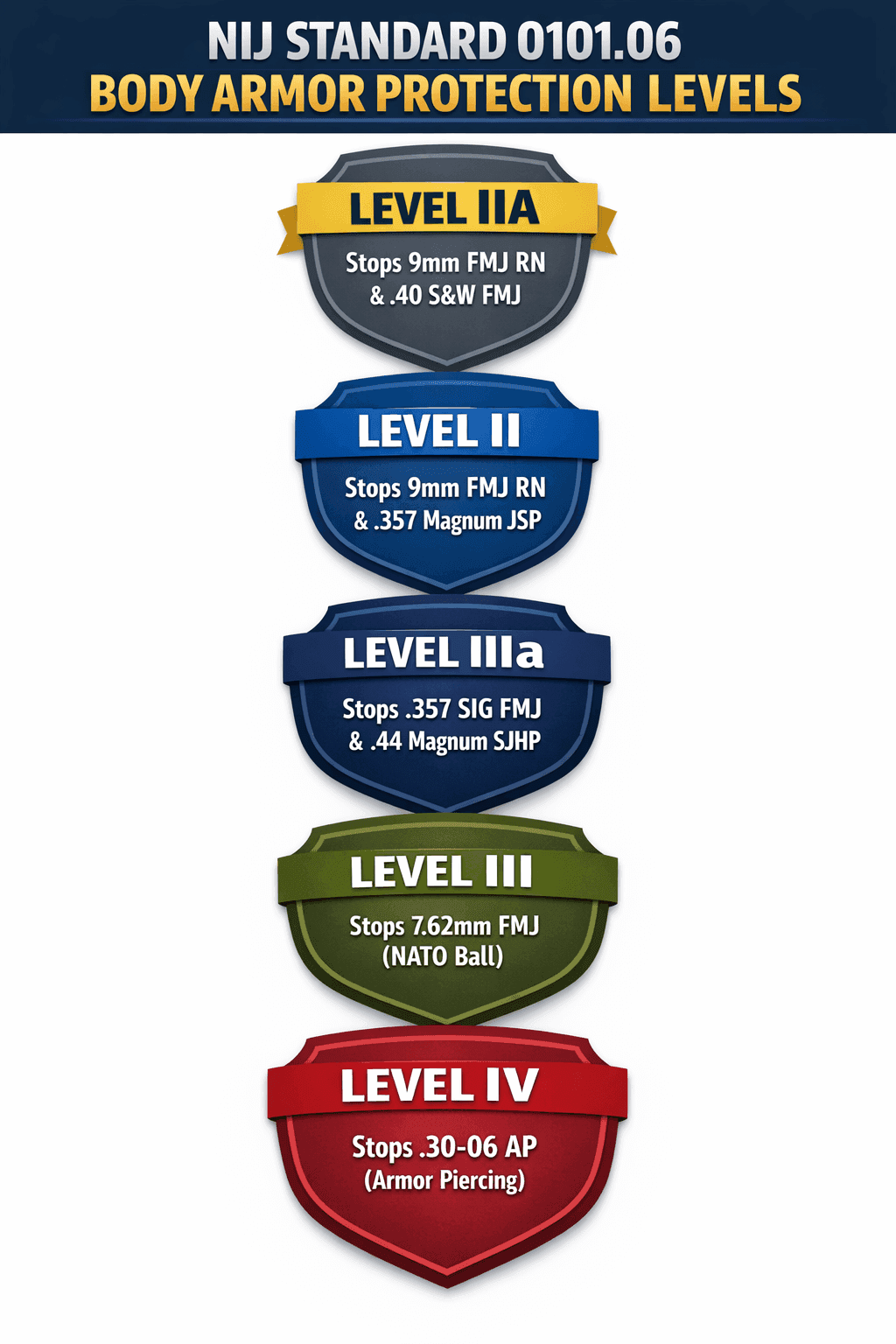
The current and most widely referenced standard is NIJ Standard 0101.06. This standard categorizes body armor into several protection levels, each designed to defeat specific types of ammunition:
- Level IIA: Offers protection against most common handgun rounds, including 9mm FMJ and .40 S&W. It is often used for concealable soft armor due to its flexibility and low profile.
- Level II: Provides increased protection over Level IIA, capable of stopping 9mm FMJ and .357 Magnum JSP rounds. This is a common standard for everyday wear soft armor.
- Level IIIA: Represents the highest level of soft armor protection, capable of defeating .44 Magnum SJHP and 9mm FMJ rounds fired at higher velocities. It is suitable for threats from most handguns and submachine guns.
- Level III: This is the first level requiring hard armor plates. Level III plates are designed to stop rifle rounds, specifically the 7.62x51mm M80 NATO ball projectile fired at specified velocities.
- Level IV: The highest standard in the NIJ classification, Level IV armor is designed to defeat .30-06 Springfield M2 Armor-Piercing (AP) rounds, among other high-powered rifle threats. These are typically thick, heavy ceramic or composite plates.
Beyond NIJ: Understanding "Special Threats," Multi-Hit Capabilities, and Compliance Standards
While the NIJ Standard .06 provides a robust framework, it's important to recognize that the threat landscape can extend beyond its defined parameters. Many manufacturers also offer "special threat" testing or designations. These often address threats not explicitly covered by the standard, such as specific types of armor-piercing ammunition, exotic rounds, or specific fragmentation patterns not part of the official NIJ testing. Additionally, the concept of "multi-hit capability" is critical; while NIJ testing involves a limited number of impacts, advanced armor designs aim to withstand multiple hits from the same caliber without significant degradation of protection. Understanding whether an armor solution is "NIJ compliant" (meaning it meets the standard) versus "NIJ certified" (meaning it has undergone the full, official testing process) is also important, as compliance claims can sometimes be less rigorously verified.
Core Body Armor Types: Soft Armor vs. Hard Armor
The fundamental distinction in body armor lies between soft armor, offering flexibility and concealability, and hard armor, providing superior resistance against high-velocity threats.
Soft Armor: Flexibility, Concealability, and Lightweight Protection
Soft armor, typically made from tightly woven high-strength synthetic fibers like Kevlar or Polyethylene, is designed to absorb and dissipate the energy of projectiles. Its primary advantage is its flexibility, allowing it to conform to the body for comfortable, discreet wear. This makes it ideal for law enforcement officers requiring concealable body armor or for protection against handgun rounds and fragmentation. While effective against many common threats, soft armor generally lacks the rigidity to defeat high-powered rifle rounds. Its protection levels typically range from NIJ Level IIA up to Level IIIA.
Hard Armor Plates: Unyielding Protection Against Rifle Threats
Hard armor plates are rigid inserts, typically made from materials like ceramic, steel, or advanced composites, designed to be worn in conjunction with a plate carrier. These plates are essential for defeating rifle rounds. Their rigid structure is capable of shattering or deforming high-velocity projectiles that would easily penetrate soft armor. NIJ Level III and Level IV certifications are achieved by hard armor plates. While offering superior protection against rifle threats, they are heavier, less flexible, and generally less comfortable for prolonged wear compared to soft armor.
Hybrid and Multi-Threat Vests: Combining Protection for Comprehensive Safety (e.g., Multi-Threat Vests)
Recognizing the limitations of single-solution armor, manufacturers have developed hybrid and multi-threat vests. These systems often combine a base layer of soft armor for handgun protection and comfort with the addition of hard armor plates to counter rifle threats. This approach offers a balance, providing comprehensive protection across a wider spectrum of potential dangers. Multi-threat vests are engineered to address a broader range of ballistic and stab threats, integrating specialized materials and design features to offer enhanced survivability in complex environments.
A Deep Dive into Materials: The Science Behind Your 2026 Protection
The performance of body armor is intrinsically linked to the advanced materials used in its construction. Understanding these materials is key to appreciating their protective capabilities, weight, and durability.
Advanced Polymers (UHMWPE): The Rise of Lightweight Ballistic Protection
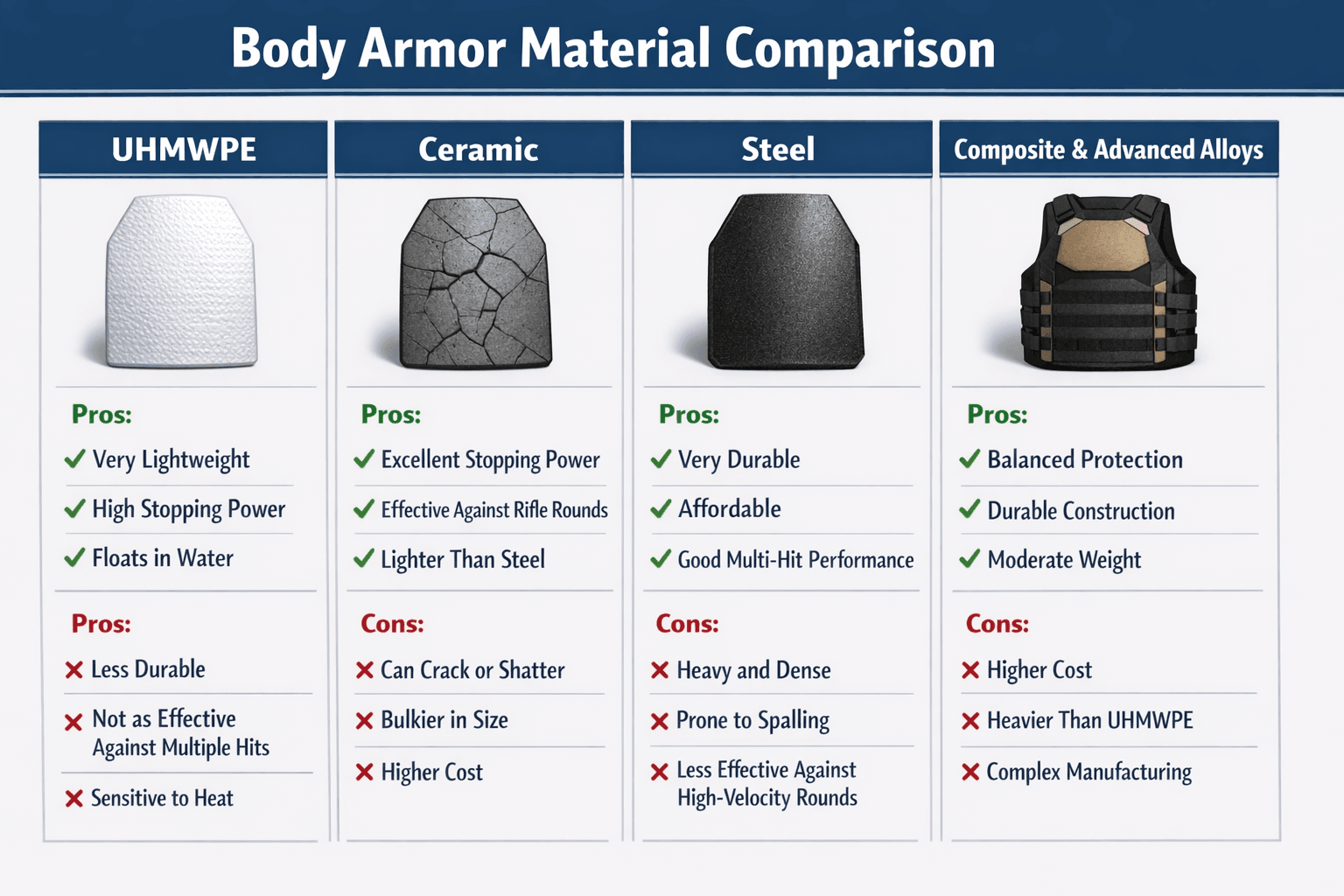
Ultra-High Molecular Weight Polyethylene (UHMWPE) has revolutionized body armor with its exceptional strength-to-weight ratio. Materials like Dyneema and Spectra are forms of UHMWPE, offering ballistic protection that is both incredibly light and remarkably strong. UHMWPE armor can achieve NIJ Level III and even Level IV ratings while being significantly lighter and more flexible than traditional ceramic or steel plates. This makes it an increasingly popular choice for applications where mobility and reduced user fatigue are paramount.
Ceramic Body Armor: Superior Rifle Protection and Weight Management
Ceramic armor plates, often composed of materials such as alumina, silicon carbide, or boron carbide, excel at defeating high-powered rifle rounds, particularly armor-piercing threats. When a projectile strikes a ceramic plate, the ceramic shatters, absorbing and dissipating a significant amount of the projectile's energy. The fragments are then typically caught by a backing material, such as UHMWPE or aramid fibers. Ceramic plates offer a good balance of protection and weight, especially when compared to steel, and are the standard for NIJ Level IV protection. However, they can be more brittle than other materials and are susceptible to damage from blunt force trauma or repeated impacts.
Steel Body Armor: Durability, Affordability, and Specific Applications
Steel body armor offers robust ballistic protection and is renowned for its durability and affordability. Steel plates can effectively stop rifle rounds and are often more resistant to edge and corner damage than ceramic plates. Their primary drawbacks are their significant weight and their tendency to retain heat, which can increase user discomfort. While less common for high-mobility applications, steel plates are an excellent option for training purposes, stationary positions, or when budget is a primary concern and weight is less of a limiting factor.
Composite Materials and Advanced Alloys: Blending Strengths for Optimal Performance
Modern body armor frequently utilizes composite materials, blending different elements to achieve optimized performance characteristics. This can involve layering various types of ceramic strike faces with advanced polymer backing materials or incorporating specialized alloys designed for ballistic resistance. The goal is to leverage the unique strengths of each component – the stopping power of ceramic, the flexibility and energy absorption of polymers, and the durability of certain metals – to create armor that is lighter, stronger, and more effective against a wider range of threats.
Emerging and Future Materials: What 2026 and Beyond Holds
The field of ballistic materials is in constant innovation. By 2026, we can anticipate further advancements in lightweight polymers, more resilient and efficient ceramic composites, and potentially novel materials inspired by biomimicry. Research is ongoing into materials that offer enhanced multi-hit capabilities, reduced backface deformation, and even integrated sensor technologies. Investment in advanced armor prototypes, with over 15,000 featuring biometric sensors, impact data loggers, and GPS trackers tested in 2023-2024 across defense agencies [Body Armor Market, 2026], highlights a significant push towards "smart armor" that not only protects but also provides critical tactical data.
Tailoring Your 2026 Body Armor: Matching Protection to Your Purpose
The "best" body armor is not a universal concept; it is entirely dependent on the intended use, the expected threats, and the operational environment. Tailoring your selection to your specific needs is crucial for optimal effectiveness and survivability.
For Law Enforcement and Military Professionals
For law enforcement and military personnel, the requirements are often diverse and demanding. Officers on patrol may need concealable soft armor for everyday wear, offering NIJ Level IIIA protection against common handgun threats. In higher-risk situations or for tactical units, hard armor plates inserted into plate carriers become essential, providing Level III or Level IV protection against rifle fire. Mobility is a critical factor; the ability to move quickly, efficiently, and without undue fatigue is paramount. Therefore, lighter materials like UHMWPE are highly valued for these roles.
For Security Personnel and Undercover Investigators
Security personnel and undercover investigators often face a unique set of challenges. Concealability and comfort are frequently prioritized, especially for long shifts or when operating discreetly. Soft armor, such as concealable vests rated to NIJ Level IIIA, is commonly used. In situations where a higher threat might be anticipated, but overt armor is not feasible, manufacturers offer low-profile hard armor inserts or specialized vests designed to blend in. The choice often involves a trade-off between maximum protection and the ability to remain undetected or move freely.
For Home Defense, Civilian Preparedness, and SHTF Scenarios
For civilians concerned with home defense or preparing for uncertain "SHTF" (Shit Hits The Fan) scenarios, body armor offers a critical layer of personal security. The threat landscape for civilians can range from common handgun rounds encountered during a home invasion to potential rifle threats in more extreme circumstances. A common and effective approach is to utilize a plate carrier equipped with NIJ Level III or Level IV hard armor plates, providing broad protection against prevalent rifle calibers. Soft armor inserts can also be incorporated for added comfort and protection against handgun threats. Accessibility and ease of use are important considerations.
Specialized Protection: Ballistic Shields and Backpack Body Armor
Beyond wearable vests, specialized body armor solutions cater to specific tactical needs. Ballistic shields, often large, rigid panels made of composite materials or Kevlar, provide a broad area of protection for individuals or teams, commonly used by law enforcement in active shooter situations or during high-risk operations. Backpack body armor, designed to fit into standard backpacks, offers a discreet way for civilians and students to augment their personal protection. These shields and inserts provide an additional layer of defense when a full vest might not be practical or available.
The Body Armor Ecosystem: Plate Carriers, Trauma Pads, and Essential Gear
Body armor is not merely a standalone product; it is part of a larger system. The components that hold your armor and mitigate its secondary effects play a critical role in its overall effectiveness and user experience.
Choosing the Right Plate Carrier for Your Needs
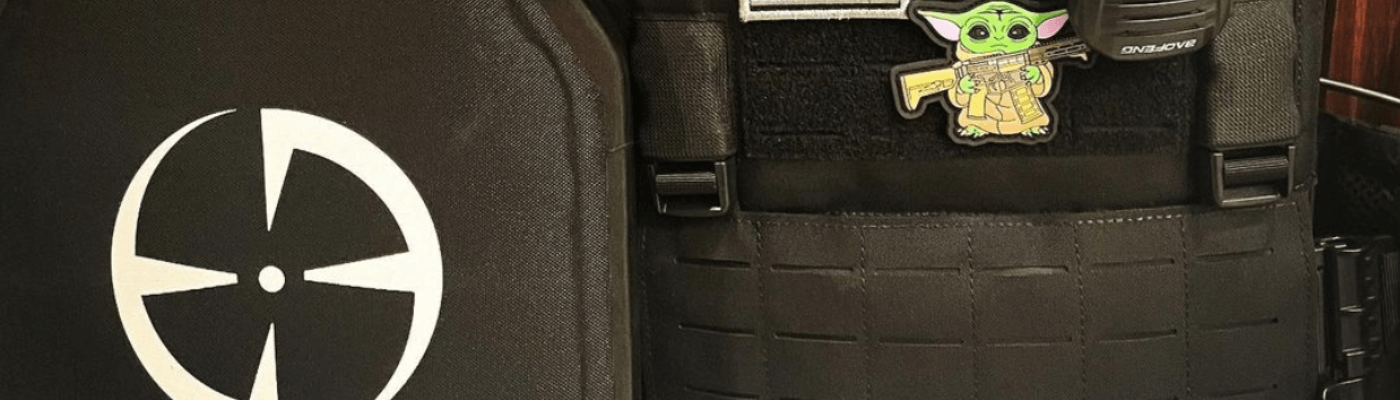
A plate carrier is the vest designed to hold hard armor plates and often soft armor panels. The selection of a plate carrier is as important as the armor itself. Key considerations include comfort, adjustability, weight, and the ability to carry additional equipment via MOLLE (Modular Lightweight Load-carrying Equipment) webbing. A well-fitting plate carrier distributes weight evenly, enhances mobility, and ensures that the armor is positioned correctly for optimal protection. Features like adjustable cummerbunds and shoulder straps are vital for achieving a secure and comfortable fit.
The Crucial Role of Trauma Plates and Spall Liners
When a projectile strikes an armor plate, it can cause significant blunt force trauma to the wearer, even if the projectile is stopped. Trauma plates, or backface deformation (BFD) pads, are designed to absorb and spread this impact energy, reducing the risk of serious injury. Similarly, spall liners are critical for mitigating "spall" – fragments of the projectile and the armor material that can be ricocheted by the impact. High-quality armor systems incorporate advanced BFD reduction and spall containment features to enhance survivability beyond simply stopping the projectile.
Beyond Armor: Integrating Essential Tactical Gear
Effective personal protection extends beyond ballistic resistance. The ability to carry and quickly access essential tactical gear—such as ammunition magazines, communication devices, medical supplies, and tools—is integral to operational effectiveness. A well-designed plate carrier with ample MOLLE real estate allows for the customization of loadouts. Integrating these essential items ensures that the wearer is not only protected but also equipped to respond to threats and manage evolving situations efficiently.
Navigating the Market: Certifications, Brands, and Smart Buying for 2026
The body armor market is diverse, with numerous manufacturers offering a wide array of products. Making an informed purchase requires careful consideration of certifications, brand reputation, and an understanding of common pitfalls.
Verifying Certifications and Compliance Standards
The most critical step in purchasing body armor is verifying its certification. Always look for NIJ Standard 0101.06 certification. Reputable manufacturers will prominently display this information and often provide links to official test reports from accredited laboratories. Be wary of vague claims of "ballistic protection" or "military-grade" without specific NIJ level designations. If a product is simply "NIJ compliant," it suggests it may have met the criteria but hasn't necessarily undergone the full, rigorous certification process.
Reputable Brands and Quality Assurance
Choosing a well-established brand with a proven track record in producing quality ballistic protection is paramount. Research brands that have a history of supplying law enforcement and military agencies. Look for manufacturers who are transparent about their materials, testing procedures, and quality control processes. While price is a factor, prioritizing the lowest cost over verified protection can have life-threatening consequences. The Asia Pacific region, for instance, dominated the body armor market with a market share of 34.52% in 2024 [Fortune Business Insights, 2026], indicating significant global activity and a diverse range of manufacturers to evaluate.
Top Body Armor brands of 2026:
1. LA Police Gear
LA Police Gear focuses on accessible, value-driven body armor and tactical equipment designed for law enforcement, security professionals, and prepared civilians. The brand is known for balancing affordability with practical performance, emphasizing direct-to-consumer availability and broad product education. Its positioning centers on entry-to-mid-level protection with strong retail reach.
2. AR500 Armor
AR500 Armor is best known for its steel body armor, particularly plates made from AR500-grade steel, appealing to cost-conscious civilians and training-focused users. The brand emphasizes durability, multi-hit capability, and U.S.-made manufacturing, while also offering ceramic and lightweight options in recent years. Its reputation is closely tied to ruggedness and budget-friendly ballistic solutions.
3. Armor Express
Armor Express specializes in high-performance soft body armor primarily for law enforcement and first responders. The company is recognized for its advanced materials, lightweight designs, and custom-fit programs tailored to agency needs. Its market position emphasizes comfort, concealability, and cutting-edge ballistic technology.
4. Safariland
Safariland is a premium, duty-grade brand serving military, law enforcement, and federal agencies worldwide. Known for rigorous testing and NIJ-certified solutions, the company offers both soft and hard armor integrated into broader protective systems. Its reputation centers on reliability, innovation, and large-scale institutional adoption.
5. Point Blank
Point Blank is one of the largest and most established body armor manufacturers in the U.S., with a strong focus on law enforcement and military contracts. The brand is known for vertically integrated manufacturing, extensive NIJ-certified offerings, and long-term government relationships. Its positioning emphasizes proven performance, scalability, and mission-critical protection.
Common Pitfalls and What to Avoid
Several common mistakes can lead to purchasing inadequate body armor. These include:
- Buying Used or Expired Armor: Soft armor has a limited lifespan, typically 5-7 years, after which its protective capabilities degrade. Used armor may have hidden damage or be past its service life.
- Ignoring Fit and Comfort: Armor that does not fit properly can reduce mobility, cause discomfort, and compromise protection coverage.
- Overlooking "Special Threats": While NIJ standards are crucial, consider if your operational environment involves threats not explicitly covered by the standard.
- Trusting Marketing Over Certification: Always prioritize official NIJ certification over vague or unsubstantiated claims.
- Forgetting the Ecosystem: The plate carrier, trauma pads, and how they integrate with your armor are as important as the armor itself.
Conclusion
In 2026, the imperative for effective body armor is undeniable. As threats evolve and the operational landscape becomes more dynamic, understanding the intricacies of ballistic protection is no longer optional but a necessity. This guide has illuminated the critical role of NIJ standards, the fundamental differences between soft and hard armor, the science behind advanced materials, and the importance of tailoring your selection to your specific mission. From the high-threat environments faced by law enforcement and military personnel to the crucial preparedness needs of civilians, informed choices about body armor can be life-saving.
Prioritize verified NIJ certifications, understand the unique advantages of materials like UHMWPE and ceramic, and never underestimate the importance of a well-fitting plate carrier and effective trauma mitigation. The body armor market is a complex one, but by focusing on reputable brands, transparent testing, and a clear understanding of your own needs, you can equip yourself with the best possible protection. The continuous investment in smart armor technology, as evidenced by extensive testing of advanced prototypes [Body Armor Market, 2026], signals a future where protection and data converge, further enhancing survivability. Make an informed decision today to ensure your safety tomorrow.
FAQs
What are the main types of body armor available in 2026?
Body armor falls into two broad categories: soft armor and hard armor. Soft armor is flexible and designed to stop handgun threats, while hard armor uses rigid plates to defeat rifle rounds. Many buyers choose hybrid systems that combine both for balanced protection.
What’s the difference between soft armor and hard armor?
Soft armor (like IIIA panels) is lightweight, flexible, and ideal for concealed wear. Hard armor (ceramic, steel, or composite plates) is built to stop rifle threats and is typically worn in plate carriers. Your choice depends on whether you prioritize mobility or maximum ballistic protection.
What NIJ rating should I choose for everyday civilian protection?
Most civilians choose Level IIIA for concealed handgun protection or Level III/III+ for rifle protection in a plate carrier. The right level depends on your environment, threat concerns, and whether you need discreet or overt protection.
What’s the difference between Level III and Level III+?
Level III is tested to stop standard 7.62x51 NATO ball rounds. Level III+ is an industry term (not an official NIJ rating) used to describe plates that also stop faster or more penetrative rounds like M855 “green tip.” Always check the manufacturer’s test data.
Is Level IV armor worth it for civilians?
Level IV offers the highest rifle protection, stopping armor‑piercing rounds. It’s heavier and more expensive, so it’s typically chosen by professionals or buyers preparing for worst‑case scenarios. For most users, Level III or III+ provides a more practical balance.
What materials are used in modern armor plates?
Common materials include ceramic, UHMWPE (polyethylene), steel, and hybrid composites. Ceramic and composite plates offer high protection with lower weight, while steel is durable but heavier and prone to spalling without coatings.
Is steel body armor still a good option in 2026?
Steel remains budget‑friendly and extremely durable, but it’s heavier and can create dangerous fragmentation without proper coatings. Many buyers now prefer ceramic or composite plates for better weight‑to‑protection performance.
How long does body armor last?
Soft armor typically has a 5–7 year lifespan, while hard plates can last 5–10+ years depending on materials and storage. Always follow the manufacturer’s expiration guidelines and inspect armor regularly for damage.
Can body armor stop knife or spike attacks?
Not all ballistic armor protects against edged threats. Look for NIJ-rated stab or spike protection if you need defense against knives, improvised weapons, or corrections-style threats. Some vests combine both ballistic and stab protection.
Is body armor legal to own in the U.S. in 2026?
In most states, civilians can legally purchase and own body armor. Restrictions typically apply only to convicted felons or during the commission of a crime. Always check your state’s current laws before buying.
What’s the best type of armor for home defense?
For home defense, many buyers choose a plate carrier with Level III or III+ plates because rifle threats are possible and concealment isn’t a priority. Soft armor is more suited for daily wear or low-profile use.
How do I choose the right plate carrier for my armor?
Match the carrier size to your plate size (usually 10x12 or SAPI sizing). Look for features like adjustable cummerbunds, ventilation, and MOLLE or laser-cut attachment points. A good carrier should hold plates securely without shifting.
What’s the difference between SAPI and 10x12 plates?
SAPI plates follow military sizing and curvature standards, while 10x12 is the most common commercial size. Most civilian carriers accept 10x12 plates, but some are SAPI-specific—always check compatibility before buying.
How heavy should my armor setup be?
A typical civilian setup ranges from 12–20 lbs depending on plate material and carrier design. Ceramic and composite plates keep weight down, while steel plates can double the load. Choose a weight you can realistically train with.
Do I need side plates?
Side plates add extra protection to your flanks but increase weight and bulk. They’re useful for high-risk environments or professional use. Most civilian buyers stick to front and back plates for mobility.
How do I maintain and store body armor?
Keep armor dry, avoid dropping hard plates, and store it flat in a cool environment. Soft armor should never be machine-washed—use mild soap and a damp cloth. Proper care extends the lifespan and reliability of your gear.