Listen to this article
Table of Contents
- Introduction: The Evolving Landscape of Ballistic Protection
- The Critical Role of NIJ Standards in Body Armor
- The Shift: From NIJ 0101.06 to the New NIJ 0101.07
- A Deep Dive into NIJ 0101.07: Core Innovations and Changes
- Direct Comparison: NIJ 0101.06 vs. NIJ 0101.07 Side-by-Side
- Overview of Old (0101.06) vs. New (0101.07) Level Nomenclature
- The new NIJ Standard 0101.07 Threat levels and what they can stop.
- Key Differences in Ballistic Threat Coverage and Ammunition
- Contrasting Backface Deformation Limits and Testing Stringency
- Understanding the Practical Impact of Simplified Terminology
- Practical Implications of the New Standards
- Choosing the Right Body Armor Under the New NIJ Standards
- Impact of NIJ Standard 0101.07 on Body Armor Safety
- FAQs
Introduction: The Evolving Landscape of Ballistic Protection
Personal protective equipment evolves with new threat technologies and ballistic science. For those relying on body armor—law enforcement, military, and high-risk civilians—keeping up with standards is vital for survival. The National Institute of Justice (NIJ) updates its standards to ensure effective protection. The recent NIJ Standard 0101.07 replaces 0101.06, offering clearer classifications, relevant threat testing, and better performance criteria. This article reviews the new NIJ standards, compares them to the old, and explores their impact on buying, making, and using ballistic-resistant gear.
The Critical Role of NIJ Standards in Body Armor
The National Institute of Justice (NIJ) is the research, development, and evaluation agency of the U.S. Department of Justice. Its mission includes supporting the criminal justice community through research and technology. Within this framework, the NIJ has established rigorous standards for body armor to ensure its effectiveness and reliability. These standards act as a benchmark. They give manufacturers a common basis to design and test their ballistic-resistant equipment. They also help agencies and individuals make informed buying decisions. The standardization provided by the NIJ helps to create a level playing field, ensuring that all certified products meet a defined level of protection.
Why Staying Updated on Standards is Paramount for Safety and Performance
The threats faced by those who wear body armor are not static. Advances in ammunition technology and tactical approaches mean that older protection levels may no longer adequately address contemporary risks. The NIJ continually monitors these developments, updating its standards to reflect current and emerging threats. This commitment to evolution is crucial because body armor represents a critical layer of defense. During the past three decades, ballistic-resistant soft body armor has saved the lives of more than 3,000 police officers [National Institute of Justice, 2025]. Staying updated ensures that individuals are protected against the most relevant dangers, thereby enhancing their safety and the performance of their protective gear. Adherence to updated standards is vital for maintaining confidence in the protective capabilities of body armor.
What This Article Will Cover: A Deep Dive into NIJ 0101.07 and Its Predecessor
This article will provide a thorough exploration of the new NIJ Standard 0101.07, examining its core innovations and how it differs from the previous NIJ Standard 0101.06. We will delve into the NIJ's role in setting these crucial standards, explain the rationale behind the update, and dissect the changes in Ballistic Protection Levels, Test Threats, and testing methodology. Comparing the old and new standards will show main differences. Then, we will discuss what this means for police, military, and civilians. Finally, we will offer guidance on how to choose the right body armor under the new framework.
The Shift: From NIJ 0101.06 to the New NIJ 0101.07
For many years, NIJ Standard 0101.06 served as the benchmark for body armor standards in the United States. However, the ever-evolving nature of threats and advancements in armor technology necessitated an update. This led to the development and release of NIJ Standard 0101.07, a significant revision aimed at improving the clarity, relevance, and effectiveness of ballistic protection standards. This transition marks a crucial step in ensuring that body armor continues to provide the highest level of protection against contemporary dangers.
Why the Standards Needed an Update: Addressing Evolving Threats and Technologies
The decision to update NIJ Standard 0101.06 was driven by several key factors. Foremost among these was the need to address evolving ammunition technologies and test threats that have emerged since the previous standard was established. Threats change over time. Ammo makers keep creating new bullets that can challenge current ballistic gear. New materials and ways to make body armor improved. This made it necessary to review testing methods and performance standards. The NIJ recognized the importance of ensuring that its standards remained current, relevant, and effective in providing meaningful protection for users.
Key Goals of the NIJ 0101.07 Revision
The revision to NIJ Standard 0101.07 was guided by several specific goals designed to enhance the overall effectiveness and usability of body armor. The main goal was to make Ballistic Protection Levels and terms simpler. This helps users understand what different armor systems can do. The update also aimed to incorporate more realistic and relevant test threats, reflecting the actual dangers faced by law enforcement and military personnel in the United States. The testing methods became stricter and more complete. This is especially true for tests on perforation and backface deformation. An important aspect of the revision also included increasing focus on inclusivity, with improved testing for body armor designed for women. These aims collectively contribute to a more robust and user-centric approach to body armor standardization.
A Deep Dive into NIJ 0101.07: Core Innovations and Changes
NIJ Standard 0101.07 represents a significant advancement in the science of ballistic-resistant equipment. This updated standard introduces several core innovations and changes that aim to provide clearer classifications, more relevant threat testing, and improved performance evaluations. The revision is a testament to the NIJ's commitment to ensuring that individuals wearing body armor are protected against the most contemporary and concerning ballistic threats.
Reclassified Ballistic Protection Levels and Simplified Terminology
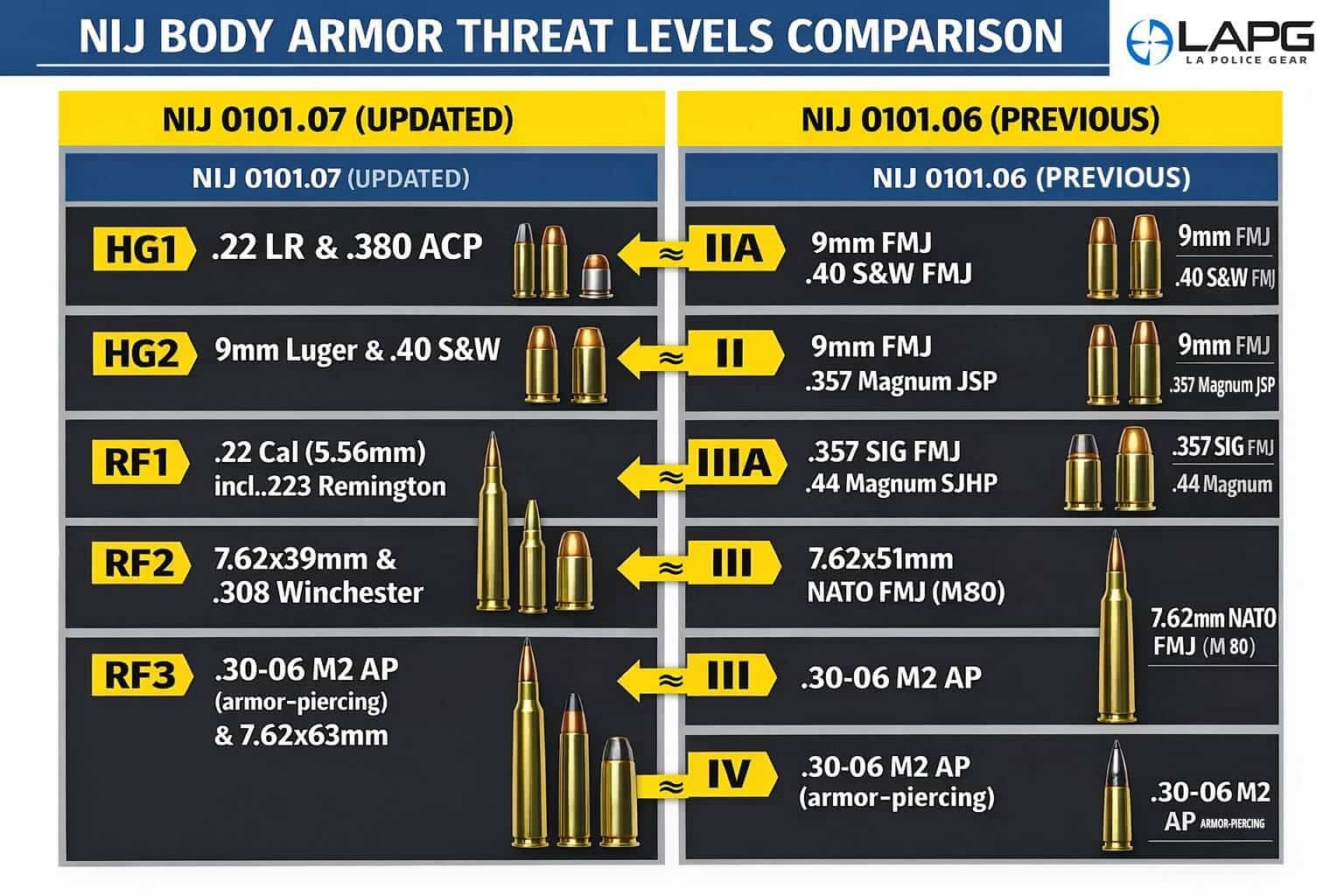
One of the most noticeable changes in NIJ Standard 0101.07 is the reclassification of Ballistic Protection Levels. The previous numerical designations (Levels IIA, II, IIIA, III, and IV) have been replaced with a new system designed for greater clarity and to better align with threat profiles. The new standard utilizes a two-tiered classification system: "HG" for handgun ammunition and "RF" for rifle ammunition.
- HG Levels: These levels (HG1 and HG2) are designed to defeat specific handgun rounds.
- RF Levels: These levels (RF1, RF2, and RF3) are intended to defeat specific rifle rounds.
This shift away from Roman numerals to a more intuitive alphanumeric system, coupled with the clear separation of handgun and rifle threats, aims to reduce confusion for end-users and procurement specialists. This simplification is a direct response to feedback and a desire to make the information about protective capabilities more accessible.
Updated Test Threats and Ammunition Specifications
The test threats employed in NIJ Standard 0101.07 have been meticulously updated to mirror the ammunition types most frequently encountered by law enforcement and military personnel in the United States. This ensures that the body armor is tested against threats that are genuinely relevant in contemporary scenarios. The NIJ has also clarified the specific ammunition types and reference velocities used for each protection level, providing greater transparency and consistency in testing. This updated threat profile allows manufacturers to design armor that specifically counters prevalent dangers, moving beyond older threat models. For example, the new RF levels are designed to address threats identified by U.S. law enforcement agencies [High End Armor, 2024], ensuring the standards are directly applicable to real-world risks.
Enhanced Testing Methodology and Performance Criteria
NIJ Standard 0101.07 improves testing methods, including how armor is conditioned and tested against ballistic impact. It increases focus on perforation-backface deformation testing, which measures the dent depth on armor's back after stopping a bullet. Too much deformation can cause blunt force trauma even without penetration. The new standard updates limits and applies measurements more consistently. These changes give a more accurate view of armor's ability to protect from injury, not just penetration, ensuring higher safety.
Increased Focus on Inclusivity: Improved Testing for Body Armor Designed for Women
A significant and commendable development in NIJ Standard 0101.07 is the increased focus on inclusivity, particularly in the testing of body armor designed for women. Historically, body armor designs have often been based on male anthropometrics, leading to potential fit and protection issues for female officers and personnel. The new standard includes rules and encourages testing that considers different body shapes. It makes sure women get the same protection and comfortable fit as men. This inclusive approach underscores the NIJ's commitment to supporting all individuals who rely on body armor for their safety.
Direct Comparison: NIJ 0101.06 vs. NIJ 0101.07 Side-by-Side
The transition from NIJ Standard 0101.06 to NIJ Standard 0101.07 involves several key changes that impact how body armor is classified, tested, and understood. While both standards aim to provide effective ballistic protection, the updated framework offers greater clarity and relevance to contemporary threats. Understanding these differences is crucial for anyone involved in the selection or use of ballistic-resistant equipment.
Overview of Old (0101.06) vs. New (0101.07) Level Nomenclature
Old Level (0101.06) | New Level (0101.07) | Primary Threat Type |
|---|---|---|
Level IIA | HG1 | Handgun |
Level II | HG2 | Handgun |
Level IIIA | HG2 | Handgun |
Level III | RF1 | Rifle |
Level III+ | RF2 | Rifle |
Level IV | RF2 / RF3 | Rifle |
Note: The NIJ 0101.07 Standard effectively separates handgun and rifle threats into distinct levels. Previously, Level IIIA was the highest soft armor rating, while Levels III and IV addressed rifle threats typically requiring hard armor inserts.
The new nomenclature simplifies the understanding by grouping protection levels based on the type of threat (handgun vs. rifle). The introduction of "HG" and "RF" designations, along with numerical indicators for increasing protection within those categories, provides a more intuitive system. For instance, RF3 is the highest rifle threat level. This simplification directly addresses a common point of confusion with the older system, providing clearer information for users. However, using the table above helps you see what you can purchase now that is the equivalent of the new rules. For instance, if you want the highest RF3 protection, you can buy Level 4 Plates.
The new NIJ Standard 0101.07 Threat levels and what they can stop.
Protection Level | Test Threat | Ammunition Identifier | Reference Velocity |
|---|---|---|---|
NIJ HG1 | 9mm Luger FMJ RN 124 grain | Remington #23558 | 1305 ft/s (398 m/s) |
.357 Mag JSP 158 grain | Remington #22847 | 1430 ft/s (436 m/s) | |
NIJ HG2 | 9mm Luger FMJ RN 124 grain | Remington #23558 | 1470 ft/s (448 m/s) |
.44 Mag JHP 240 grain | Speer OEM #744531; #44532 or #47362 2This ammunition may be purchased from surplus. | 1430 ft/s (436 m/s) |
Protection Level | Test Threat | Ammunition Identifier | Reference Velocity |
|---|---|---|---|
| NIJ RF1 | 7.62x51mm M80 Ball NATO FMJ Steel Jacket 149 +0/-3 grain | U.S. military supply or rounds meeting NATO specifications | 2780 ft/s (847 m/s) |
7.62x39mm MSC Ball Ammunition Type 56 from Factory 31 | Factory 31 Ammunition evaluated and meeting the requirements of Appendix A -- NIJ Ammunition Audit Process -- of the standard | 2400 ft/s (732 m/s) | |
5.56mm M193 56 +0/-2 grain | U.S. military supply or rounds meeting NATO specifications | 3250 ft/s (990 m/s) | |
| NIJ RF2 | 7.62x51mm M80 Ball NATO FMJ Steel Jacket 149 +0/-3 grain | U.S. military supply or rounds meeting NATO specifications | 2780 ft/s (847 m/s) |
7.62x39mm MSC Ball Ammunition Type 56 from Factory 31 | Factory 31 Ammunition evaluated and meeting the requirements of -- NIJ Ammunition Audit Process -- of the standard | 2400 ft/s (732 m/s) | |
5.56mm M193 56 +0/-2 grain | U.S. military supply or rounds meeting NATO specifications | 3250 ft/s (990 m/s) | |
5.56mm M855 61.8 ± 1.5 grain | U.S. military supply or rounds meeting NATO specifications | 3115 ft/s (950 m/s) | |
| NIJ RF3 | 30.06 M2 AP 165.7 +0/-7 grain | U.S. military supply | 2880 ft/s (878 m/s) |
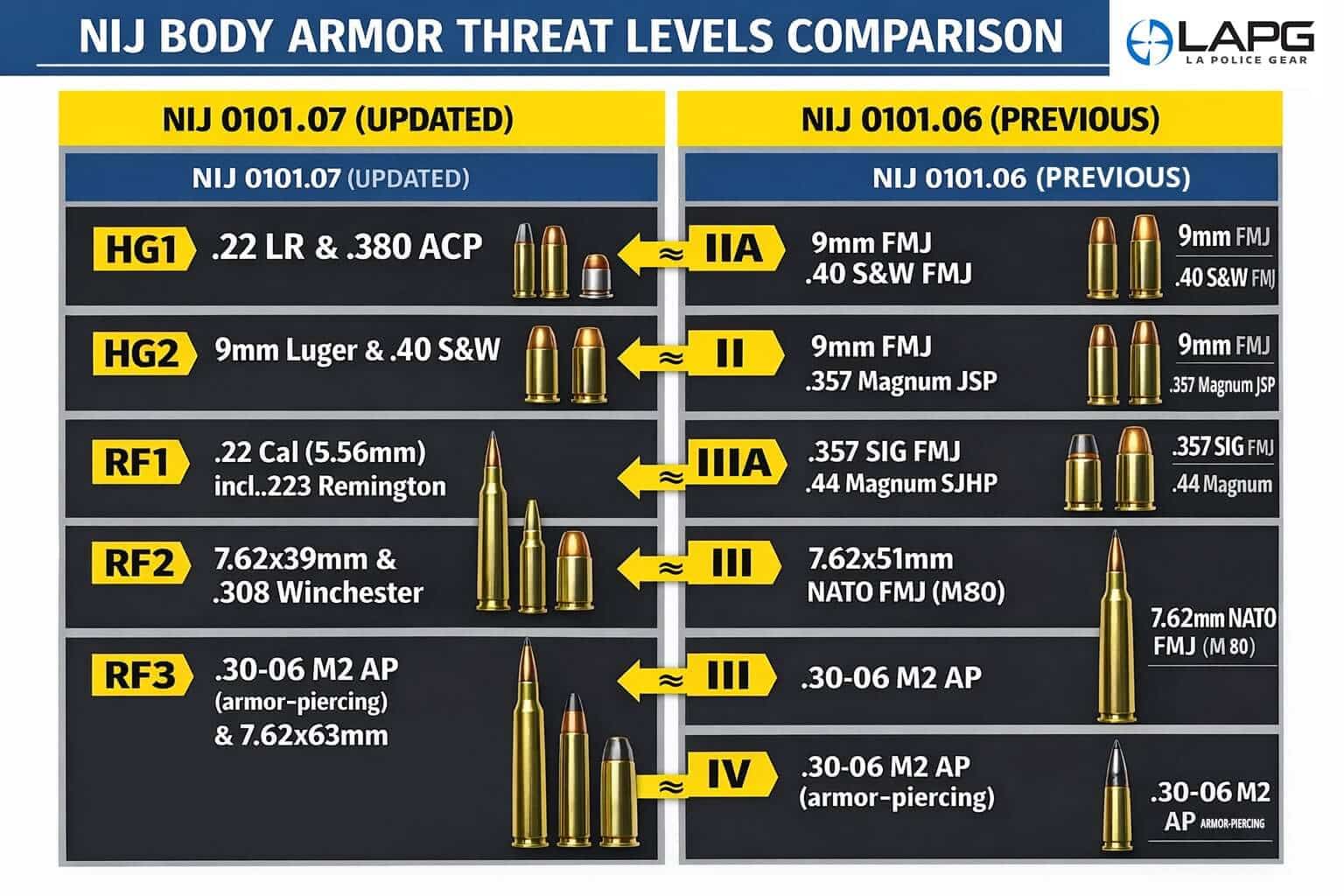
Key Differences in Ballistic Threat Coverage and Ammunition
The core of the update lies in the alignment of test threats with current ammunition. NIJ Standard 0101.07 introduces specific changes to the ammunition types used for testing. While Level IIIA in 0101.06 protected against common handgun rounds, the HG levels in 0101.07 offer refined protection specifically against common handgun ammunition. More significantly, the RF levels in 0101.07 provide updated and often more stringent protection against common rifle ammunition types compared to Level III and IV in the older standard. For example, the test rounds may now include more common or higher-velocity rifle rounds encountered in today's operational environments. These updated test threats ensure that body armor is validated against the most prevalent risks faced by law enforcement and military personnel.
Contrasting Backface Deformation Limits and Testing Stringency
Perforation-backface deformation is a critical metric for determining the potential for blunt force trauma. NIJ Standard 0101.06 set limits for backface deformation. NIJ Standard 0101.07 may change these limits or how they test for backface deformation. The goal is to ensure that armor not only stops a projectile but also minimizes the secondary trauma to the wearer. The details of these changes in testing methodology can lead to armor that offers improved protection against blunt force impact, even when a projectile is fully defeated. This increased stringency in testing methodology is essential for providing comprehensive safety.
Understanding the Practical Impact of Simplified Terminology
The simplification of Ballistic Protection Levels under NIJ Standard 0101.07 offers significant practical benefits. Previously, the distinction between Level II, IIA, and IIIA, and the specific rounds each defeated, could be a source of confusion. The new HG and RF designations, along with their associated test threats, offer a more straightforward understanding of what type of ammunition each level is designed to defeat. This clarity is invaluable for procurement officers making purchasing decisions and for end-users who need to understand the capabilities of their body armor. It streamlines the process of selecting the appropriate protection for a given threat assessment, making the information more digestible and actionable.
Practical Implications of the New Standards
The introduction of NIJ Standard 0101.07 has far-reaching practical implications for all stakeholders involved with body armor. Updated standards affect buying processes, product design, and personal choices. They guide how people check and use ballistic-resistant gear. Understanding these implications is key to leveraging the advancements offered by the new framework.
For Law Enforcement and Military Personnel: Procurement and Selection
For law enforcement and military, the new NIJ standards affect buying and choosing body armor. The simpler HG and RF levels help match gear to threats. Agencies can better assess threats since test threats and ammo specs reflect real situations. This means they can trust the gear offers relevant protection. The focus on backface deformation and improved testing ensures safer armor against more ballistic impacts. This helps agencies make better decisions. Nearly all law enforcement agencies (99%) provide body armor, but only 59% require officers to wear it sometimes [Police Executive Research Forum (PERF), 2023], showing the need for clear standards.
For Body Armor Manufacturers: Compliance and Innovation
Manufacturers of ballistic-resistant gear must comply with NIJ 0101.07 and NIJ 0123.00 by re-testing products and developing new armor that meets updated threats and criteria. The new standards encourage innovation with clearer threat classes and testing methods, pushing makers to use advanced materials and designs for better protection, comfort, and fit, including armor for women. The NIJ Conformity Testing Program remains key for market approval, stressing rigorous testing. The body armor plates market, valued at USD 962.4 million in 2024, is expected to grow [Mordor Intelligence, 2024], showing strong demand for compliant, innovative products.
For Civilian End-Users: Making Informed Purchasing Decisions
Civilian users like security professionals and preppers benefit from updated NIJ standards. The simpler terms and clearer threat classes in NIJ 0101.07 help consumers understand body armor protection better. Buyers can now trust HG and RF levels linked to specific threats instead of old terms. Knowing test threats and methods helps consumers pick armor that fits their risks. The global body armor market is growing fast, expected to reach about €2.43 billion this year [Future Market Insights Inc., 2025], showing rising demand for personal protection and clear standards.
Choosing the Right Body Armor Under the New NIJ Standards
Choosing the right body armor is very important. You must think about personal needs, possible dangers, and how well different products protect. The updated NIJ standards provide a more refined framework to facilitate this process, offering clearer information and more relevant test threats. By understanding the nuances of the new system, individuals can make more informed choices to ensure their safety.
Conducting a Thorough Threat Assessment: Matching Armor to Risk
The foundation of selecting the right body armor lies in conducting a thorough threat assessment. This involves identifying the specific ballistic risks one is likely to encounter. Under the new NIJ standards, this means understanding the difference between handgun threats (HG levels) and rifle threats (RF levels). A security guard in a low-risk area might only need protection against handgun bullets. Someone in a higher-risk area may need protection against rifle bullets. The updated test threats provide a more accurate reflection of common ammunition types, allowing for a more precise match between the armor's capabilities and the perceived threats. This approach ensures that one is not over-protected with unnecessary weight or under-protected against critical dangers.
Soft Armor vs. Hard Armor: Understanding Your Needs
Body armor comes in two primary forms: soft armor and hard armor. Soft armor, typically made from woven fibers like Kevlar or Dyneema, offers flexibility and comfort, making it ideal for everyday wear and protection against handgun rounds (HG levels). By armor type, soft armor commanded 46.21% of 2025 revenue [Mordor Intelligence, 2026]. Hard armor, usually composed of ceramic, composite, or metal plates, provides protection against higher-velocity rifle rounds (RF levels). NIJ Standard 0101.07 continues to address both types, with the HG levels generally correlating to soft armor capabilities and the RF levels often requiring hard armor plates or inserts. Understanding one's likely threats will dictate whether soft armor, hard armor, or a combination thereof is the most suitable choice.
Essential Considerations Beyond Ballistic Protection (Weight, Mobility, Concealability)
While ballistic protection is the primary function of body armor, other factors are crucial for user comfort and operational effectiveness. Weight and mobility are significant considerations, especially for individuals who wear armor for extended periods or need to perform physically demanding tasks. Heavier armor can impede movement and lead to fatigue. Concealability is important for police officers or civilians who want hidden protection. NIJ Standard 0101.07, with its focus on enhanced testing methodology, may indirectly influence these factors by encouraging the development of lighter and more efficient armor systems. When selecting body armor, it is essential to balance the required level of ballistic protection with these practical considerations to ensure optimal performance and comfort in real-world situations.
Impact of NIJ Standard 0101.07 on Body Armor Safety
The introduction of NIJ Standard 0101.07 marks a significant evolution in the realm of body armor standards, providing a more relevant, clear, and robust framework for ensuring ballistic protection. The NIJ simplified the naming system. It updated test threats to match current ammunition. It also improved testing methods. These steps help make ballistic-resistant gear more effective and easier to use. This update gives important information. It helps law enforcement, military, and civilian users make better decisions. This improves safety and readiness for action.
For manufacturers, compliance with NIJ 0101.07 is essential, but it also serves as a catalyst for innovation, driving the development of advanced protective solutions. For end-users, understanding the new HG and RF levels, the updated test threats, and the importance of perforation-backface deformation testing is paramount. The NIJ Conformity Testing Program remains the bedrock of trust, assuring users that certified products meet rigorous performance criteria. As the threats continue to evolve, staying informed about these critical standards and the details they provide is not merely an option, but a fundamental commitment to safety and preparedness. The global body armor market is expected to grow. This shows more people want this life-saving technology. So, understanding and following updated standards is very important.
FAQs
What changed in the new NIJ body armor standards compared to the old levels?
The biggest shift is that the NIJ moved away from the familiar Level II, IIIA, III, and IV labels and replaced them with more precise threat-based categories. Instead of broad “levels,” the new system specifies the exact types of ammunition and velocities each armor type must stop. This makes it easier for buyers to match armor to real-world threats rather than relying on outdated level names.
Why did the NIJ update the standards in the first place?
The NIJ updates its standards to reflect modern ballistic threats, new materials, and improved testing methods. Ammunition has evolved significantly since the previous standard, and the new framework ensures armor is tested against rounds that are actually common today. It also closes loopholes and inconsistencies that existed in the older system.
Are the old NIJ levels (II, IIIA, III, IV) still valid?
Yes, armor certified under the older NIJ 0101.06 standard is still considered valid and safe if it hasn’t expired or been damaged. However, manufacturers are transitioning to the new standard, so buyers will increasingly see the updated labels. Over time, the new categories will become the industry norm.
How do the new rifle-rated categories compare to the old Level III and Level IV?
The new rifle categories break down threats more granularly. Instead of lumping all rifle plates into Level III or IV, the new system tests plates against specific rounds like M855, M193, or .308. This means a plate might outperform an old Level III in some areas but not others—so reading the exact threat ratings matters more than ever.
Does the new standard change anything for soft armor?
Yes. Soft armor now has updated handgun threat categories that better reflect modern duty ammunition. The new tests include more realistic velocities and round types, giving buyers a clearer picture of what their vest can actually stop.
Will armor become heavier or more expensive under the new NIJ rules?
Not necessarily, but some plates may increase slightly in weight or cost because the new tests are more demanding. Manufacturers often redesign products to meet the updated requirements, which can lead to improved performance but also higher production costs. That said, many companies are using advanced materials to keep weight down.
How can I tell if armor is certified under the new NIJ standard?
Look for the NIJ certification label sewn or printed inside the armor. It will clearly state the standard version and the specific threat categories it meets. If the label doesn’t mention NIJ certification at all, the armor is not officially tested—regardless of marketing claims.
Are “NIJ tested” and “NIJ certified” the same thing?
No. “NIJ tested” usually means the manufacturer performed its own testing using NIJ-style protocols, but the NIJ did not certify it. “NIJ certified” means the armor passed official NIJ testing at an accredited lab and is listed on the NIJ’s compliance database. Buyers should always prioritize certified products.
Do civilians need to worry about the new NIJ categories?
Civilians benefit from the new system because it provides clearer, more transparent information about what armor can actually stop. Whether you're buying armor for personal protection, training, or preparedness, the updated categories help you choose gear that matches realistic threats rather than relying on outdated level names.
Will my old armor fail police or agency requirements now?
Most agencies will continue to accept older NIJ-certified armor until it reaches its expiration date. However, new purchases—especially for duty use—will increasingly require compliance with the updated standard. Departments typically phase in new requirements over time rather than switching overnight.
Does the new standard affect multi-hit performance?
Yes. The updated tests include more rigorous multi-hit requirements, especially for rifle plates. This ensures armor can withstand repeated impacts from common duty rounds, not just a single shot. Buyers should expect clearer multi-hit data on product labels and spec sheets.
How often does the NIJ update its armor standards?
Historically, major updates occur every 10–15 years, but the NIJ has signaled a desire for more frequent revisions as ballistic technology evolves. The goal is to keep the standard aligned with real-world threats rather than letting it stagnate.