Table of Contents
- The Unsung Hero: Why a Tactical Sling is Indispensable for Any Firearm
- What This Guide Will Cover: From Basic Concepts to Advanced Choices for Every Rifle Type
- The Foundation: Understanding Sling Anatomy and Attachment Points
- Deconstructing Sling Attachment Hardware: Security Meets Versatility
- Explaining All Sling Types: Finding Your Perfect Match
- Single-Point Slings: Rapid Response and Unrestricted Movement
- Two-Point Slings: The Versatile Workhorse for Any Rifle
- Three-Point Slings: Enhanced Retention and Controlled Carry
- Hybrid and Modular Slings: Customization for Dynamic Needs
- Elastic (Bungee) Slings: Dynamic Carry and Shock Absorption
- Specialty Slings: Precision and Purpose-Built Designs
- Key Factors When Choosing Your Tactical Sling
- Sling Setup, Adjustment, and Best Practices
- Reputable Brands and Notable Models (Examples for Reference)
- Concluding Remarks on Selecting the Ideal Tactical Sling
- FAQs
Introduction: Elevate Your Rifle Handling with the Right Sling
In the realm of firearm ownership, precision, control, and readiness are paramount. While the rifle itself is the primary tool, its effective deployment and management are significantly enhanced by often-overlooked accessories. Among these, the tactical sling stands out as an indispensable component, transforming a firearm from a mere object to be held into an extension of the shooter. Whether you're an operator, marksman, hunter, or civilian, knowing tactical slings is key to optimizing firearm handling, ensuring comfort during long carries, and enabling quick transitions from stowed to firing positions. This guide clarifies tactical slings, covering their anatomy, types, selection criteria, and best practices, helping you choose the ideal sling for your rifle and needs.
The Unsung Hero: Why a Tactical Sling is Indispensable for Any Firearm
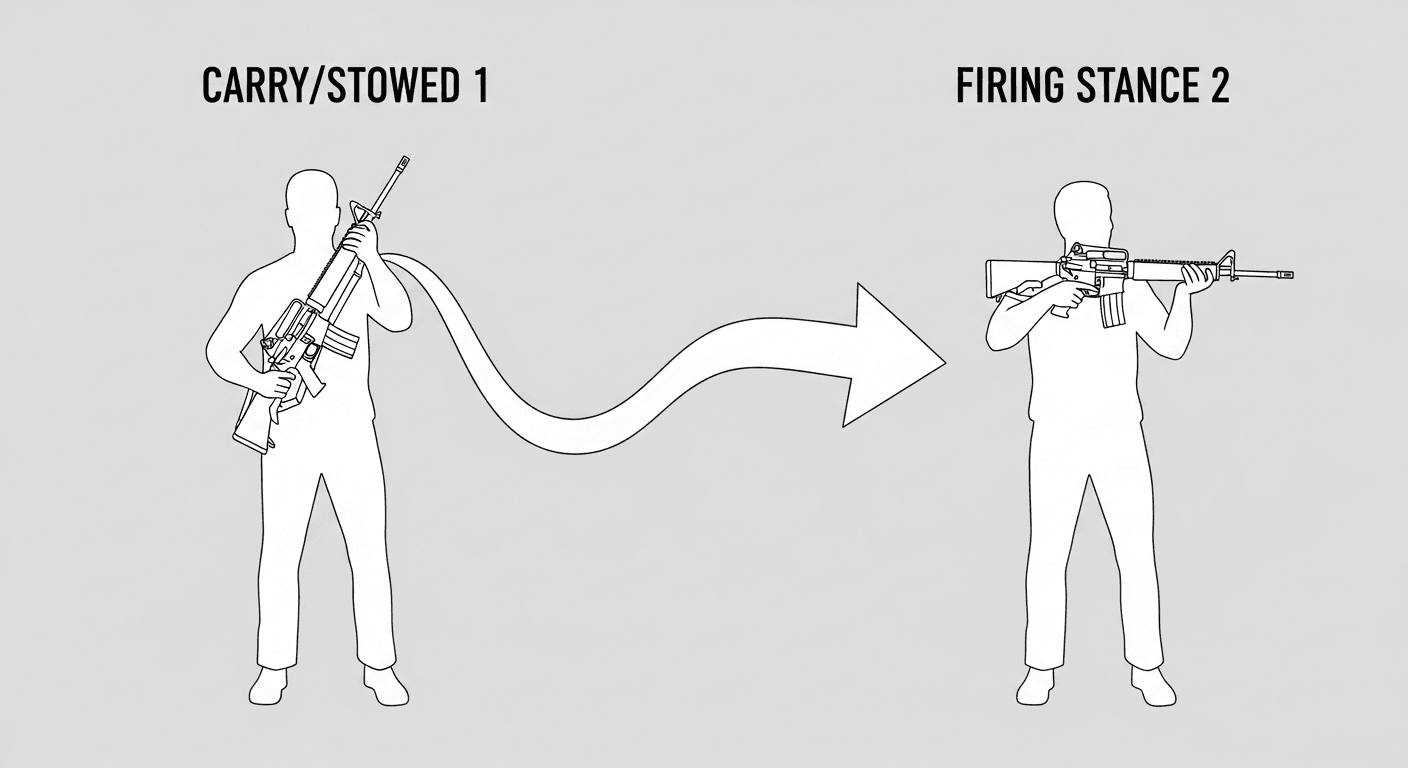 A properly used sling facilitates a rapid and smooth transition from a passive carry state to an active firing position.
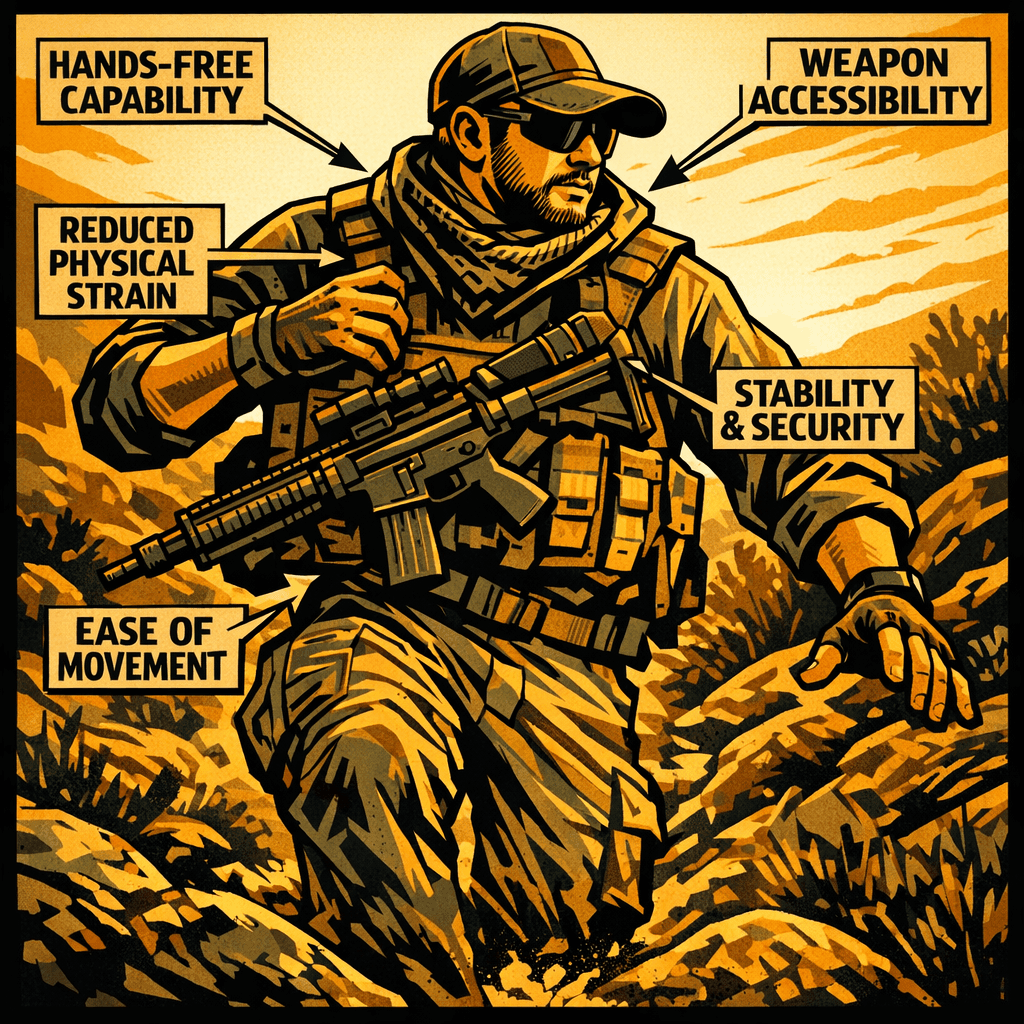
A tactical sling provides multiple advantages that enhance a shooter's effectiveness, safety, and comfort.
A tactical sling is far more than just a strap; it is a fundamental piece of gear that amplifies a shooter's capabilities. Its primary function is to provide a secure and efficient method for carrying a firearm hands-free. This seemingly simple benefit has profound implications. It allows shooters to maintain mobility, manage complex environments, and keep their hands free for other tasks, such as operating equipment, navigating terrain, or administering first aid. For tactical professionals, this translates to enhanced readiness and reduced fatigue during prolonged patrols or engagements. For hunters, it means greater freedom of movement over rugged landscapes without sacrificing weapon retention. For those at the shooting range, a sling can offer additional stability during firing sequences or aid in quickly shouldering the firearm.
The importance of a well-chosen sling cannot be overstated. It directly impacts weapon retention, preventing accidental drops and deterring theft. It facilitates smoother weapon transitions, enabling faster response times in dynamic situations. A well-fitted tactical sling lessens perceived firearm weight and user fatigue by evenly distributing the weight, reducing fatigue during long operations [source: Victory Ridge Sports, 2024].This elevated level of stability and comfort allows shooters to focus more on their target and less on managing their weapon. Ultimately, a tactical sling is an investment in improved performance, safety, and overall shooting experience for virtually any rifle.
What This Guide Will Cover: From Basic Concepts to Advanced Choices for Every Rifle Type
This guide is meticulously structured to provide a holistic understanding of tactical slings, serving as an authoritative resource for every shooter. We will begin by dissecting the fundamental components of a sling and exploring the various attachment points on a rifle. Subsequently, we will delve into the critical aspects of sling hardware, examining the pros and cons of different connectors that ensure secure and versatile mounting.
We will also touch upon hybrid designs and specialty options tailored for specific applications. We'll cover essential considerations for choosing a sling, including rifle type, intended use (hunting, tactical, or range), materials, durability, adjustability, and comfort. This guide explores sling types, including the agility of single-point, the balanced utility of two-point, and the secure retention of three-point slings.
Finally, we will provide practical advice on sling setup, adjustment, and best practices for maximizing its performance and longevity. We will also highlight reputable brands and notable models as reference points, empowering you to make an informed decision that elevates your firearm handling. By the end of this guide, you will possess the knowledge to confidently select the ideal tactical sling for your rifle, enhancing your proficiency and comfort across all shooting disciplines.
The Foundation: Understanding Sling Anatomy and Attachment Points
Before delving into specific types and selection criteria, it's essential to grasp the fundamental building blocks of a tactical sling. Understanding these components and how they interface with your rifle is the first step toward making an informed purchase.
Core Components of a Rifle Sling: Webbing, Adjustment, Hardware
The anatomy of a sling primarily consists of three key elements: the webbing, the adjustment mechanism, and the hardware that connects it to the firearm.
The webbing forms the main body of the sling. It is typically made from durable synthetic materials such as nylon, often incorporating robust variants like Cordura or ballistic nylon. The strength and weave of the webbing are critical. For instance, MIL SPEC webbing is engineered to resist water, UV rays, and abrasion, ensuring tactical gear remains functional in various climates and conditions [source: JUDE Webbing, 2025]. The width of the webbing also plays a role, with wider straps generally distributing weight more comfortably. Nylon webbing delivers superior tensile strength exceeding 2,000 lbs, with some applications combining 2,000–3,500 lbs tensile strength [source: Anmyda, 2024], providing ample support for most rifles.
The adjustment mechanism is what allows the shooter to fine-tune the sling's length to their body and preferred carry position. This can range from simple ladder-style adjustments to more sophisticated quick-adjust systems that allow for rapid changes in length with a pull tab or slider. The ease and speed of adjustment are crucial, especially in dynamic shooting scenarios where the length might need to be shortened for mobility or lengthened for stability.
Finally, the hardware refers to the connectors that attach the sling to the rifle. These are critical for security and versatility, and we will explore them in greater detail in the following section. The interplay between these three components – webbing, adjustment, and hardware – dictates the sling's overall performance, comfort, and durability.
Common Rifle Attachment Points: Where Your Sling Connects
Understanding where a sling can attach to your rifle is as important as understanding the sling itself. Different firearm designs and accessory configurations offer various attachment points.
For modern sporting rifles like the AR-15, common attachment points include receiver end plates with integrated QD (Quick-Detach) sockets or sling loops, specialized stocks with built-in sling mounts, and aftermarket rail-mounted sling adapters. Many carbines feature a front sling swivel stud located on the handguard or gas block.
Bolt-action hunting rifles and precision rifles typically have more traditional sling swivels located at the buttstock and the forearm tip. These can be robust metal loops or screw-in studs. Some modern bolt-action rifles also incorporate M-LOK or KeyMod slots on their forends, which can accept dedicated sling adapter Mounts.
Lever-action rifles often feature barrel bands and stock swivels, though their placement can vary significantly by model. Tactical shotguns might have swivel studs on the magazine cap and buttstock, or utilize specialized mounting solutions that integrate with the receiver or action bars.
When selecting a tactical sling, it is imperative to assess your rifle for compatible attachment points. Many slings are designed to work with standard swivel studs, while others are intended for QD sockets or specialized M-LOK/KeyMod adapters. Compatibility is key to ensuring a secure and functional setup.
Deconstructing Sling Attachment Hardware: Security Meets Versatility
The hardware that connects a sling to a firearm is a critical interface, dictating how quickly and securely the sling can be attached, detached, and adjusted. Several common types of hardware exist, each with its own advantages and ideal use cases.
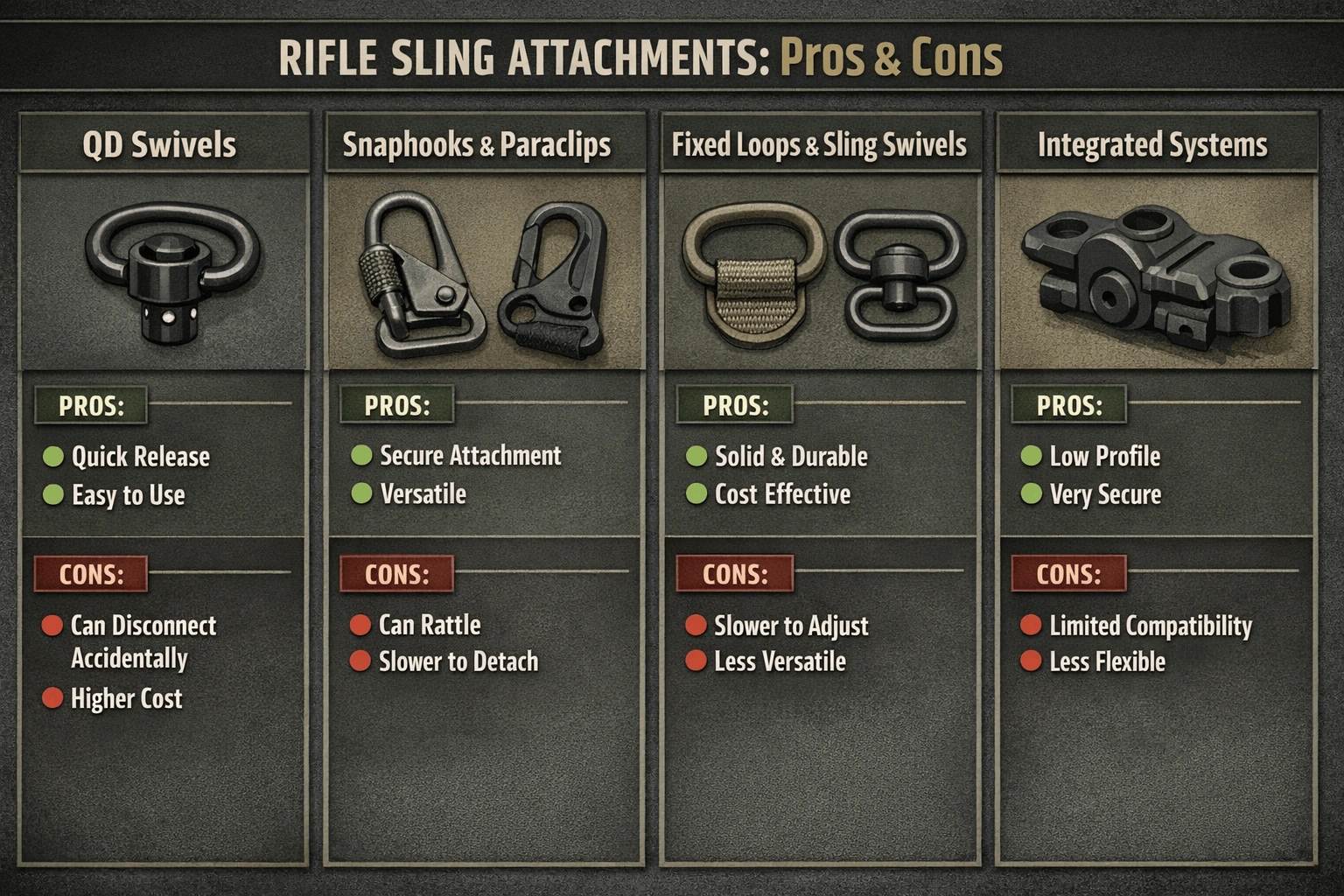 Attachment types for Rifle Slings
Quick-Detach (QD) Swivels: The Modern Standard for Speed and Security
Quick-Detach (QD) swivels have become a de facto standard in modern tactical gear. These small, robust mechanisms allow for the rapid attachment and detachment of a sling from the firearm via a push-button or similar release mechanism. QD swivels are typically found integrated into QD sockets on stocks, receiver end plates, or as standalone adapters for M-LOK/KeyMod systems. Their primary advantage is speed; a shooter can remove or reconfigure their sling in seconds without tools. This is invaluable for training, maintenance, or transitioning to a different carry method. The security offered by a well-made QD swivel is generally excellent, with robust internal mechanisms designed to prevent accidental release.
Snaphooks and Paraclips: Traditional and Robust Options
Snaphooks are a more traditional form of sling hardware. These J-shaped metal clips attach to sling loops or swivels on the rifle. While generally secure, they can be slower to operate than QD swivels and may present a greater risk of snagging. Paraclips, a variation often made of durable polymer, offer a lighter and sometimes quieter alternative to metal snaphooks. Both snaphooks and paraclips rely on a spring-loaded gate for retention. They are often found on older sling designs or on slings intended for less dynamic applications where rapid detachment is not a primary concern.
Fixed Loops and Sling Swivels: Classic Solutions for Hunting and Sporting Rifles
Many hunting and sporting rifle slings utilize fixed loops or classic sling swivels for attachment. Fixed loops are simply sewn loops of webbing or leather designed to pass through standard sling swivel studs. These are generally very secure and durable but offer no quick-detach capability. Classic sling swivels are metal attachments that screw into the rifle's stock and forearm, featuring a loop through which the sling hardware (often a fixed loop or sometimes a snaphook) attaches. These are reliable and widely used, particularly for bolt-action rifles intended for hunting where the need for frequent sling removal is minimal.
Integrated Systems: Proprietary attachment systems and specialized mounts
Beyond the universal hardware types, some manufacturers employ proprietary attachment points and integrated sling systems. These systems are designed to work exclusively with their own hardware or specific firearm platforms. Examples include specialized M-LOK or KeyMod sling adapters that are more streamlined than universal options, or integrated sling loops built directly into polymer stocks. Though these systems may provide enhanced integration and a more polished look, they often restrict compatibility with slings from other manufacturers. Shooters should be aware of these proprietary designs when considering an integrated sling or an AR-15 platform with specialized mounting solutions.
Explaining All Sling Types: Finding Your Perfect Match
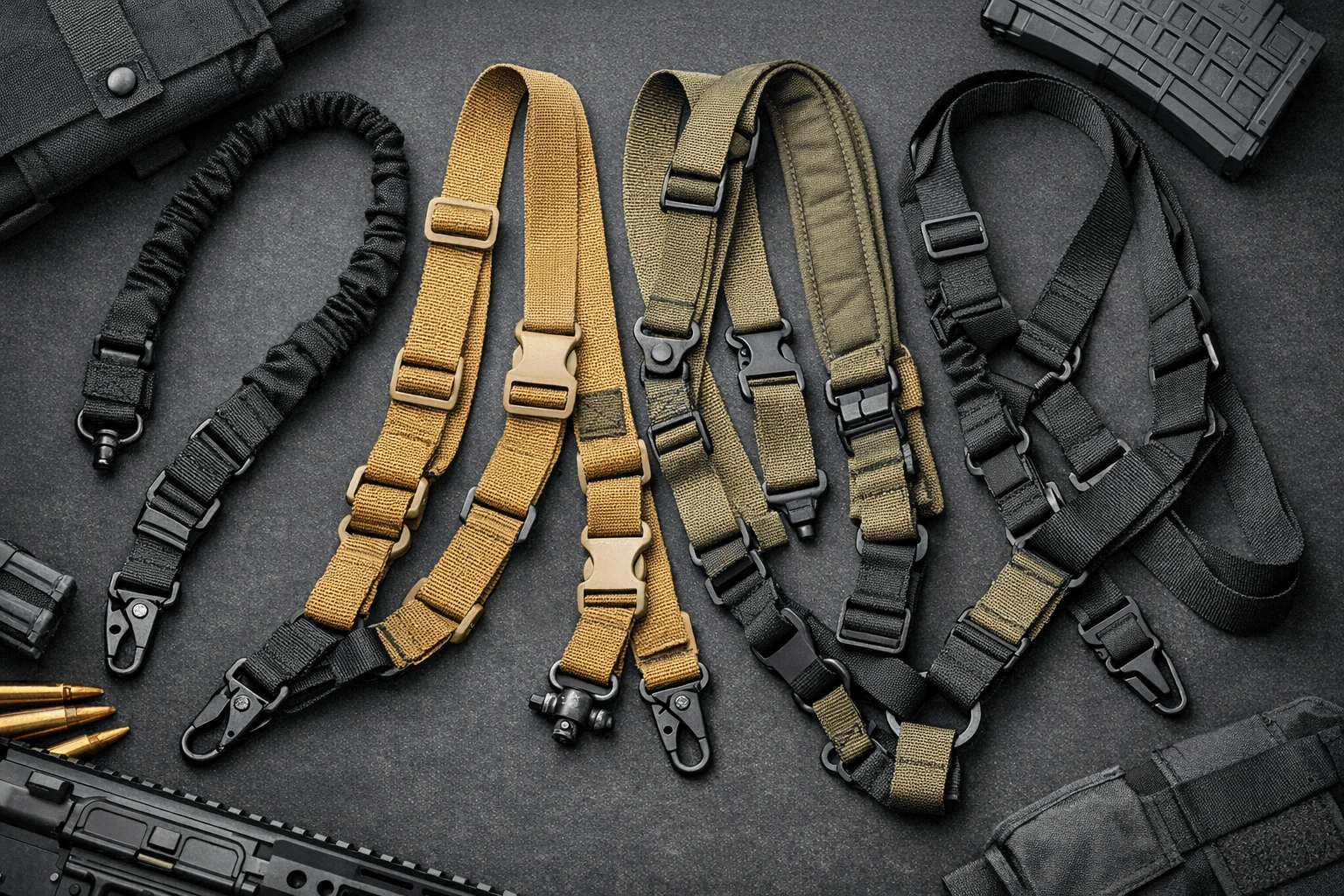
The diversity of tactical slings means there is a sling type designed for almost every conceivable application and user preference. Understanding the distinct characteristics of each type is paramount to selecting the one that best suits your needs.
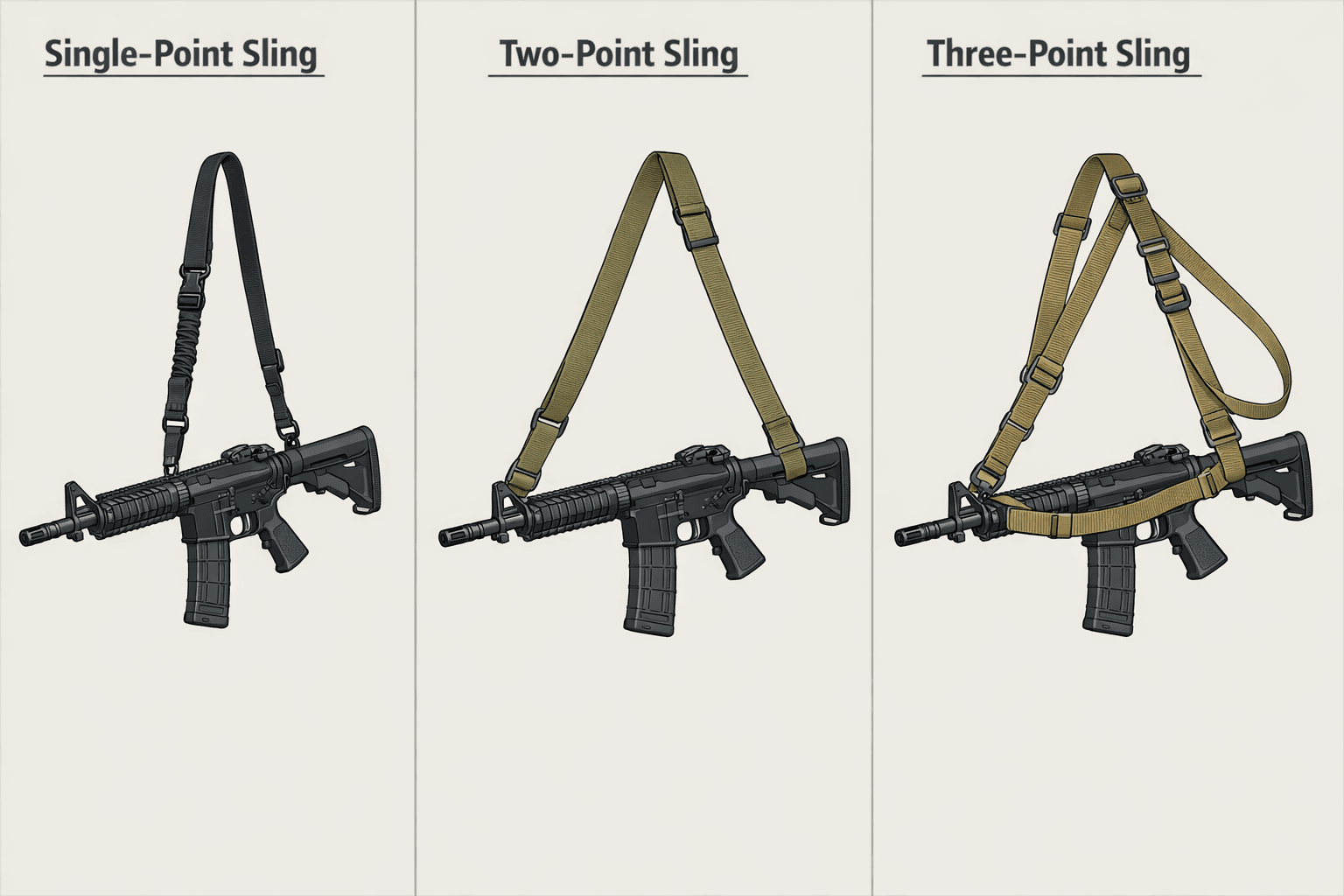 Reference guide to 1, 2 and 3 point slings
Single-Point Slings: Rapid Response and Unrestricted Movement
A single-point sling attaches to the firearm at a single point, typically near the rear receiver or stock. This configuration allows the rifle to hang across the shooter's body, usually perpendicular to the ground, with the muzzle pointing downwards.
Pros:
- Rapid Transitions: Ideal for quickly bringing the weapon to bear. Transitioning from a slung position to a firing stance is exceptionally fast.
- Unrestricted Movement: Offers excellent freedom of movement, particularly in confined spaces like buildings.
- Shoulder Versatility: Easy to transition between shoulders without reconfiguring the sling.
- Hands-Free Carry: Keeps the firearm readily accessible.
Cons:
- Weapon Wobble: The firearm can swing more freely, which may be less stable during movement or when holstered.
- Less Stable for Shooting: Can offer less platform stability for precise shots compared to other types.
- Potential for Entanglement: In cluttered environments, a long single-point sling can sometimes snag.
Best For: Law enforcement officers, military personnel in close-quarters battle (CQB) scenarios, and competitive shooters in disciplines like 3-gun where speed is critical.
Two-Point Slings: The Versatile Workhorse for Any Rifle
The two-point sling is arguably the most common and versatile sling type. It attaches to the firearm at two points: typically one near the front (e.g., barrel or handguard) and one near the rear (e.g., stock or receiver).
Pros:
- Versatility: Can be used in various carry positions (e.g., across the chest, over the shoulder) and offers good balance.
- Stability: Provides a more stable platform for carrying and can aid in shooting stability by offering a point of contact for the arm.
- Weight Distribution: Effectively distributes the firearm's weight across the shoulders and torso, reducing fatigue. A major benefit of using a tactical rifle sling is the reduction of fatigue during extended operations, as the sling helps distribute the weight evenly across the body [source: Victory Ridge Sports, 2024].
- Adaptability: Can be configured for different shooting disciplines and hunting applications.
Cons:
- Transition Speed: Generally slower to transition from a slung position to a firing stance compared to a single-point sling.
- Potential for Entanglement: Can become tangled if not managed properly, especially during rapid movements.
- Adjustment: May require more manual adjustment to fine-tune length for different carry styles.
Best For: A broad range of applications including general use, hunting, range practice, carbine courses, and tactical operations where a balance of mobility and stability is required.
Three-Point Slings: Enhanced Retention and Controlled Carry
The three-point sling is a more complex design that attaches to the firearm at three points, creating a more secure and encompassing carry system. This design often includes adjustable straps that wrap around the user's body.
Pros:
- Maximum Retention: Offers the highest level of weapon retention, making it difficult for the weapon to be dislodged.
- Controlled Carry: Keeps the firearm very close to the body, minimizing sway and movement.
- Multiple Carry Options: Can be configured for various carrying methods.
Cons:
- Complexity: Can be more complicated to don, doff, and adjust.
- Entanglement Risk: Due to its multiple straps, it presents a higher risk of snagging.
- Less Common in Modern Use: While effective for retention, they are less popular in many modern tactical applications compared to their single- and two-point counterparts due to their bulk and complexity.
Best For: Scenarios demanding uncompromised weapon security, like navigating dense environments or high-threat situations where retaining control of the weapon is crucial.
Hybrid and Modular Slings: Customization for Dynamic Needs
Hybrid and modular slings offer the best of multiple worlds. These sling types are designed to be convertible, allowing a shooter to switch between configurations (e.g., from a two-point sling to a single-point sling) on the fly. They often utilize QD hardware or specialized adapters to facilitate these transitions.
Pros:
- Adaptability: Can be tailored to a wide range of situations and preferences.
- Versatility: One sling can perform the functions of two or more specialized slings.
- Customization: Allows shooters to fine-tune their setup based on evolving needs. Over 50% of sports enthusiasts prefer lightweight, modular equipment for ease of use in shooting sports [source: Dataintelo, 2026].
Cons:
- Potential Complexity: Some modular systems can have more parts or require more thought to configure correctly.
- Cost: Can sometimes be more expensive due to their advanced design.
Best For: Shooters who engage in diverse activities and require a single sling that can adapt to various scenarios, from range training to field use.
Elastic (Bungee) Slings: Dynamic Carry and Shock Absorption
Elastic or bungee slings incorporate bungee cord sections into their design. This feature allows for a degree of stretch and shock absorption.
Pros:
- Comfort during Movement: The elasticity can absorb some of the shock when moving rapidly or when the firearm shifts position.
- Dynamic Carry: Provides a somewhat more forgiving carry, especially for activities involving a lot of movement.
Cons:
- Reduced Stability: The stretch can lead to less precise weapon control and stability during shooting.
- Potential for Sag: The elastic nature can sometimes result in more slack than desired.
- Durability Concerns: The elastic components may be less durable over the long term than traditional nylon webbing.
Best For: Specific tactical roles where constant, dynamic movement is involved and a degree of shock absorption is beneficial, though they are less common for precision shooting.
Specialty Slings: Precision and Purpose-Built Designs
Beyond the common categories, there are specialty slings designed for niche applications. These might include:
- Precision/Sniper Slings: Often wider, made of stiffer materials, and featuring specific adjustment mechanisms to create a stable shooting platform when bracing against the sling. These are crucial for long-range shooting.
- Hunting Slings: May prioritize comfort for long treks, durability for harsh environments, and simpler designs that don't interfere with hunting techniques like stalking or field dressing.
These specialized options cater to the unique demands of specific firearm disciplines and user groups.
Key Factors When Choosing Your Tactical Sling
Selecting the right tactical sling is a personal decision that hinges on a confluence of factors. It requires a clear understanding of your firearm, your intended use, and your personal preferences.
Rifle Type and Configuration: The "Any Rifle" Compatibility Challenge
The rifle type and its specific configuration are primary determinants in sling selection. While the AR-15 platform has a vast array of aftermarket accessories and standardized mounting options, other firearms present unique challenges.
For bolt-action rifles, especially those used for hunting or precision shooting, the availability and placement of traditional sling swivels are key. Slings with simpler hardware like fixed loops or standard swivels often integrate best.
For AR-platform carbines, selecting between fixed stocks, adjustable stocks (such as the M4 style), and specialized chassis systems significantly affects the location of sling attachment points and the practicality of different sling types. It's important to determine whether your AR-15 is equipped with Quick Detach (QD) sockets integrated into the receiver end plate or the stock. If these are not available, you may need to consider using rail-mounted adapters to facilitate sling attachment.
Lever-action rifles might have limited or uniquely placed sling points, requiring a sling that can adapt. Tactical shotguns, like semi-automatics and pump-actions for defense, often need a two-point or convertible sling with QD hardware for flexibility.The overarching challenge is ensuring the chosen sling's hardware and attachment points are compatible with your firearm without compromising stability or ease of use.
Intended Use Case: Matching the Sling to Your Mission
Your primary use case for the rifle should heavily influence your sling choice. Different activities place different demands on a sling.
- Tactical/Professional: For law enforcement, military, or civilian self-defense, rapid deployment, weapon retention, and freedom of movement are paramount. Single-point slings or convertible two-point/single-point hybrid slings are often favored for their speed and agility.
- Range/Competition: At the range or in competitive shooting (like 3-gun), a balance of stability, speed, and comfort is essential. A versatile two-point sling, especially one with a quick-adjust feature, is often ideal. For precision shooting, specialized slings designed to create a stable shooting platform are critical.
- Hunting:Hunting scenarios demand durability, comfort for extended carry over varied terrain, and ease of transition from carrying to shooting. A comfortable two-point sling, potentially with padding, that offers secure carry without impeding movement is typically preferred. The global hunting equipment and accessories market, valued at USD 25.34 billion in 2024, is projected to reach USD 40.16 billion by 2030, growing at a CAGR of 7.98% [source: TechSci Research, 2025], indicating a significant user base for purpose-built hunting accessories like slings.
- General Civilian Use: For home defense or recreational shooting, a versatile two-point sling generally offers the best blend of security, comfort, and ease of use.
Materials, Durability, and Construction Quality
The materials, durability, and overall construction quality of a tactical sling are critical for its longevity and performance.
- Webbing: High-quality nylon, such as Cordura or ballistic nylon, is standard for modern tactical slings. These materials offer excellent abrasion resistance, water repellency, and tensile strength. MIL SPEC webbing is engineered to resist water, UV rays, and abrasion, ensuring tactical gear remains functional in various climates and conditions [source: JUDE Webbing, 2025]. As previously noted, nylon webbing delivers superior tensile strength exceeding 2,000 lbs, with some applications combining 2,000–3,500 lbs tensile strength [source: Anmyda, 2024].
- Stitching: Look for reinforced stitching at stress points, such as where the webbing connects to hardware or adjustment points. Double or triple stitching, box-x stitching, and bar tacking are indicators of superior construction.
- Hardware: Metal hardware (like QD swivels or snaphooks) should be robust and corrosion-resistant. Polymer hardware should be made from high-impact-resistant plastics. The security and reliability of the attachment hardware are paramount.
- Padding: For slings intended for extended carry or heavier rifles, padding can significantly enhance comfort. Padded sections are typically made from closed-cell foam wrapped in durable fabric. However, padding can add bulk and cost, so it's a trade-off to consider based on your needs.
Adjustability, Comfort, and Weapon Handling
The adjustability, comfort, and how the sling affects weapon handling are crucial for practical application.
- Ease of Adjustment: A sling that is difficult to adjust is a liability. Quick-adjust systems, while potentially more complex, offer significant benefits in dynamic environments. The ability to rapidly change sling length allows a shooter to maintain optimal stability when needed or maximize mobility when required. Over 50% of sports enthusiasts prefer lightweight, modular equipment for ease of use in shooting sports [source: Dataintelo, 2026].
- Comfort: Beyond padding, the width of the webbing, the smoothness of the edges, and how the sling distributes weight all contribute to comfort. A poorly designed sling can chafe, dig into the shoulder, or create pressure points, negating its benefits.
- Weapon Handling: The ultimate test of a sling is how it impacts your ability to handle your firearm. Does it allow for smooth transitions? Does it impede weapon manipulation, reloads, or malfunction clearances? Does it keep the rifle securely positioned while allowing freedom of movement? A good sling should feel like a natural extension of the firearm, enhancing rather than hindering its use.
Sling Setup, Adjustment, and Best Practices
Choosing the right tactical sling is only the first step; proper setup, adjustment, and adherence to best practices are vital for maximizing its effectiveness and ensuring safe operation.
Proper Installation: Securely Attaching Your Sling
The initial installation of your sling is critical. Ensure that all attachment points are secure and that the hardware is correctly engaged. If using QD swivels, confirm they click securely into their sockets. For fixed loops or snaphooks, ensure they are properly seated in the rifle's sling swivels or loops. The orientation of the sling matters; ensure it is not twisted, which can lead to discomfort and reduced functionality. For slings that offer convertible configurations (e.g., two-point to single-point), understand the mechanism for changing modes before you need to do it under duress.Many lack formal training; a survey found 39% of gun owners never received it, and 81% believe training should be mandatory before firearm ownership [source: Everytown, 2023]. Proper installation is a foundational element of that training.
Optimizing Length and Fit: The Key to Performance
Achieving the optimal length and fit for your sling is paramount for both comfort and performance. There is no single "correct" length; it depends on your body size, the rifle you are using, and your intended application.
- Carry Position: For a two-point sling, the rifle should hang comfortably at your side or across your chest, allowing you to quickly bring it to your shoulder without excessive fumbling. It should not be so long that the firearm sways excessively, nor so short that it restricts your movement or feels constricting.
- Shooting Position: When adjusting for shooting stability, the sling might need to be tightened to create a stable platform. This often involves shortening the sling so it provides firm support when your arm is placed through it, creating a tensioned loop.
- Transition: The adjustment system should allow you to quickly transition between these positions. Practice making adjustments to become proficient. A sling that is too long can hinder mobility, while one that is too short can restrict your ability to shoot effectively or move naturally.
Training and Drills with Your Sling
A tactical sling is not merely for carrying; it is an integral part of your firearm handling system. Regular training with your sling is essential.
- Weapon Retention: Practice drills to ensure your firearm remains secure, even during dynamic movements.
- Transition Drills: Focus on smoothly transitioning the rifle from a slung position to a firing position, and back again. This includes practicing rapid shouldering and unshouldering.
- Movement Drills: Integrate the sling into movement exercises. Practice moving through obstacles, up and down stairs, or in confined spaces while managing your slung weapon.
- Reloads and Malfunctions: Practice performing reloads and clearing malfunctions with your rifle in the slung position. This ensures you can maintain weapon control and efficiently address common issues.
Sling Care and Maintenance: Extending Durability and Performance
To ensure your tactical sling performs reliably over its lifespan, proper care and maintenance are necessary.
- Cleaning: Clean the webbing and hardware periodically, especially after exposure to dirt, sand, or moisture. Use mild soap and water, and allow the sling to air dry completely. Avoid harsh chemicals that could degrade the materials.
- Inspection: Regularly inspect the webbing for signs of wear, such as fraying or thinning. Check all hardware for damage, corrosion, or looseness. Pay close attention to stitching.
- Storage: Store your sling properly when not in use. Avoid prolonged exposure to direct sunlight, extreme temperatures, or harsh chemicals, which can degrade the synthetic materials over time.
Reputable Brands and Notable Models (Examples for Reference)
The market for tactical slings is robust, with many manufacturers producing high-quality gear. While this list is not exhaustive, it highlights some of the most respected brands and their popular models known for durability, functionality, and innovative design. These examples can serve as excellent starting points for your research.
- Blue Force Gear: Their Vickers Sling, particularly the padded variant, is a benchmark in the two-point sling category. Known for its robust construction, intuitive adjustability, and comfort.
- Magpul: Offers a range of slings, including the MS1, MS3 (convertible), and MS4 (QD-equipped convertible). They are recognized for their durable materials and user-friendly designs.
- Viking Tactics (VTAC): The VTAC Padded Sling is a long-standing favorite, particularly among those who favor a two-point sling with excellent adjustment capabilities and comfort. They also offer wider padded versions.
- Ferro Concepts: The Slingster is a highly regarded modular sling known for its excellent adjustability and ability to transition between configurations.
- Specter Gear: Offers a variety of tactical slings, including their popular 3-point slings, known for their durability and specific retention features.
- BLACKHAWK!: A well-established brand in tactical accessories, BLACKHAWK! offers a range of slings catering to different needs, often featuring QD hardware and robust construction.
When considering specific models, pay attention to reviews that discuss the sling's performance with your specific rifle type and intended use.
Concluding Remarks on Selecting the Ideal Tactical Sling
Choosing the right tactical sling is a critical decision that significantly impacts your ability to control, carry, and deploy your firearm effectively. Understanding sling anatomy, types, attachment nuances, and key differentiators like rifle compatibility, usage, materials, and adjustments equips you to make an informed choice.
Whether your priority is the rapid transitions offered by a single-point sling, the balanced utility of a two-point sling, or the specialized features of a hybrid or precision model, the perfect tactical sling exists to enhance your shooting experience. Remember that proper installation, meticulous adjustment, and consistent training are as crucial as the sling itself; these practices ensure you can harness its full potential for improved stability, reduced fatigue, and enhanced readiness. The global shooting and gun accessories market is projected to expand significantly [source: Market.us, 2025], reflecting a growing demand for high-quality gear that supports responsible firearm ownership and effective marksmanship. Invest the time to select wisely, practice diligently, and you will find that the right sling becomes an indispensable ally for any firearm.
FAQs
What’s the main difference between single‑point and two‑point slings?
Single‑point slings attach at one point and excel at fast shoulder transitions and close‑quarters maneuvering. Two‑point slings attach at the front and rear of the rifle, offering better stability, retention, and comfort for longer carry. If you want control and support, two‑point is usually the safer bet; if you want speed and mobility, single‑point shines.
Is a three‑point sling still worth buying today?
Three‑point slings offer excellent weapon retention, but they’re bulkier and more complex than modern two‑point or convertible designs. Many shooters find the extra webbing gets in the way of controls or snagging hazards. They still work, but most buyers prefer simpler, more streamlined options.
What’s a convertible sling and why would I want one?
A convertible sling can switch between single‑point and two‑point modes using quick‑detach hardware or built‑in adapters. It’s ideal if you want the stability of a two‑point but occasionally need the mobility of a single‑point. They’re slightly more complex, but extremely versatile.
Will any sling fit my rifle?
Most modern rifles with QD sockets, M‑LOK slots, KeyMod, or standard sling swivels can accept a wide range of slings. If your rifle lacks attachment points, you may need adapters like QD mounts, paraclip loops, or rail-mounted sling cups. Always check compatibility before buying to avoid extra hardware surprises.
What’s the most comfortable sling for long periods of carry?
A padded two‑point sling is usually the most comfortable for extended use. The padding distributes weight across your shoulder and reduces fatigue, especially with heavier rifles. Wider straps also help prevent digging or hot spots.
Are bungee slings good or bad?
Bungee sections add shock absorption and flexibility, which can feel great in single‑point setups. However, they can introduce bounce and reduce stability in precision or patrol-style shooting. They’re best for dynamic movement, not for steady supported positions.
What sling material is the most durable?
Most quality slings use heavy-duty nylon webbing because it resists abrasion, moisture, and UV exposure. Some premium models use reinforced stitching or proprietary blends for added strength. Avoid cheap, thin webbing — it wears out quickly and can fail under load.
Do I need QD swivels, or are fixed loops fine?
QD swivels offer fast attachment and detachment, making them great for modular setups or switching rifles. Fixed loops are simpler, cheaper, and extremely reliable but less flexible. If you frequently reconfigure gear, go QD; if you want set‑and‑forget durability, fixed loops work perfectly.
Is a tactical sling legal to own and use?
Yes — slings are legal in all U.S. states and are considered accessories, not regulated components. Just be mindful of local rules when carrying a rifle in public or transporting it in a vehicle. The sling itself has no legal restrictions.
How do I adjust a two‑point sling correctly?
Set it so you can cinch it tight for stability but loosen it quickly for movement. Most modern slings use a pull‑tab or slider that lets you tighten or release tension in one motion. If you can shoulder the rifle, move freely, and stabilize it without fighting the sling, you’re dialed in.
Can a sling improve my shooting accuracy?
A properly tensioned two‑point sling can act as a support, reducing wobble and helping you lock into a stable shooting position. It won’t replace fundamentals, but it can noticeably improve steadiness, especially in kneeling or seated positions.
What’s the best sling for home defense?
Most shooters prefer a two‑point adjustable sling because it offers control without letting the rifle swing freely. If you expect tight hallways or rapid transitions, a convertible sling gives you the option to switch to single‑point mode. Ultimately, choose the setup that matches your home layout and training style.
How do I keep my sling from snagging on gear or clothing?
Look for streamlined hardware, minimal loose webbing, and smooth pull tabs. Routing excess strap through elastic keepers helps keep everything tidy. If snagging is a recurring issue, consider switching to a lower‑profile sling or attachment method.
How do I clean and maintain a tactical sling?
Most nylon slings can be hand‑washed with mild soap and warm water, then air‑dried. Avoid harsh chemicals or high heat, which can weaken fibers. Periodically inspect stitching, buckles, and QD swivels for wear — replacing a worn part is far cheaper than replacing a dropped rifle.
Do I really need a sling if I only shoot at the range?
A sling still helps with stability, safe muzzle control, and carrying the rifle between stages or benches. Even casual shooters benefit from having one. It’s one of the simplest upgrades you can make to improve both safety and comfort.