Listen to this article
Table of Contents
- Defining the Standard: What Is OC Spray and Is It the Same as Pepper Spray?
- The Science of Heat: Why 'OC Percentage' is a Marketing Myth
- Operational Effectiveness: Incapacitation and Safety Data
- Tactical Delivery Systems: Stream, Gel, and Fogger Applications
- Liability and Law: Navigating the Legal Landscape of OC
- The Professional's Toolkit: Top-Tier OC Brands and Selection Criteria
- Conclusion: Prioritizing Reliability Over Marketing
- FAQs
When professionals ask what is OC spray, the answer is more precise than most product labels suggest — and that precision matters when you are selecting a tool that has to perform under stress, against a non-compliant subject, with no margin for equipment failure.
Oleoresin Capsicum (OC) is a naturally derived inflammatory agent extracted from capsicum peppers. It is the professional and tactical designation for what the general public calls "pepper spray." Both terms describe the same chemical foundation — a capsicum-derived oil suspended in a pressurized aerosol carrier — but the terminology is not interchangeable in a professional context. "Pepper spray" is a civilian label. "OC spray" is what LEOs, corrections officers, and security professionals use when they are evaluating duty-grade tools against documented performance standards.
That distinction is not semantic. It reflects a difference in how the product is selected, tested, and carried. Consumer-grade pepper spray is marketed on shelf appeal. Professional OC is evaluated on Major Capsaicinoid concentration, delivery system reliability, and field incapacitation data.
This guide covers all of it — the chemistry behind the formulation, the metric that actually determines stopping power, the delivery systems suited to different operational environments, and the legal framework that governs deployment. If you carry OC as part of an authorized use-of-force continuum, or you are selecting a formulation for your unit or agency, the information below will give you a defensible, evidence-based foundation for that decision.
Defining the Standard: What Is OC Spray and Is It the Same as Pepper Spray?
Oleoresin Capsicum (OC) is not a brand name, a marketing category, or a vague descriptor — it is a precise chemical classification. Understanding that distinction matters when your deployment decision has real consequences.
Oleoresin Capsicum (OC): A naturally derived, non-lethal inflammatory agent extracted directly from capsicum peppers. According to law enforcement study guidance, OC causes immediate expansion of the capillaries and swelling of the mucous membranes upon contact — producing incapacitating effects within seconds.
So what is OC spray, exactly? It is the professional and tactical designation for what the general public calls "pepper spray." Both terms refer to a similar delivery mechanism — an aerosol formulation built around that capsicum-derived oil — but the terminology signals something meaningful. "Pepper spray" is the civilian label. "OC spray" is what LEOs, corrections officers, and security professionals use when they are selecting duty-grade tools that need to perform under stress, in degraded conditions, against non-compliant subjects.
The Resin Behind the Designation
Before addressing whether OC and pepper spray are the same thing, it helps to understand what the OC designation actually refers to at the chemical level. Raw Oleoresin Capsicum is a thick, oily extract—typically presenting as an orange to amber resin with a viscous, paste-like consistency before it is emulsified into a carrier solution. That color and texture are visual indicators of the concentrated capsicum oil content. When formulated into a pressurized aerosol, that oil becomes the active agent that overwhelms the respiratory system, forces involuntary eye closure, and triggers intense topical burning. The physiological response is not based on pain tolerance; it is an inflammatory reaction, which is precisely why OC remains a reliable tool even against subjects under the influence of alcohol or stimulants. That shared chemical foundation is why the answer to whether OC and pepper spray are the same thing is essentially yes, but the professional designation carries weight that the consumer label does not, particularly when evaluating formulation quality and field performance standards.
Clearing Up the Mace and Tear Gas Confusion
The terms "Mace," "tear gas," and "OC spray" are not interchangeable — and confusing them is a professional liability. CN (chloroacetophenone) and CS (o-chlorobenzalmalononitrile) are synthetic chemical irritants, not pepper-derived compounds. Traditional Mace was a CN-based product. CS is the compound most commonly associated with military and riot-control tear gas. Neither produces the same physiological effects as OC, and neither carries a similar efficacy profile against high-pain-tolerance or chemically impaired subjects. Some formulations marketed commercially blend OC with CN or CS, which is worth noting on any product label — but professional-grade OC is a clean capsicum formulation, full stop.
The distinction between OC and these chemical agents is not academic. It shapes deployment policy, decontamination procedures, and use-of-force documentation across agencies.
What it does not settle is whether the OC formulation on your duty belt is actually strong enough to do the job. That answer comes down to a number most manufacturers obscure — and it is not the percentage on the front label.
The Science of Heat: Why 'OC Percentage' is a Marketing Myth
When evaluating OC and pepper spray for professional use, the single most misleading number on any label is the OC percentage. It appears authoritative. It sounds like a potency rating. It is neither.
OC percentage measures only the volume of raw pepper oil present in the formula — not the heat intensity of that oil, not its purity, and not its effectiveness against a resisting subject. A 10% OC concentration using low-grade pepper extract can deliver significantly less stopping power than a 1% OC formula derived from high-potency capsicum. The number tells you how much oil is in the canister. It tells you nothing about what that oil will do.
This is where the gap between consumer products and professional grade pepper spray becomes operationally significant. A civilian product can advertise a high OC percentage, pass a shelf-appeal test, and still fail the moment it is deployed against a non-compliant subject in the field. Professional grade pepper spray is evaluated on a different standard entirely — one that measures the active chemistry, not the volume of oil.
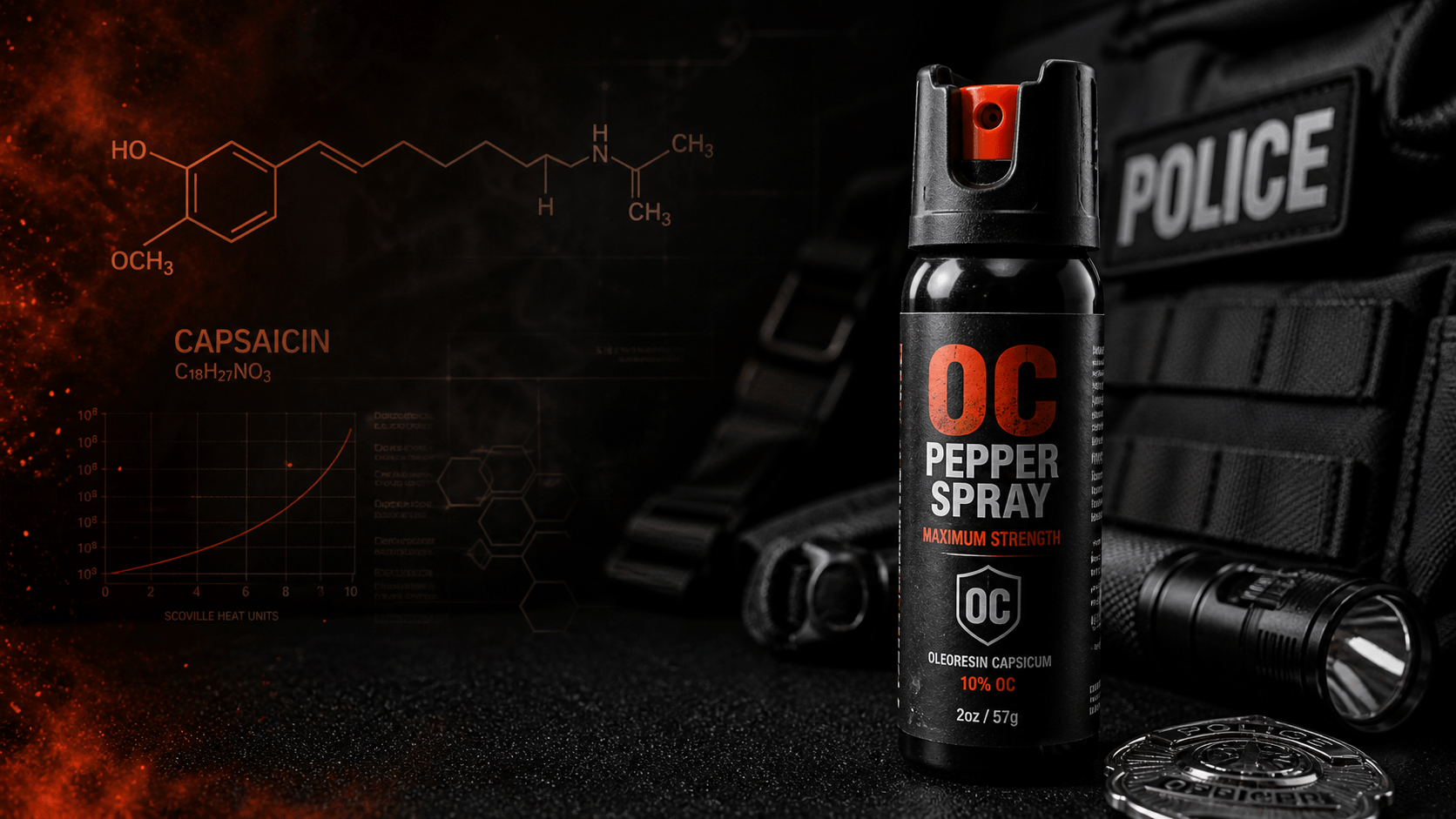
Major Capsaicinoids (MC): The active chemical compounds within oleoresin capsicum — primarily capsaicin and dihydrocapsaicin — that directly bind to pain receptors (TRPV1) and produce the incapacitating physiological response. MC concentration is the only standardized, verifiable measure of an OC formulation's true heat and effectiveness.
OC %: The Volume Metric That Misleads
A common pattern in consumer-grade products is to advertise high OC percentages — sometimes 10%, 15%, or even higher — while using inferior pepper extract with minimal active capsaicinoid content. The result is a product that looks powerful on the shelf and underperforms in the field. For LEOs, corrections officers, or security professionals who rely on OC as an intermediate use-of-force tool, that gap between label and performance is operationally unacceptable.
In practice, OC% functions more as a manufacturing variable than a quality indicator. The raw oleoresin capsicum used in production varies considerably in potency depending on pepper species, harvest conditions, and extraction methods. Without knowing the MC content of the oil itself, the percentage figure is effectively context-free.
Metric | What It Measures |
|---|---|
Volume of pepper oil in formula | Low — ignores oil quality |
SHU | Legacy heat estimate |
MC %: The Standard That Actually Matters
Major Capsaicinoid percentage is the metric that professional-grade manufacturers and federal procurement standards rely on. According to SABRE, most civilian-grade products deliver approximately 0.5% MC — enough to deter an aggressive dog or a non-committed attacker, but insufficient for reliable incapacitation in high-stress field encounters. Professional-grade OC sprays used by law enforcement, per Federal CRC Regulation Standards, typically contain between 1.3% and 2% Major Capsaicinoids — a threshold that ensures consistent physiological effect regardless of a subject's size or pain tolerance.
Scoville Heat Units (SHU): A legacy measurement of capsaicin concentration that has largely been replaced by MC% in professional standards. SHU values are inconsistent across testing methods and offer no reliable basis for cross-product comparison.
The practical delta between 0.5% MC and 1.3% MC is not a minor variance — it represents a meaningfully different physiological response in the field.
The MC Formula at a Glance
Metric | What It Measures | Professional Relevance |
|---|---|---|
OC % | Volume of pepper oil in formula | Low — ignores oil quality |
SHU | Legacy heat estimate | Unreliable — inconsistent testing |
MC % | Active capsaicinoid concentration | High — the professional standard |
Choosing a spray based on OC% alone is the equivalent of judging a round by its casing rather than its ballistic performance. For professionals who carry OC as part of an authorized use-of-force continuum, MC% is the only number that matters at the point of deployment.
Understanding what's in the canister is the foundation — but knowing how reliably that formulation performs against a resisting or chemically altered subject is the next critical question. The data on operational effectiveness tells a more complete story.
Operational Effectiveness: Incapacitation and Safety Data
The more operationally relevant question — beyond confirming that is OC and pepper spray the same thing at their chemical core — is whether the formulation actually performs when it matters. Field data provides a clear, evidence-backed answer. Peer-reviewed law enforcement research consistently documents OC incapacitation rates in the range of 85% to 94% against actively resisting subjects. That figure holds across a range of subject sizes, resistance levels, and environmental conditions — provided the formulation meets professional MC% thresholds. The remaining failure cases are not random. They cluster around specific variables: inadequate MC concentration, improper deployment technique, extreme environmental conditions, or subjects with a documented physiological resistance to capsaicinoid compounds. On the safety side, OC's profile is well-established. The inflammatory response it produces — involuntary eye closure, mucous membrane swelling, respiratory restriction — is temporary and self-limiting. Symptoms typically resolve within 30 to 45 minutes with fresh air and water decontamination. There is no documented evidence linking properly formulated OC to permanent injury when deployed according to manufacturer and agency guidelines. The compound does not cause lasting respiratory damage in healthy subjects, and the incapacitation mechanism is physiological rather than pain-dependent, which is why OC remains effective against subjects under the influence of alcohol or stimulants. That last point carries significant operational weight. A subject who can override pain signals — whether due to intoxication, adrenaline, or mental health crisis — cannot override the inflammatory response triggered by capsaicinoids binding to TRPV1 receptors. The eyes close. The airway restricts. The response is involuntary. Injury reduction data supports OC's place in the use-of-force continuum from both directions. Studies published in law enforcement literature indicate that OC deployment correlates with measurable reductions in officer injury rates and suspect injury rates compared to physical control techniques. When OC works as intended, the encounter ends before it escalates to hands-on force — which is the outcome every agency's use-of-force policy is designed to achieve.
The 90% Incapacitation Rate — And What It Actually Means
Research conducted by the Baltimore County Police Department and referenced by the National Institute of Justice found that OC spray successfully incapacitated subjects in 90% of field confrontations — 156 out of 174 documented cases. That is not a laboratory result. That is deployment data collected under real patrol conditions, against resisting subjects, by working LEOs.
Key Finding: A 90% field effectiveness rate positions OC as one of the most reliable less-lethal tools in an officer's use-of-force continuum — outperforming verbal commands and reducing the need for physical escalation.
That figure, however, does not tell the complete story. The remaining 10% of cases highlights a critical operational reality: OC spray is not universally effective against all subjects.
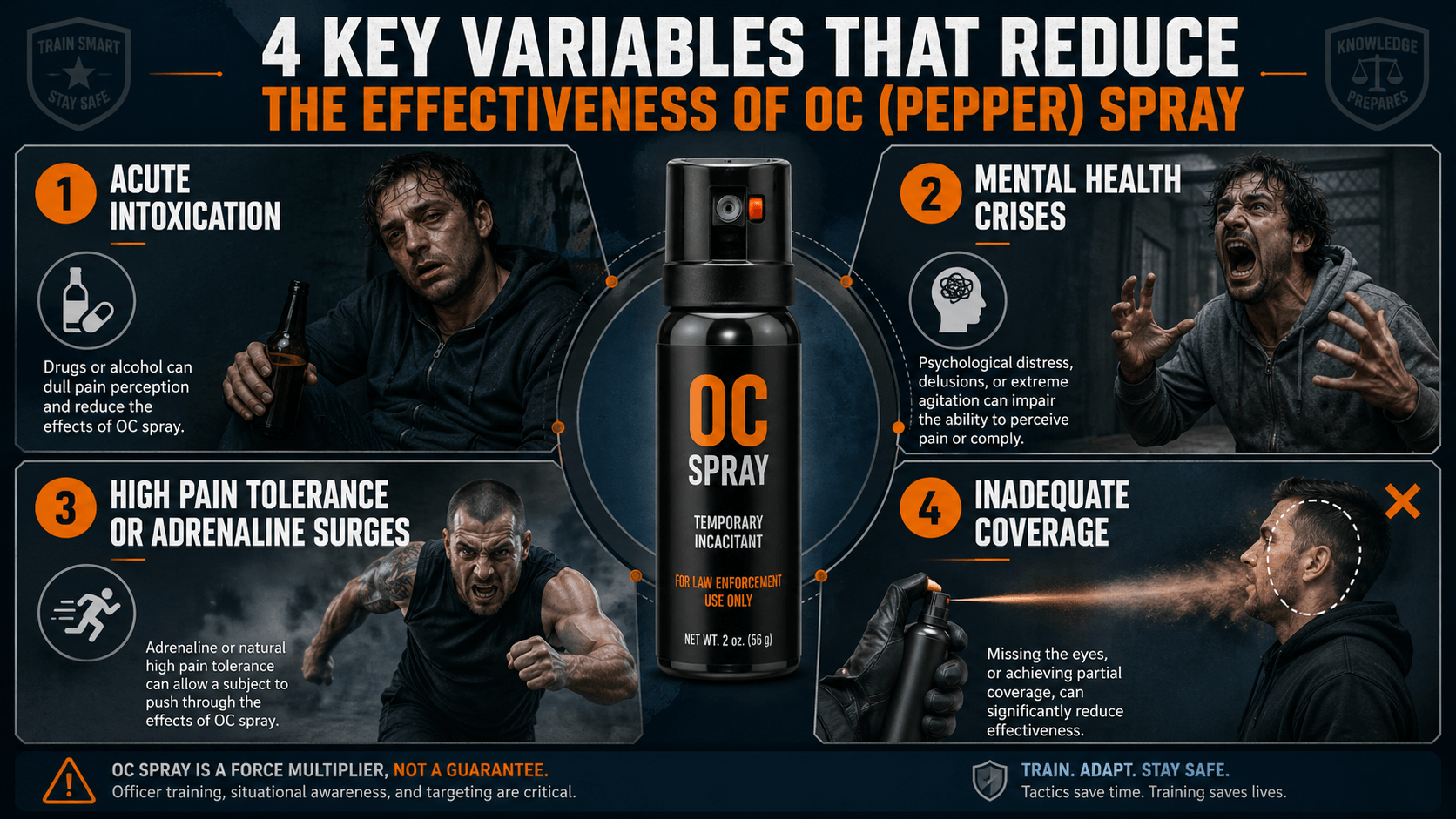
Variables That Reduce Effectiveness
Several documented factors can diminish OC's incapacitation effectiveness:
Acute intoxication: Subjects under the influence of alcohol, methamphetamine, or PCP often exhibit significantly reduced pain response, limiting the deterrent effect of capsaicinoids.
Mental health crises: Individuals experiencing psychotic episodes or extreme emotional disturbance may not respond to pain stimuli in predictable ways.
High pain tolerance or adrenaline surges: Subjects in a state of acute physiological arousal may continue to resist despite confirmed exposure.
Inadequate coverage: Partial facial exposure — particularly when the eyes and nasal passages are not directly contacted — reduces effectiveness considerably.
In practice, officers should treat OC as a primary less-lethal option within a layered force strategy, not as a guaranteed outcome. Situational awareness before deployment remains non-negotiable.
Addressing the Respiratory Risk Myth
One of the most persistent misconceptions surrounding OC deployment is the claim that exposure causes respiratory failure — particularly when combined with physical restraint. The research does not support that concern. According to a study conducted by the University of California–San Diego and cited by the National Institute of Justice:
"OC exposure and inhalation do not result in a significant risk for respiratory compromise or asphyxiation, even when combined with positional restraint."
Key Finding: OC-related respiratory effects — coughing, involuntary eye closure, mucous membrane irritation — are temporary and self-limiting in subjects without pre-existing severe pulmonary conditions.
This distinction matters operationally. Officers can deploy OC with confidence that proper application does not create a life-threatening respiratory event under standard conditions.
Injury Reduction: The Officer and Suspect Benefit
Beyond incapacitation, OC deployment consistently correlates with reduced injury rates for both officers and subjects. When effective, OC eliminates or shortens the duration of physical struggle, decreasing the probability of blunt-force injury, joint damage, and secondary use-of-force escalation. That outcome benefits the department, an officer, and a subject simultaneously.
The effectiveness profile of OC is established. The next operational variable — one that directly influences whether those effectiveness numbers hold in your specific environment — is how the agent is delivered. Stream, gel, and fogger formulations each carry distinct tactical implications worth understanding before your next qualification.
Tactical Delivery Systems: Stream, Gel, and Fogger Applications
Knowing that OC spray is chemically validated and operationally effective is foundational — but the delivery system determines whether that chemistry works for you or against you in the field. The wrong formulation in the wrong environment creates liability, limits effectiveness, and can incapacitate the wrong people. Matching the delivery system to the operational environment is a non-negotiable part of professional deployment.
Stream: Precision and Wind Resistance for Outdoor Engagements
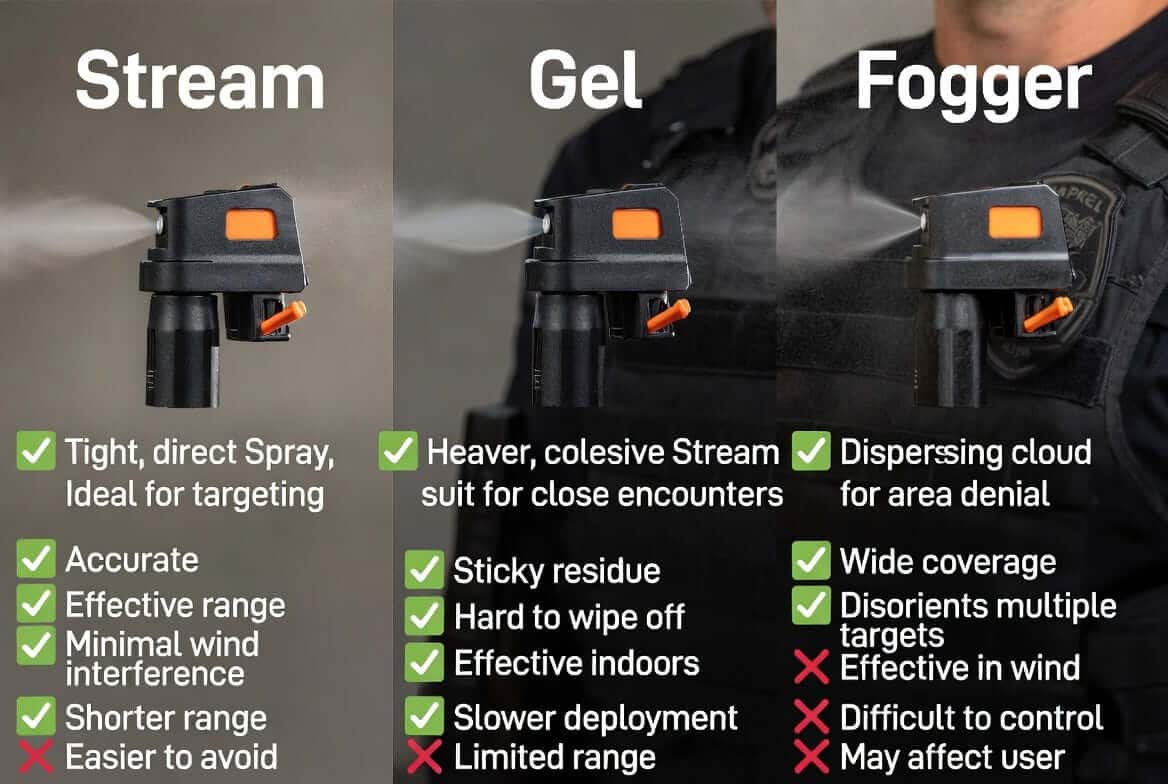
Stream delivery projects OC in a tight, coherent liquid column — offering the highest degree of target accuracy and the greatest resistance to wind interference. In outdoor settings, where ambient airflow is unpredictable, a stream pattern keeps the agent on target rather than dispersing it into the surrounding environment or back toward the operator.
For patrol officers conducting vehicle stops, perimeter control, or foot pursuits in open terrain, stream is the default choice. It allows for engagement from a greater standoff distance — typically 10 to 15 feet — which reduces physical contact risk and maintains positional advantage. The tradeoff is a narrower dispersion pattern, requiring more precise aim under stress. This is where dry-fire familiarity with your specific canister matters.
Gel: Controlled Deployment for Confined and Sensitive Environments
OC Gel: A viscous, adhesive formulation that attaches to a subject on contact, reducing airborne particulate and significantly limiting cross-contamination to bystanders or secondary personnel.
For LEOs working inside hospitals, courtrooms, detention facilities, or any enclosed structure with civilian populations, gel is the tactically responsible choice. It adheres directly to the face and does not aerosolize on impact, keeping the agent localized. Notably, OC gel is non-combustible and can be configured to suit tactical requirements where cross-contamination must be avoided — a critical factor in environments where supplemental oxygen or other accelerants may be present.
One practical consideration: gel can be wiped off by a subject and thrown back. Train accordingly. Control a subject's hands immediately following deployment.
Officers sometimes ask what color is OC spray in gel form — it typically ranges from amber to orange-brown, depending on the carrier and MC percentage, and is visually distinguishable from stream or fogger formulations on contact.
Fogger: Area Denial and Crowd Control
Fogger (or cone/mist) delivery disperses OC in a wide aerosol pattern, making it effective for area denial, cell extractions, and crowd control scenarios. The dispersion radius is broad, which reduces the need for precision targeting — an advantage when managing multiple subjects.
The primary risk is blowback. In any environment with wind or limited ventilation, the aerosol cloud moves unpredictably. Foggers are an indoor liability in most contexts and should be reserved for controlled outdoor scenarios or specialized entries by trained tactical teams.
Delivery System Comparison
The table below maps each operational environment to the appropriate delivery format—a quick-reference framework for matching professional grade pepper spray selection to the conditions you are working in. | Environment | Best Delivery | Why | |---|---|---| | Outdoor patrol / open terrain | Stream | Wind-resistant, precise, extended range | | Indoor / civilian-dense spaces | Gel | Minimal cross-contamination, non-combustible | | Cell extraction / crowd control | Fogger | Wide dispersion, area denial capability | | Courtroom / hospital | Gel | Localized effect, reduced bystander risk | | Vehicle interior | Stream or Gel | Prevents operator self-exposure from mist | No single delivery system covers every scenario. Professional grade pepper spray is available across all three formats from duty-rated manufacturers; the selection decision should be driven by your primary deployment environment, not by what happens to be in stock.
Canister Design: Flip-Top vs. Twist-Lock
The formulation inside the canister means nothing if the canister fails at the moment of deployment. Canister actuation design — specifically the safety mechanism — directly affects deployment speed under stress. Flip-top safeties allow single-handed, gross-motor activation and are generally preferred for duty carry. Twist-lock mechanisms require more deliberate manipulation and carry a higher risk of fumbling during an adrenaline-driven encounter.
Proper canister selection is inseparable from deployment training. The best OC formulation, in the wrong canister design for your carry position, creates a failure point under the exact conditions it's meant to address.
The operational choices covered here — formulation type, delivery system, and canister design — don't exist in isolation. They're subject to departmental policy, state statute, and the legal framework governing use-of-force decisions. The next section addresses exactly that.
Liability and Law: Navigating the Legal Landscape of OC
Delivery system selection, addressed in the previous section, is a tactical decision. Legal compliance is a mandatory one. Before you carry or deploy any OC formulation — whether you're an LEO, a security professional, or a tactical enthusiast — understanding the legal framework governing its use is non-negotiable.
General Legality and State-Specific Restrictions
OC spray is legal for civilian carry in all 50 states, but several states impose meaningful restrictions that require attention:
New York: Canister size is capped at 4 fl. oz.; purchasers must be 18+ and cannot have a felony or assault conviction on record.
Massachusetts: OC may only be purchased from a licensed firearms dealer; buyers must be 18+.
Michigan: Formula must be 2% or less MC (Major Capsaicinoids); canisters are capped at 35 grams.
California: Canisters are limited to 2.5 fl. oz.; use for anything beyond self-defense can trigger criminal liability.
Washington D.C.: Registration requirements apply; purchase from unlicensed sources is prohibited.
For professionals operating across jurisdictions — armed security contractors, transport officers, or federal agents — confirming local statutes before deployment is standard operating procedure.
OC in the Use-of-Force Continuum
Use-of-Force Continuum: A policy framework that defines escalating levels of force available to law enforcement, from verbal commands through lethal response, with OC spray typically positioned as an intermediate-force option.
For LEOs, whether is OC spray pepper spray is simply a nomenclature question — operationally, both refer to the same tool positioned between verbal control and physical force. OC provides a distance-based, intermediate-force option that allows officers to achieve compliance without closing the gap to hand-to-hand engagement. Research published via the NIH confirms that introducing OC spray into use-of-force protocols decreases the odds of suspect injury by approximately 70% and reduces use-of-force complaints by 53%. Those numbers carry real weight in post-incident review.
Professional-Grade Equipment and Civil Liability
Deploying professionally validated, specification-compliant OC formulations is one of the most defensible choices an operator can make. In civil litigation, documented SHU ratings, verified MC percentages, and agency-approved formulations demonstrate that an officer or security professional used a calibrated, recognized tool — not an unvetted product. Consistent performance data supports the narrative of proportional, trained response.
De-escalation is the operational benefit that often goes underdiscussed. Because OC creates a compliance window without requiring physical contact, it reduces injury risk on both sides of an encounter — a factor that attorneys, review boards, and department oversight bodies increasingly weigh in their assessments.
Selecting the right OC formulation from a reputable manufacturer is where legal defensibility and operational performance converge. The next section covers exactly that — the top-tier brands professionals trust and the specifications that justify that trust.
The Professional's Toolkit: Top-Tier OC Brands and Selection Criteria
Navigating legal requirements and delivery systems narrows your options considerably — but the final decision comes down to the manufacturer. Not every canister on the market meets the threshold for professional grade pepper spray. The brands below have earned their place on duty belts and in EDC kits through verified MC concentrations, consistent batch quality, and real-world operational performance.
Defense Technology - The Proven Choice for Law Enforcement
When it comes to OC sprays, Defense Technology's First Defense line stands in a class of its own as the trusted choice for law enforcement professionals across the country. Three out of four police departments choose First Defense OC Aerosols — not only for their proven effectiveness, but because they are the only such products backed by a comprehensive effectiveness study, and the only products that address the ever-growing concerns over health and environmental risks. Hundreds of professional agencies trust Defense Technology because of their commitment to product integrity, ensuring their pepper spray products are always on the cutting edge. First Defense OC is water-soluble and processed to remove natural oils, waxes, and fats, yielding a formulation that is clear in color and consistent in potency — and at 500,000 SHU, it is the hottest water-soluble OC available. Defense Technology offers a complete line of aerosol projectors for duty issue or specialized assignment, including OC, chemical, or blended formulations in stream, fog, or foam delivery systems — giving officers the versatility they need for any situation. From the patrol belt to crowd control operations, Defense Technology has built an unmatched reputation for reliability, safety, and performance that law enforcement agencies worldwide continue to depend on.
Best For: High-risk law enforcement and security professionals who require maximum MC concentration and consistent stopping power.
Mace Security International: EDC-Optimized Performance
When it comes to everyday carry personal protection, Mace Security International stands as the proven choice for OC sprays. With decades of industry experience dating back to the invention of the original Mace formula, the brand has built a legacy of reliability that serious EDC practitioners trust with their lives. Their pepper sprays are formulated with a potent blend of OC that delivers fast-acting stopping power, backed by rigorous quality control that ensures consistent performance when it matters most. From compact keychain models for discreet daily carry to stream and gel formulas for maximum range and accuracy, Mace offers a lineup engineered for real-world self-defense. When professionals and everyday carriers alike keep reaching for the same brand generation after generation, that's not marketing — that's a proven track record.
Best For: Plain-clothes officers, off-duty carry, and professionals requiring a discreet, everyday-carry OC option.
SABRE: The Agency Standard
SABRE supplies law enforcement agencies across more than 40 countries, and that operational footprint is not accidental. SABRE's internal High Performance Liquid Chromatography (HPLC) testing validates MC concentration on every production batch — a quality control standard most manufacturers do not maintain. For departments standardizing issue equipment, SABRE's supply chain reliability and documented testing protocol make it a defensible procurement choice.
Best For: Agency-wide issue, patrol officers, and departments requiring documented QC standards for liability purposes.
ASP: Engineering-First Approach
ASP approaches OC from a systems integration perspective. Their canisters are engineered to complement ASP's broader less-lethal platform, including baton and spray integrated carry solutions that reduce transition time in a force continuum scenario. Regarding the question of what color is OC spray, ASP formulations exhibit the characteristic orange-to-amber hue of high-quality oleoresin capsicum resin; this coloration is a visual indicator of concentrated capsicum oil content rather than a defect. Build quality is consistent across the line, and the ergonomics reflect input from working professionals. For officers who carry ASP impact tools, the integrated system reduces training complexity and equipment inconsistency across the duty belt.
Conclusion: Prioritizing Reliability Over Marketing
OC spray effectiveness is not determined by the boldest label claim or the highest Scoville number printed on a canister — it is determined by one metric: Major Capsaicinoids (MC) percentage. Everything else is marketing noise. As covered throughout this guide, MC percentage is the only standardized, verifiable measure of a formulation's active inflammatory compounds. If a manufacturer cannot provide a third-party verified MC percentage, that product does not belong on a duty belt.
The operational case for getting this right extends beyond an officer. Properly formulated OC, matched to the correct delivery system and deployed with trained technique, reduces injury risk for both a subject and an officer. That is not an incidental benefit — it is a core argument for investing in duty-grade gear rather than cutting corners on a less-lethal tool you may carry for years without deploying.
Final Checklist Before You Carry
Verify MC percentage first. A minimum of 1.0% MC from a verified, third-party tested formulation is the professional standard. Reject any product that leads with SHU claims instead.
Match the delivery system to your environment. Cone patterns for open-field patrol, stream patterns for indoor or windy conditions, and gel formulations where cross-contamination is a liability concern — the right delivery system matters as much as the formulation.
Source from manufacturers with documented LEO track records. Duty-grade OC comes from brands that supply law enforcement agencies, maintain consistent formulations, and publish verifiable specifications.
The standard you carry reflects the standard you adhere to. Invest in OC from a trusted, duty-grade manufacturer — one that treats MC percentage as a non-negotiable baseline, not a selling point. Explore our selection of professional-grade OC sprays and less-lethal tools built for the demands of real-world operations.
Oleoresin Capsicum (OC) is a non-lethal inflammatory agent that causes immediate expansion of the capillaries and swelling of the mucous membranes.
Source: City of West St. Paul Police / NIJ
OC gel is non-combustible and can be configured to suit tactical requirements where cross-contamination must be avoided.
Source: DEFENDTEX
OC exposure and inhalation do not result in a significant risk for respiratory compromise or asphyxiation, even when combined with positional restraint.
Source: University of California–San Diego / NIJ
OC spray successfully incapacitated subjects in 90% of confrontations (156 out of 174 cases) in studies conducted by the Baltimore County Police Department.
Source: National Institute of Justice (NIJ)
Professional-grade OC sprays used by law enforcement typically contain between 1.3% and 2% Major Capsaicinoids (MC).
Source: SABRE / Federal CRC Regulation Standards
Oleoresin Capsicum (OC) is a non-lethal inflammatory agent that causes immediate expansion of the capillaries and swelling of the mucous membranes.
Source: City of West St. Paul Police / NIJ
FAQs
What is the difference between OC spray and pepper spray?
OC spray and pepper spray are essentially the same thing—both use oleoresin capsicum (OC), a natural extract from chili peppers, as the active ingredient. “Pepper spray” is the common retail term, while “OC spray” is the professional or law enforcement designation.
The key differences come down to formulation, concentration, and delivery systems rather than the base ingredient. Professional-grade OC sprays often specify Major Capsaicinoid (MC%) levels, which directly measure heat effectiveness. Understanding this distinction helps buyers compare products more accurately when shopping for tactical or self-defense use.
What are major capsaicinoids and why do they matter in OC spray?
Major capsaicinoids (MC%) are the compounds in OC spray responsible for its burning and inflammatory effects. They are the most accurate indicator of a spray’s real-world effectiveness.
While Scoville Heat Units (SHU) measure raw pepper heat, MC% reflects the actual potency delivered to a target. For example, a spray with 1.33% MC is generally more reliable than one with high SHU but lower MC%. Professionals prioritize MC% because it directly correlates to incapacitation performance under stress.
Is higher SHU or higher MC% more important when choosing pepper spray?
Higher MC% is more important than SHU when choosing pepper spray. MC% measures the active ingredients that cause incapacitation, while SHU measures overall pepper heat.
Many retail products advertise high SHU numbers, but that can be misleading without strong MC levels. Law enforcement-grade sprays typically focus on MC% (often between 1–2%) because it provides consistent results. When comparing products, prioritize MC% for reliability rather than marketing-heavy SHU claims.
Which is better for self-defense: OC spray or pepper spray?
There is no functional difference—OC spray and pepper spray are the same, so neither is inherently “better.” The effectiveness depends on formulation quality and delivery method.
For self-defense, look for a spray with a proven MC% range, a reliable spray pattern (stream, cone, or gel), and a trusted brand. For example, shoppers browsing tactical options can explore curated selections like pepper spray and personal defense tools to find products designed for real-world reliability.
What spray pattern is best for tactical reliability—stream, cone, or gel?
A stream pattern is generally best for tactical reliability because it offers greater range and reduces blowback. Cone sprays cover a wider area but are more affected by wind, while gel sticks to the target and minimizes cross-contamination.
Professionals often choose stream or gel for controlled deployment in unpredictable environments. Each pattern has trade-offs, so your choice should match your environment—urban, indoor, or outdoor use.
How long does OC spray typically last once deployed?
The effects of OC spray typically last 20 to 45 minutes, depending on the concentration and the individual exposed. Immediate symptoms include intense eye closure, burning skin, and difficulty breathing.
Although the effects are temporary, they are designed to incapacitate long enough for escape or restraint. High-quality OC sprays with verified MC% levels provide more consistent duration and intensity, which is critical for both civilians and professionals.
Is pepper spray legal to carry in California?
Pepper spray is legal to carry in California for self-defense, but there are restrictions. Civilian sprays must generally be 2.5 ounces or less and cannot be used for offensive purposes.
Buyers should always verify local regulations before purchasing. Retailers like LA Police Gear offer compliant options designed specifically for California users, ensuring you stay within legal limits while maintaining effective protection.
What should I look for when buying professional-grade OC spray?
When buying professional-grade OC spray, focus on MC%, spray pattern, range, and brand reliability. These factors determine real-world performance far more than marketing claims.
Look for sprays with clearly labeled MC% (typically 1–2%), a dependable actuator, and safety features to prevent accidental discharge. Exploring trusted gear providers like LA Police Gear’s duty and tactical equipment can help ensure you’re selecting products used by professionals.
Does OC spray work on everyone?
OC spray is effective on the vast majority of individuals, but no chemical agent is 100% guaranteed. Factors like intoxication, pain tolerance, or mental state can reduce responsiveness.
However, properly formulated OC sprays with strong MC% levels still cause involuntary eye closure and inflammation in most cases. This is why law enforcement agencies continue to rely on OC as a primary less-lethal option.
How should I store and maintain pepper spray for reliability?
Pepper spray should be stored at room temperature and checked regularly for expiration dates and pressure integrity. Extreme heat or cold can reduce effectiveness.
Most sprays have a shelf life of 3–5 years. Periodic inspection and replacement ensure consistent performance. For everyday carry users, pairing spray with accessible gear setups—like those found in tactical everyday carry collections—can improve readiness and response time.