Listen to this article
Table of Contents
What Is MOA? Precision Shooting Math Explained
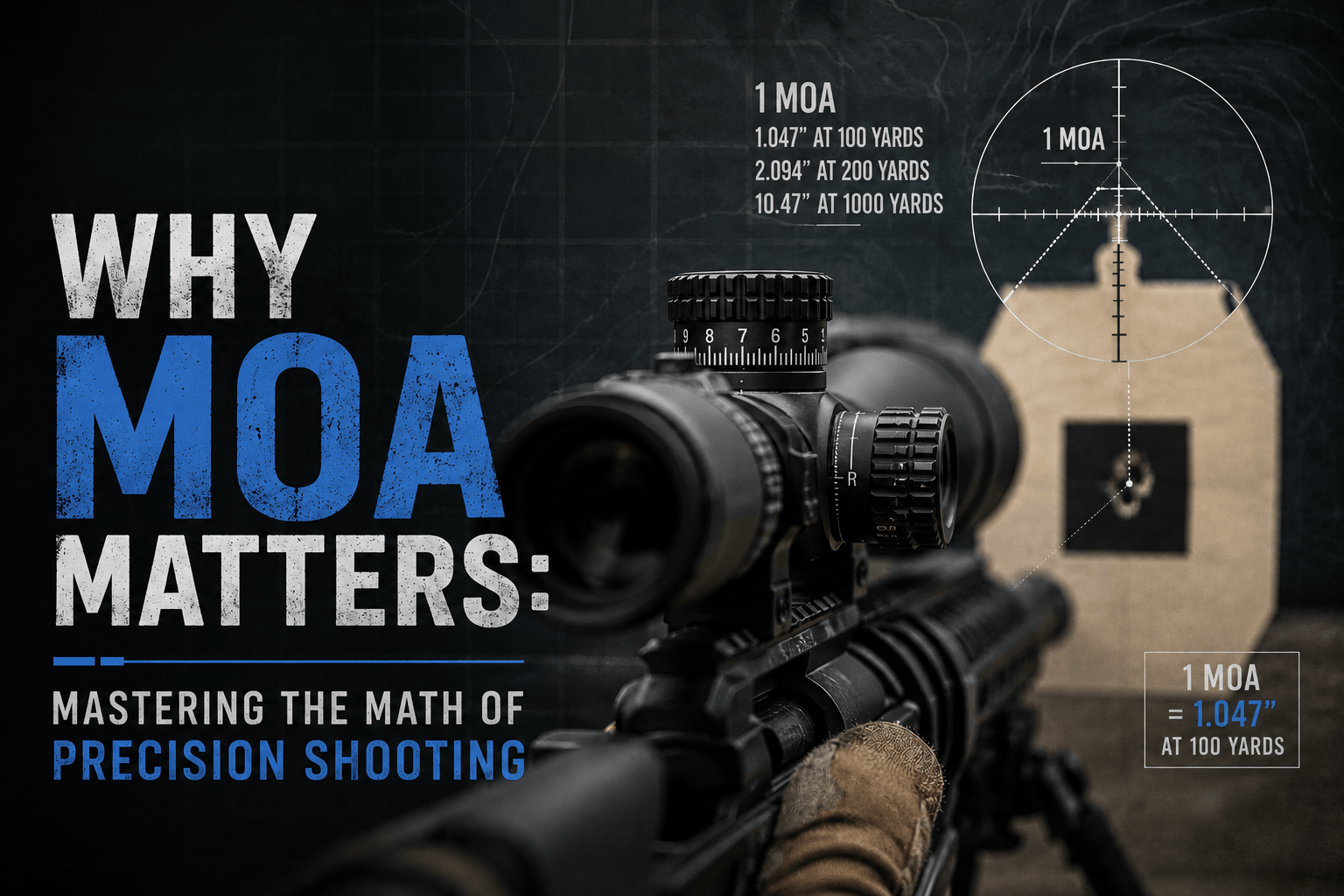
MOA, short for minute of angle, is one of the most important measurements in precision shooting. It tells you how group size, scope adjustments, and point-of-impact corrections scale as distance increases. If you zero rifles, confirm optic tracking, or make elevation and windage calls, understanding MOA helps turn guesswork into repeatable math.
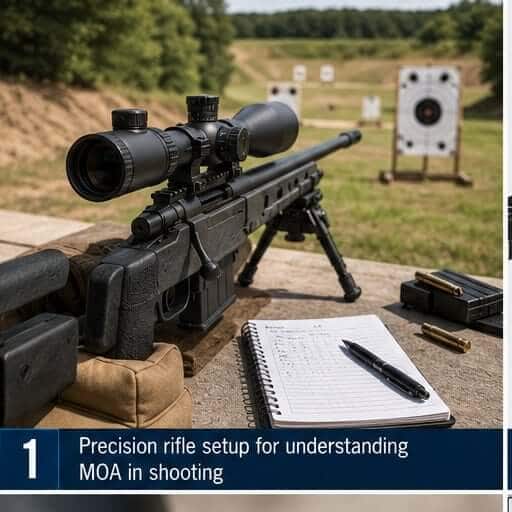
TL;DR: MOA in Shooting
- MOA means minute of angle. It is an angular measurement, not a fixed inch measurement.
- 1 MOA equals 1/60th of one degree. That works out to about 1.047 inches at 100 yards.
- Most shooters round 1 MOA to 1 inch at 100 yards for faster field math.
- MOA scales with distance. One MOA is about 3.141 inches at 300 yards and 5.235 inches at 500 yards.
- Many rifle scopes use 1/4 MOA clicks. Four clicks usually equal 1 MOA of adjustment.
For range work, duty rifle training, and precision practice, MOA is the shared language between the shooter, rifle, optic, target, and ballistic data. It also makes equipment choices easier. A dependable optic, stable mount, consistent ammunition, and practical range kit all matter when you are trying to confirm a true zero.
What Does MOA Mean in Shooting?
MOA stands for minute of angle. It is an angular unit equal to 1/60th of one degree. The National Shooting Sports Foundation explains that 1 MOA spreads about 1 inch per 100 yards, with the more precise value being 1.047 inches at 100 yards. NSSF: Minute of Angle
The key point is that MOA is angular, not linear. It does not describe one fixed distance on a target. Instead, it describes an angle that grows wider as the range increases.
Picture a narrow cone extending from the muzzle to the target. The angle of the cone stays the same, but the circle it covers gets larger as distance increases. At 100 yards, 1 MOA is just over 1 inch. At 500 yards, the same 1 MOA angle is just over 5 inches.
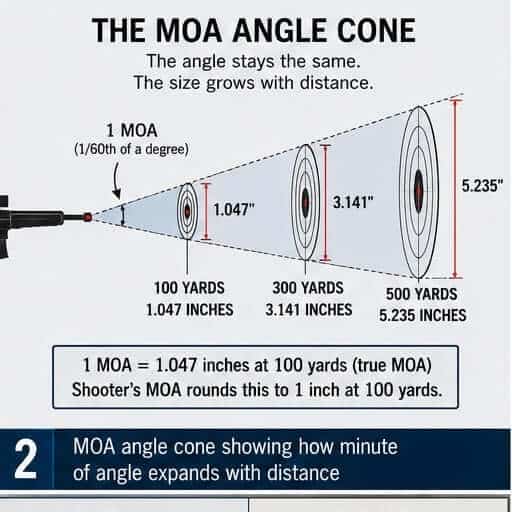
Why MOA Matters for Accuracy
MOA helps shooters describe three important things:
- Group size: How tightly a rifle, ammunition, and shooter can place shots at a known distance.
- Scope adjustment: How much elevation or windage a turret click moves the point of impact.
- Holdovers and corrections: How much to compensate for bullet drop, wind, or observed impact shift.
When someone says a rifle is “1 MOA accurate,” they usually mean the rifle system is capable of producing about a 1-inch group at 100 yards under suitable conditions. That result depends on the rifle, ammunition, optic, rest, environment, and shooter skill.
MOA to Inches: The 1.047 Rule
The precise conversion is simple:
1 MOA = approximately 1.047 inches at 100 yards.
That number comes from geometry. A circle has 360 degrees. Each degree has 60 minutes of angle, giving a full circle 21,600 minutes. A very small slice of that circle at a 100-yard radius equals about 1.047 inches. For angle-unit reference, NIST lists degree, minute, and second as accepted units used with SI in specific contexts. NIST: Conversion Factors for Angle
For practical shooting, many people use shooter’s MOA, which rounds 1.047 inches down to 1 inch at 100 yards. That makes mental math faster on the range.
Field Note: True MOA vs. Shooter’s MOA
True MOA uses 1.047 inches at 100 yards. Shooter’s MOA rounds that to 1 inch at 100 yards.
At 100 yards, the difference is small. At 1,000 yards, the rounding difference grows to about 4.7 inches. Use true MOA for careful zeroing and data confirmation. Use rounded MOA when fast field math matters more than decimal precision.
[IMAGE: moa-target-group-measurement.jpg — Close-up of target groups with measured 1-inch and 1.047-inch reference marks — MOA target group measurement showing 1 MOA at 100 yards]
MOA Size by Distance
Because MOA is angular, it scales in a predictable way. Use this formula:
(Distance in yards ÷ 100) × 1.047 = 1 MOA size in inches
For field math, you can use this simplified version:
Distance in hundreds of yards = approximate MOA inches
| Distance | True 1 MOA Size | Rounded Field Estimate | Practical Example |
|---|---|---|---|
| 100 yards | 1.047 inches | About 1 inch | Basic zero confirmation |
| 200 yards | 2.094 inches | About 2 inches | Intermediate rifle practice |
| 300 yards | 3.141 inches | About 3 inches | Common carbine and rifle training distance |
| 500 yards | 5.235 inches | About 5 inches | Precision rifle steel or known-distance work |
| 1,000 yards | 10.47 inches | About 10 inches | Long-range data confirmation |
A rifle that groups 5 inches at 500 yards is roughly a 1 MOA rifle at that distance. That does not mean it suddenly became less accurate. It means the same angle covers a larger target area as range increases.
How 1/4 MOA Scope Clicks Work
Many rifle scopes adjust in 1/4 MOA clicks. That means each click moves the point of impact by one quarter of one MOA.
At 100 yards, one 1/4 MOA click moves impact by about 0.261 inches using true MOA. Shooters commonly round that to 1/4 inch per click at 100 yards.
Vortex documentation notes that MOA-based rifle scopes may display turret markings such as “1 Click = 1/4 MOA,” while MRAD scopes may use “1 Click = .1 mrad.” Vortex Viper PST manual via EuroOptic
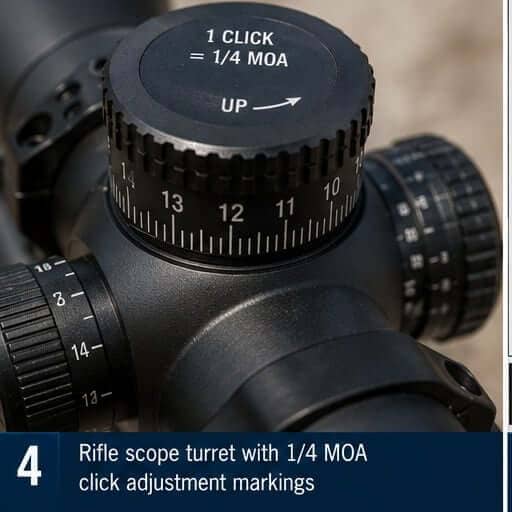
The 4-Click Rule
For a scope with 1/4 MOA adjustments:
- 4 clicks = 1 MOA
- At 100 yards: 4 clicks moves impact about 1 inch
- At 200 yards: 4 clicks moves impact about 2 inches
- At 300 yards: 4 clicks moves impact about 3 inches
- At 500 yards: 4 clicks moves impact about 5 inches
Always confirm the actual click value printed on your turret or listed in your optic manual. Not every scope uses 1/4 MOA clicks. Some use 1/2 MOA, 1/8 MOA, or MRAD adjustments.
Why Tracking Matters
Tracking is a scope’s ability to move the reticle or point of impact the expected amount with each adjustment and then return to zero. If a scope does not track consistently, the math may be correct but the impact may still be wrong.
For duty, competition, and precision training use, confirm tracking on paper before trusting a new optic. A box test or tall-target test can show whether turret adjustments match the stated MOA value.
Consistent range work also depends on stable gear. A supportive pack, weather-appropriate clothing, and footwear that holds up on uneven terrain help reduce distractions while zeroing and training.
MOA vs MRAD: Which System Should You Use?
MOA and MRAD are both angular measurement systems used for rifle optics, reticles, and ballistic corrections. Neither system is automatically better. The better choice is the one your optic, data, training environment, and team can use consistently.
MOA is common among shooters who think in yards and inches. MRAD, also called mil, is common among shooters who think in meters and centimeters. The same Vortex documentation explains that both MOA and MRAD are effective for ranging and bullet-trajectory compensation in reticle systems. Vortex Viper PST manual via EuroOptic
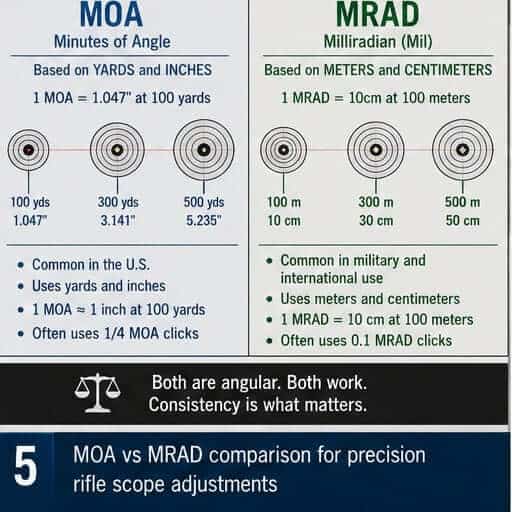
Use MOA If:
- Your range distances are usually measured in yards.
- Your corrections are usually discussed in inches.
- Your optic and ballistic data are already MOA-based.
- Your team or training group already communicates in MOA.
Use MRAD If:
- Your range distances are usually measured in meters.
- Your corrections are usually discussed in metric units.
- Your optic and reticle are MRAD-based.
- Your team or training group already communicates in mils.
The most important rule is consistency. Avoid mixing an MOA turret with an MRAD reticle unless you have a specific reason and know how to manage the conversion. Mixed systems slow down communication and increase the chance of correction errors.
Glossary: Key MOA Terms
- MOA
- MOA means minute of angle. It is an angular measurement equal to 1/60th of one degree.
- Minute of Angle
- A minute of angle is a small angular unit used to describe shot dispersion, target size, reticle subtension, and scope adjustment.
- True MOA
- True MOA uses the precise value of about 1.047 inches at 100 yards.
- Shooter’s MOA
- Shooter’s MOA rounds 1 MOA to 1 inch at 100 yards for faster mental math.
- Sub-MOA
- Sub-MOA describes a rifle system that can group shots inside 1 MOA under the tested conditions. At 100 yards, that means a group smaller than about 1 inch.
- 1/4 MOA Click
- A 1/4 MOA click is a scope adjustment that moves point of impact by one quarter of one MOA per click.
- Point of Impact
- Point of impact is where the bullet actually strikes the target.
- Point of Aim
- Point of aim is where the sights or reticle are aimed when the shot breaks.
- Tracking
- Tracking is a scope’s ability to move the expected amount per click and return reliably to zero.
- MRAD
- MRAD means milliradian. It is another angular measurement system used for rifle scopes, reticles, and ballistic corrections.
Common MOA Mistakes to Avoid
- Treating MOA like a fixed inch measurement. MOA changes size as distance changes.
- Forgetting the distance factor. One MOA at 300 yards is about 3 inches, not 1 inch.
- Using the wrong click value. Always verify whether your scope uses 1/4 MOA, 1/2 MOA, 1/8 MOA, or MRAD clicks.
- Mixing turret and reticle systems. MOA turrets and MRAD reticles can work, but they require conversion and can slow down corrections.
- Blaming the rifle before checking fundamentals. Group size depends on rifle, ammunition, optic, rest, wind, shooter input, and target distance.
Build a Range Kit That Supports Precision
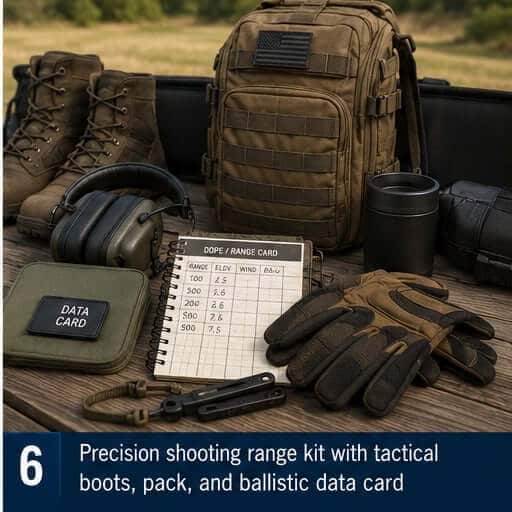
MOA knowledge helps you make better corrections, but your equipment still has to support repeatable shooting. A stable rifle, properly mounted optic, quality ammunition, and verified zero are the foundation. Your supporting gear matters too.
For structured range days, consider building a kit around:
- Weather-appropriate tactical apparel that allows stable prone, kneeling, and supported positions.
- Supportive tactical boots for uneven terrain, outdoor ranges, and training days with movement.
- A durable range bag or pack for data cards, tools, batteries, ear protection, eye protection, magazines, and cleaning gear.
- Training gear for position work, conditioning, and range preparation.
- Duty gear that matches how the rifle or carbine is actually carried and deployed.
The goal is simple. Reduce variables, confirm your data, and make every adjustment repeatable.
Final Takeaway
MOA matters because it gives shooters a repeatable way to measure accuracy and make corrections at distance. Once you understand that MOA is angular, the rest of the math becomes easier. One MOA is about 1 inch at 100 yards, 3 inches at 300 yards, and 5 inches at 500 yards. With a verified zero, consistent optic tracking, and dependable range gear, MOA becomes a practical tool for better hits, cleaner data, and more confident shooting.
FAQs
What does MOA mean in shooting?
MOA means minute of angle. It is an angular measurement used to describe rifle accuracy, group size, scope adjustments, and reticle holds.
How many inches is 1 MOA at 100 yards?
One MOA equals about 1.047 inches at 100 yards. Shooters often round that to 1 inch at 100 yards for quick field math.
What is 1 MOA at 300 yards?
One MOA at 300 yards equals about 3.141 inches. For fast range math, shooters usually round that to about 3 inches.
How many clicks is 1 MOA?
On a scope with 1/4 MOA adjustments, 1 MOA equals 4 clicks. Always check your turret markings because some scopes use different click values.
Is MOA better than MRAD?
MOA is not automatically better than MRAD. MOA is often easier for shooters who work in yards and inches. MRAD is often easier for shooters who work in meters and centimeters. Consistency matters more than the system itself.
What does sub-MOA mean?
Sub-MOA means a rifle system can produce groups smaller than 1 MOA under the tested conditions. At 100 yards, that means a group smaller than about 1 inch.