Listen to this article
Table of Contents
- What is a Taser? Understanding its Use in Self-Defense
- Demystifying the Taser: Technology, Functionality, and Key Distinctions
- The Taser as a Self-Defense Tool: When and How to Use It Effectively
- Legal Landscape: Owning and Using a Taser as a Civilian
- Training and Responsible Ownership: Mastering Your Taser for Personal Safety
- What Happens After Deployment? Post-Use Considerations for Civilians
- Beyond the Taser: A Holistic Approach to Self-Defense
- Conclusion
- FAQs
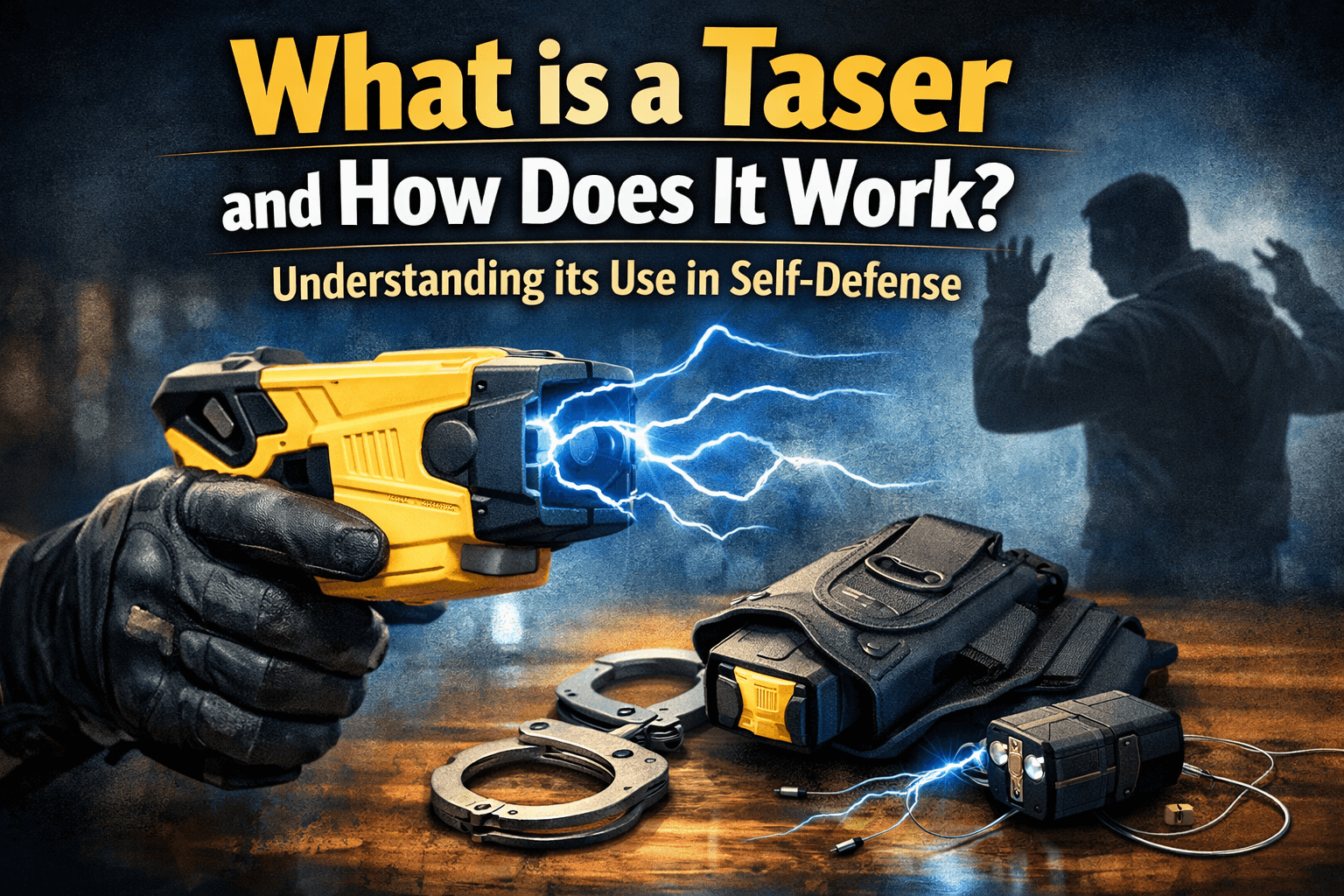
What is a Taser? Understanding its Use in Self-Defense
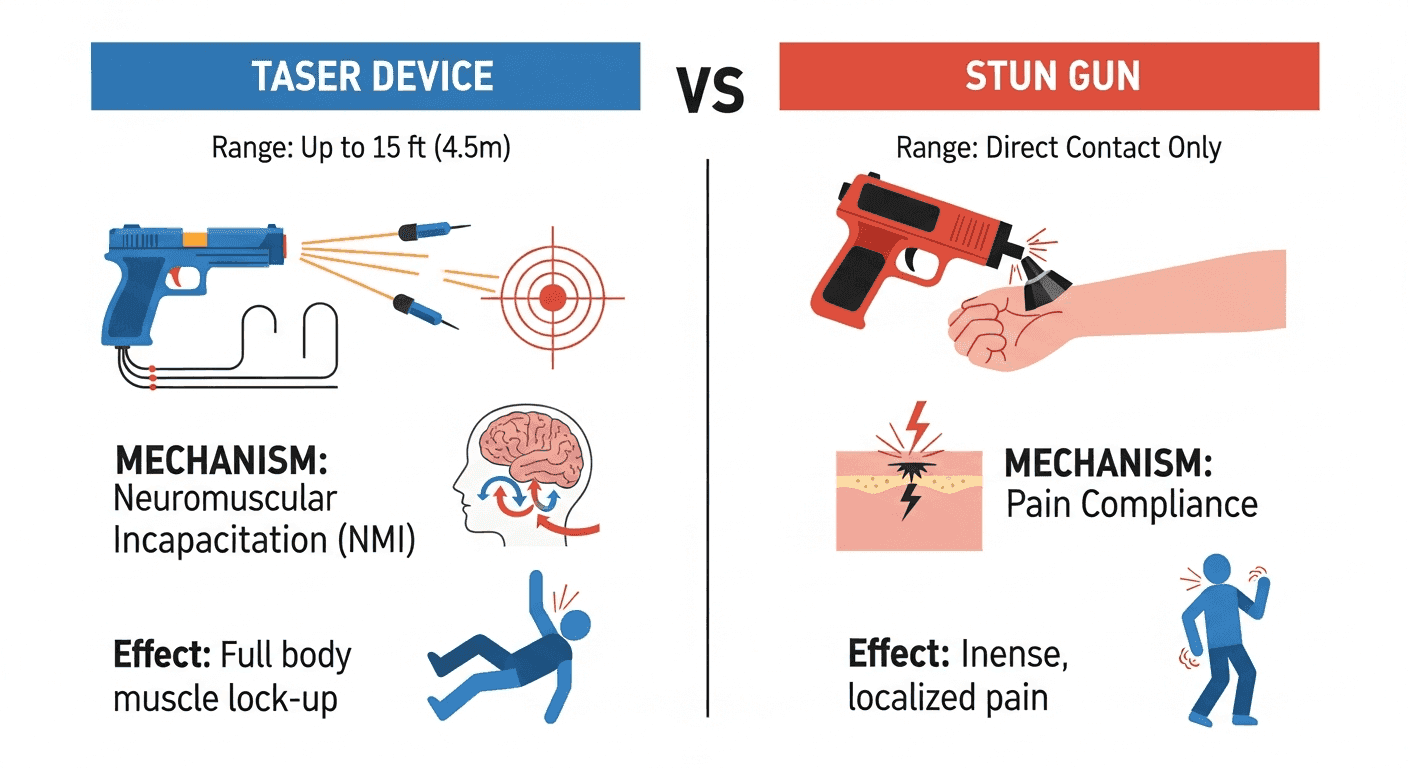
Key differences between a TASER device, which incapacitates from a distance, and a stun gun, which relies on direct-contact pain compliance.
In an increasingly unpredictable world, the desire for personal safety has never been more paramount. While awareness, de-escalation, and physical techniques form the bedrock of self-defense, the advent of non-lethal tools offers individuals additional layers of security. Among these, the TASER device has garnered significant attention, often sparking debate and curiosity. This article aims to demystify the Taser, moving beyond common misconceptions to explore its technology, its distinctions from other less-lethal options, and crucially, its potential and responsible use for civilian self-defense. We will delve into the technology behind neuromuscular incapacitation, differentiate it from stun guns, examine civilian-friendly models, and navigate the legal and practical considerations for those seeking to empower their personal safety.The Growing Need for Personal Safety
The modern landscape presents a complex tapestry of security concerns. From the mundane anxieties of walking alone at night to more serious threats of home invasion or personal assault, individuals are increasingly seeking effective ways to protect themselves and their loved ones. Statistics on crime rates, coupled with media coverage of security incidents, contribute to a heightened sense of vulnerability. This is not about living in constant fear, but rather about proactive empowerment. Understanding potential threats and equipping oneself with knowledge and appropriate tools can significantly bolster confidence and preparedness, allowing individuals to navigate daily life with greater peace of mind.
Why Consider a Taser for Self-Defense?
Traditional self-defense often relies on physical prowess or the ability to escape. However, these methods may not always be feasible or sufficient, particularly against a determined or physically superior attacker. This is where non-lethal options, such as the TASER device, come into play. Designed to incapacitate temporarily without causing permanent injury, a TASER offers a critical advantage: it can create distance and an opportunity to escape, potentially averting a physical confrontation altogether. For civilians, a TASER can represent a more accessible and often legally permissible alternative to firearms, providing a valuable tool for personal protection when faced with imminent danger.
Article Overview: Your Guide to Taser Use for Civilians
This article serves as a comprehensive guide for civilians interested in understanding and potentially utilizing a TASER device for self-defense. We will begin by dissecting the technology and core principles behind TASER energy weapons, clarifying their operational mechanisms. Subsequently, we will explore specific TASER models suitable for civilian use, highlighting their features. The heart of our discussion will focus on the practical aspects of Taser use in self-defense scenarios, including decision-making, deployment techniques, and the psychological preparation required. We will then address the crucial legal landscape surrounding civilian ownership and use, emphasizing responsible practice and the vital role of training. Finally, we will consider the aftermath of Taser deployment and how this tool fits into a broader strategy for personal security.
Demystifying the Taser: Technology, Functionality, and Key Distinctions
To effectively consider a TASER for self-defense, a clear understanding of its technology is essential. This involves knowing what distinguishes it from similar-looking devices and grasping the scientific principles that enable its incapacitating effect.
What is a TASER® Device? Beyond the Common Misconception
The term "Taser" has become almost synonymous with conducted electrical weapons. However, it is crucial to understand that TASER is a registered trademark of Axon Enterprise, Inc. Axon produces a line of conducted electrical weapons that are distinct from generic stun guns. A genuine TASER device typically employs a sophisticated delivery system that propels probes containing insulated copper wire over a distance, creating an electrical circuit with the target. This distinguishes it from many direct-contact stun guns. The primary goal of a TASER is to achieve neuromuscular incapacitation, a temporary loss of muscle control.
How TASER Energy Weapons Work: Understanding Neuromuscular Incapacitation
The core principle behind a TASER device's effectiveness is neuromuscular incapacitation (NMI). When a TASER is deployed, it fires two small probes connected by insulated copper wire to the Taser device. These probes are designed to penetrate clothing and skin. Upon impact, the TASER delivers a series of high-voltage, low-amperage electrical pulses. These pulses override the body's own electrical signals that control muscles. The brain sends signals to muscles to contract; the TASER essentially floods the nervous system with its own signals, causing involuntary, chaotic muscle contractions. This results in a temporary loss of voluntary muscle control, often causing the subject to fall to the ground and be unable to move or resist for the duration of the cycle, typically five seconds. The use of compressed nitrogen is integral to propelling these probes accurately.
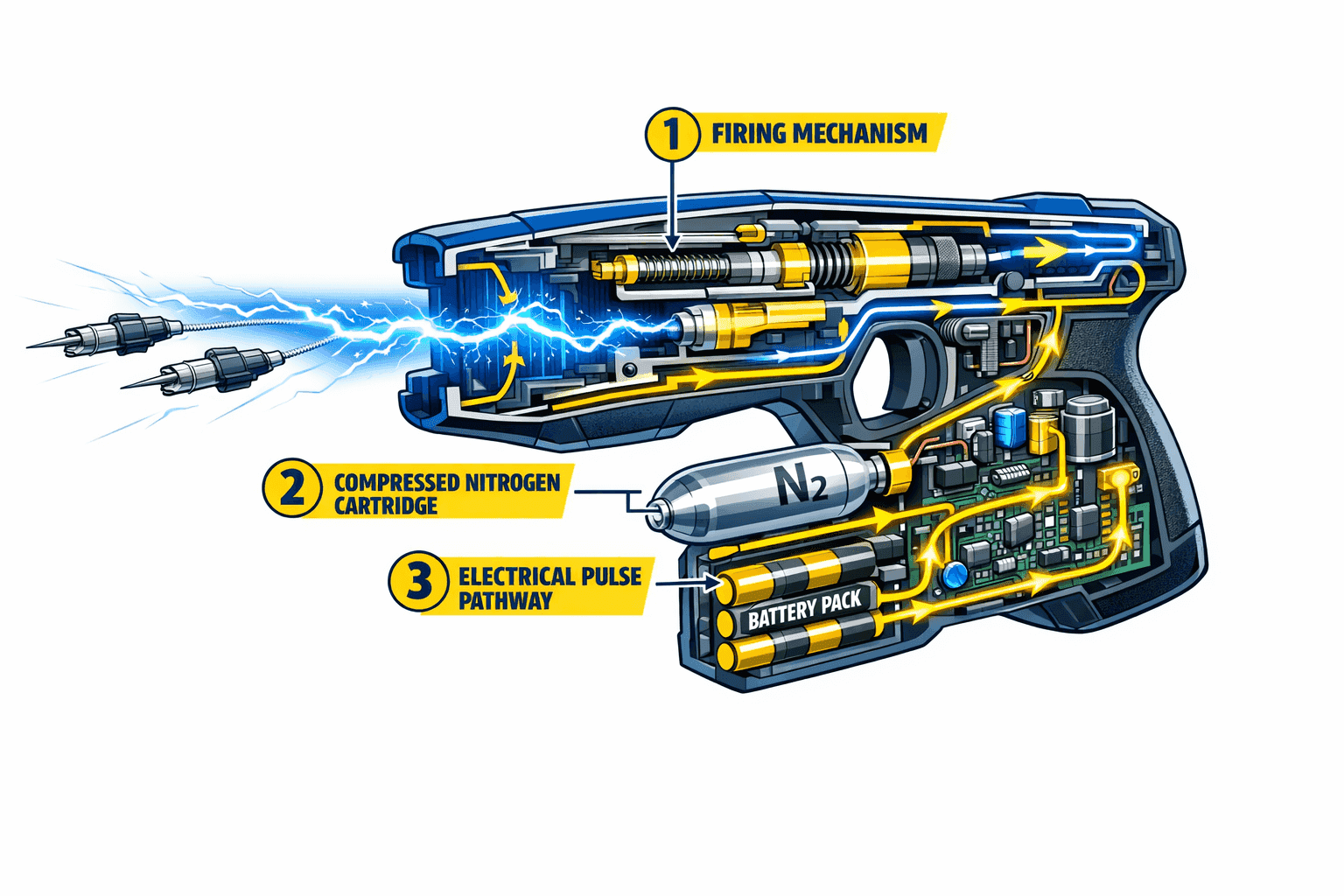 How a TASER works
Taser vs. Stun Gun: A Critical Difference for Self-Defense
The distinction between a TASER and a traditional stun gun is paramount for anyone considering a less-lethal self-defense option. While both deliver an electrical charge, their operational mechanisms and effectiveness differ significantly. A stun gun requires direct physical contact with the target to deliver its shock. It typically operates by creating pain compliance, startling the individual, but does not usually induce neuromuscular incapacitation. This means the attacker may still retain voluntary muscle control and the ability to fight back. In contrast, a TASER device fires probes that can incapacitate from a distance, creating a safer buffer zone for the user. The probes create the necessary electrical circuit for NMI, a capability most stun guns lack. This range and the induction of neuromuscular incapacitation are the primary advantages of a TASER for self-defense.
Civilian-Friendly TASER Models: Features for Personal Protection
Axon has developed several TASER models specifically designed for civilian personal protection, aiming to balance effectiveness with user-friendliness and legal compliance. These models are generally more compact and easier to operate than their law enforcement counterparts.
Key models include the TASER Pulse and its successor, the TASER Pulse 2. These are lightweight, handheld devices designed for ease of carry and quick deployment. They typically feature a built-in light and laser sight to aid aiming, and often incorporate safety mechanisms to prevent accidental discharge. The Taser Pulse 2, for instance, offers improved ergonomics and enhanced performance over its predecessor.
Another significant offering is the Taser 7, which represents Axon's latest generation for law enforcement but also has civilian applications. The Taser 7 is known for its advanced probe spread, improved accuracy, and effective NMI delivery. Understanding the specific features of each model, such as range, cartridge capacity, and ease of aiming, is crucial for selecting the right device for individual needs.
The Taser as a Self-Defense Tool: When and How to Use It Effectively
Acquiring a TASER device is only the first step; understanding its role in a self-defense scenario is critical for effective and responsible use. This involves cultivating the right mindset, knowing when and how to deploy it, and practicing its application.
The Self-Defense Mindset: Decision-Making Under Duress
Facing a threat is a high-stress situation. Developing a self-defense mindset means preparing mentally to make critical decisions quickly and effectively. This involves heightened situational awareness – being aware of your surroundings, potential threats, and escape routes. It also means recognizing the threshold for using force. A TASER is a tool of use of force, intended for situations where you reasonably believe you are in imminent danger of physical harm. This isn't about aggression; it's about defense. The decision to deploy a TASER should be a last resort, made when de-escalation or escape are no longer viable options, and you need to create distance and time to get to safety.
Understanding Taser Modes of Operation for Self-Defense
While the primary and most effective mode of Taser use for incapacitation is projectile deployment, some devices may offer secondary functions. The standard mode of operation involves firing the probes, which then deliver the incapacitating electrical charge via neuromuscular incapacitation. Some Axon devices also offer a drive stun capability. This mode involves direct contact with the device against the attacker, delivering a painful electrical shock without the probes. While a drive stun can be effective for pain compliance and deterring an attacker, it does not typically induce NMI and is generally considered less effective for incapacitation than probe deployment. For civilian self-defense, the focus is usually on the projectile mode for its incapacitating capabilities.
Practical Scenarios for Civilian Taser Use
Taser use for civilians is envisioned in specific, high-risk scenarios. Consider the following:
- Home Invasion: If confronted by an intruder in your home, a TASER can provide immediate defense, creating an opportunity to escape or call for help.
- Street Harassment Escalating to Physical Threat: If verbal harassment escalates to a physical assault or the threat of one, a TASER can be deployed to create distance.
- Mugging or Robbery: In a situation where your safety is threatened, a TASER can deter an assailant and allow you to escape.
- Carjacking: If facing a threat while in or near your vehicle, a TASER can be a tool to protect yourself.
It is crucial to remember that these are hypothetical scenarios, and the decision to use any use of force tool must be based on a genuine and immediate threat to your safety. The goal is always to de-escalate or escape, and the TASER is a means to achieve that when other options fail.
Maximizing Effectiveness: Aiming and Deployment Techniques
Effective Taser use relies on proper aiming and deployment. For projectile modes, the goal is to have both probes make contact with the subject, ideally in a way that creates a complete electrical circuit across the chest or abdomen.
- Targeting: Aim for large muscle groups, typically in the center mass of the torso. Avoid aiming for the head or neck, as this can increase the risk of serious injury and may have legal implications.
- Distance: Be aware of your TASER device's effective range. Ensure you are within this range for accurate deployment.
- Deployment: Draw the device, activate the laser sight (if applicable) to acquire a target, disengage the safety, and depress the trigger to fire the probes.
- Post-Deployment: Once deployed, the TASER typically cycles for five seconds. Use this critical window to escape to safety and contact emergency services.
Practice, even dry firing (without a cartridge), can help build muscle memory and confidence in handling the device under pressure.
Psychological Aspects: Preparing for the Reality of Use
The decision to deploy a TASER, even in self-defense, carries significant psychological weight. It's one thing to consider it hypothetically; it's another to face a situation where you must use it. The physiological effects of stress – adrenaline, tunnel vision, and impaired judgment – can be profound.
- Anticipation: Mentally rehearse scenarios and your intended actions. This can help reduce the shock of a real event.
- Emotional Impact: Be prepared for the emotional aftermath. Using force against another person, even in defense, can be disturbing. Acknowledge these feelings and seek support if needed.
- Responsibility: Understanding the responsibility that comes with wielding such a tool is crucial. It's not about aggression; it's about survival and safety.
This mental preparation is as vital as understanding the technical aspects of the TASER.
Legal Landscape: Owning and Using a Taser as a Civilian
The legality of owning and using TASER devices for civilians varies significantly. Navigating this complex landscape is crucial to ensure responsible possession and avoid legal repercussions.
Navigating State and Local Laws: Your Primary Responsibility
The United States has a patchwork of laws regarding the possession and use of conducted electrical weapons. Some states permit them, others have restrictions, and some prohibit them entirely. It is the individual's primary responsibility to research and understand the specific laws in their state, county, and city. This includes:
- Permit Requirements: Some jurisdictions may require a permit to carry a TASER.
- Age Restrictions: There are often minimum age requirements for possession.
- Prohibited Locations: Carrying a TASER may be illegal in certain places, such as schools, government buildings, or airports.
- Federal Regulations: While federal law doesn't broadly prohibit Tasers, state and local laws take precedence.
Failure to comply with these laws can result in fines, confiscation of the device, and even criminal charges.
Understanding "Reasonable Force" and Self-Defense Law
In most jurisdictions, the use of force in self-defense is governed by the principle of "reasonable force." This means the force used must be proportionate to the threat faced. A TASER is generally considered a less-lethal option, meaning its use of force is often deemed reasonable when facing a threat of significant physical harm. However, the context is critical:
- Imminent Threat: The force must be used in response to an immediate and unavoidable danger.
- Proportionality: The level of force used should not be excessive compared to the threat.
- Duty to Retreat: In some areas, you may have a duty to retreat if safely possible before using force.
Using a TASER outside of these legal parameters can lead to criminal charges.
Distinguishing Civilian Use from Law Enforcement Use of Force
It's important to recognize that while TASER devices are used by police and law enforcement officers, their deployment context and legal justification differ for civilians. Police officers operate under specific departmental policies and use-of-force continuums, which guide their decision-making. Civilians, on the other hand, rely on state self-defense laws. While the TASER is designed for incapacitation, civilian deployment must strictly adhere to the principles of self-defense as defined by local statutes. The objective for a civilian is to create an opportunity to escape a threat, not to subdue or apprehend a suspect, which is the domain of law enforcement.
Training and Responsible Ownership: Mastering Your Taser for Personal Safety
Possessing a TASER device comes with a profound responsibility. To wield this tool effectively and safely, dedicated training and a commitment to responsible ownership are paramount.
The Importance of Familiarization and Practice
A TASER is a complex tool, and effective Taser use is not intuitive for most people. Without proper training, a TASER can be ineffective or even dangerous. Familiarization involves understanding the device's components, safety features, and basic operation. Practice, even with inert training cartridges, builds muscle memory for drawing, aiming, and firing. This practice is crucial for overcoming the stress response in a real-world encounter. Understanding how the probes deploy, how the electrical current works, and the effects of neuromuscular incapacitation are all vital components of this familiarization.
Seeking Civilian-Focused Self-Defense Training
While police officers receive extensive training on TASER devices, civilian-focused courses are equally important. These courses should cover:
- Legal aspects: Understanding your rights and responsibilities concerning TASER use.
- Safe handling: Proper grip, drawing, and safety mechanisms.
- Deployment techniques: Aiming, firing, and understanding effective range.
- Post-deployment procedures: What to do immediately after using the device.
- Scenario-based training: Practicing in simulated self-defense situations.
- Device maintenance: Keeping your TASER in optimal working condition.
Look for certified instructors who emphasize responsible ownership and legal compliance for civilian users. This ensures you gain the necessary skills and knowledge to use your TASER appropriately.
Carrying and Storage Best Practices
Responsible ownership extends to how you carry and store your TASER.
- Carrying: If legally permitted, carry your TASER in a manner that allows for quick access. This might involve a concealed holster designed for the specific Taser device model. Ensure it is secured to prevent accidental loss or unauthorized access.
- Storage: When not carried, store your TASER securely, away from children and unauthorized individuals. A locked case or safe is highly recommended. This prevents accidental discharge and potential misuse. For example, storing a TASER Pulse 2 securely is as important as knowing how to use it.
Proper storage is a key aspect of responsible TASER ownership and legal compliance.
What Happens After Deployment? Post-Use Considerations for Civilians
The moments following the deployment of a TASER are critical and require clear understanding of immediate actions, legal obligations, and device care.
Immediate Actions: Safety First
If you have deployed your TASER device in self-defense, your immediate priority is to ensure your safety.
- Escape: Use the incapacitation provided by the TASER to create distance and escape to a safe location.
- Call for Help: Immediately contact emergency services (e.g., 911 in the US). Report the incident, your location, and that you have deployed a self-defense tool.
- Do Not Pursue: Your goal is to escape, not to apprehend or engage further. Leave the area as soon as it is safe to do so.
Interacting with Authorities: Your Rights and Responsibilities
When police officers arrive, cooperate fully but be aware of your rights.
- Identify Yourself: Provide your identification if requested.
- Explain the Situation: Clearly and calmly explain that you acted in self-defense due to an imminent threat.
- State Your Use of a Taser: Inform them that you deployed a TASER device.
- Remain Silent (If Necessary): While cooperation is key, you have the right to remain silent regarding details of the incident until you have spoken with an attorney. Do not offer voluntary statements that could be misconstrued.
- Consult Legal Counsel: It is advisable to contact a lawyer experienced in self-defense law after any use of force incident.
Device Reloading and Post-Incident Maintenance
After deployment, your TASER device will need attention:
- Cartridge Removal: The spent cartridge should be removed from the TASER device.
- Reloading: If you have spare cartridges, and it is safe to do so, you may reload your TASER device. However, your priority in an incident is escape and contacting authorities.
- Evidence: The deployed TASER device and cartridges may be considered evidence. Do not tamper with them. Follow instructions from investigating officers regarding their handling.
- Inspection/Repair: After any use, especially if the device was dropped or impacted, it should be inspected for damage. Axon may offer services for inspection or repair.
Emotional and Psychological Aftermath
What happens when you get tasered? While the article focuses on civilian use, understanding the impact on the recipient can offer perspective. For the user, deploying a TASER can be a deeply impactful experience. The adrenaline surge, the act of using force, and the subsequent encounter with law enforcement can lead to stress, anxiety, and even post-traumatic stress. Acknowledging these emotional and psychological effects is crucial. Seeking support from friends, family, or mental health professionals can be vital for processing the experience.
Beyond the Taser: A Holistic Approach to Self-Defense
While a TASER device can be a powerful tool for personal safety, it is most effective when integrated into a broader, multi-layered self-defense strategy. Relying solely on any single tool can create a false sense of security.
The TASER is one component of a comprehensive approach. Situational awareness – constantly scanning your environment and recognizing potential threats – is your first line of defense. De-escalation techniques can often resolve conflicts before they turn violent. Physical self-defense training can provide you with the skills to protect yourself if a physical confrontation becomes unavoidable, and to handle situations where a TASER might not be deployable or effective.
Ultimately, trusting your intuition is paramount. If a situation feels wrong, it probably is. Empowering yourself through knowledge, training, and a well-considered approach to personal safety, which may include a TASER device like the TASER Pulse 2 or Taser 7, provides the most robust defense against the uncertainties of the modern world.
Conclusion
Understanding what a TASER is and how it functions is the first step towards considering it as a viable option for civilian self-defense. These TASER energy weapons, particularly models like the TASER Pulse and Taser 7, offer a non-lethal means to achieve neuromuscular incapacitation and create critical distance when facing imminent threats. It is vital to distinguish them from stun guns, recognizing the superior incapacitation capability offered by TASER devices due to their projectile deployment and compressed nitrogen propulsion system.
However, responsible ownership and effective Taser use necessitate more than just understanding the technology. It demands a thorough grasp of the legal landscape, including state and local regulations governing possession and the principles of "reasonable force." Crucially, comprehensive training is indispensable, equipping individuals with the skills to deploy the Taser device effectively and safely, while also fostering the psychological preparedness required for such a significant act of use of force.
Beyond the technicalities, post-deployment procedures, interaction with authorities, and the emotional aftermath are critical considerations. A TASER should not be viewed as a standalone solution but as one element within a holistic self-defense strategy that prioritizes awareness, de-escalation, and physical preparedness. By embracing knowledge, practicing responsible ownership, and integrating a TASER device thoughtfully into their personal safety plans, individuals can enhance their ability to protect themselves and navigate life with greater confidence and security.
FAQs
What is a Taser?
A Taser is a conducted electrical weapon (CEW) designed to incapacitate a person by delivering a high‑voltage, low‑amperage electrical pulse. Unlike a stun gun, a Taser can be deployed from a distance using cartridge‑fired probes. It’s commonly used by law enforcement but is also available to civilians in many states.
How does a Taser work?
A Taser fires two small probes connected by wires that deliver an electrical pulse disrupting the body’s neuromuscular control. This causes temporary loss of muscle function, giving the user time to escape or seek help. The effect typically lasts several seconds, depending on the model and cartridge.
What’s the difference between a Taser and a stun gun?
A Taser works at a distance—usually 10 to 15 feet for civilian models—while a stun gun requires direct contact with the attacker. Tasers cause neuromuscular incapacitation, whereas stun guns rely on pain compliance. Tasers are generally more effective for self‑defense because they create space between you and the threat.
Are Tasers legal for civilian self‑defense?
Taser legality varies by state and sometimes by city or county. Most states allow civilian ownership, but some require permits or restrict carry in certain locations. Always check your local laws before purchasing or carrying a Taser.
Can a Taser penetrate clothing?
Yes—Tasers are designed to penetrate typical clothing, including jackets and thicker fabrics. However, extremely loose or layered clothing can reduce probe effectiveness. Proper aim and distance improve reliability.
Does a Taser work on someone under the influence of drugs or alcohol?
Tasers are generally effective regardless of intoxication because they target the nervous system, not pain receptors. However, no self‑defense tool is 100% effective, and results can vary based on probe placement and distance.
How long does the Taser’s effect last?
Most civilian Tasers deliver a 30‑second cycle, giving you time to escape. The incapacitation typically ends once the electrical cycle stops, though disorientation may linger briefly. Some models allow you to drop the device and run while it continues cycling.
Can a Taser be used more than once?
Yes—after firing a cartridge, many Tasers can still function as a close‑contact stun device. You can also reload with a new cartridge if you have one available. Civilian models typically come with one or two cartridges.
Is a Taser safe to use?
Tasers are designed to be non‑lethal, but they still carry risks, especially for individuals with underlying health conditions. When used properly, they are considered safer than many other force options. Training and responsible handling significantly reduce risks.
Do Tasers require training?
While not always legally required, training is strongly recommended. Understanding aiming, probe spread, safety features, and legal considerations improves both effectiveness and responsible use. Many manufacturers offer online training resources.
Can a Taser stop multiple attackers?
A single cartridge can only incapacitate one person at a time. After firing, you may switch to drive‑stun mode or reload, but this takes time. Situational awareness and escape planning are essential when facing multiple threats.
How far does a civilian Taser shoot?
Most civilian Tasers have a range of 10–15 feet. This distance is designed to give users enough space to disengage safely. Professional law‑enforcement models may reach farther.
Can a Taser be used alongside body armor?
Yes—body armor protects against ballistic threats, while Tasers address close‑range personal defense. Some body armor materials can interfere with probe penetration, but most civilian encounters involve standard clothing. Tasers and armor serve different roles in a layered defense strategy.
What should I do after deploying a Taser in self‑defense?
Your priority is to get to safety and contact law enforcement immediately. Provide a clear account of the incident and follow local reporting requirements. Many civilian Tasers include a “Safe Escape” policy allowing you to leave the device behind if needed.
How do I maintain a Taser?
Regularly check the battery, replace cartridges before expiration, and inspect the device for damage. Store it in a secure but accessible location. Following the manufacturer’s maintenance guidelines ensures reliability when you need it most.