Listen to this article
Table of Contents
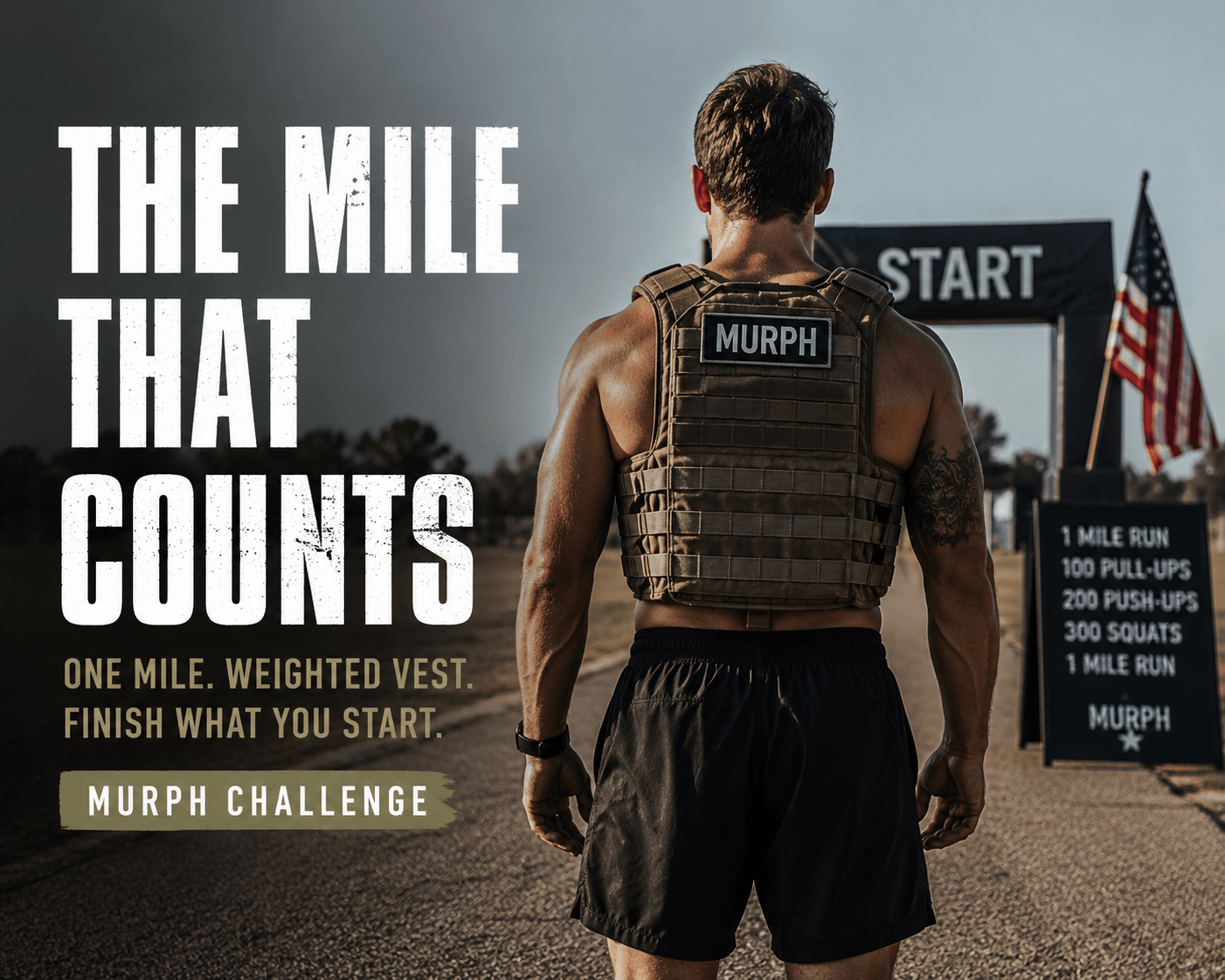
![Athlete in weighted vest at the start of a mile run — Athlete wearing a weighted vest preparing to start the Murph workout mile run]](https://dropinblog.net/34250037/files/murph-workout-weighted-vest-mile-run.png) Athlete in weighted vest at the start of a mile run — Athlete wearing a weighted vest preparing to start the Murph workout mile run
TL;DR: The Murph is a Hero WOD consisting of a 1-mile run, 100 pull-ups, 200 push-ups, 300 air squats, and a final 1-mile run, performed in a weighted vest (20 lb for men, 14 lb for women). Named after Navy SEAL Lt. Michael P. Murphy, killed in action during Operation Red Wings in 2005. This glossary defines every major term, movement standard, and performance benchmark you need to understand the workout and train for it correctly.
Whether you're approaching the Murph for the first time or refining your benchmark performance, the terminology matters. Misunderstanding the RX standard, the partition options, or the movement requirements leads to inaccurate results and wasted training cycles. This glossary covers every key term, from the tactical origins of the workout to the precise movement standards that define a legitimate rep.
Air Squat
Air Squat is the standard bodyweight squat used throughout the Murph workout. A legal rep requires the hip crease to break below the parallel plane of the knee at the bottom, with full hip and knee extension at the top. At 300 reps of total volume, form degradation is the primary failure point. Prioritize depth and lockout over pace.
Body Armor Standard
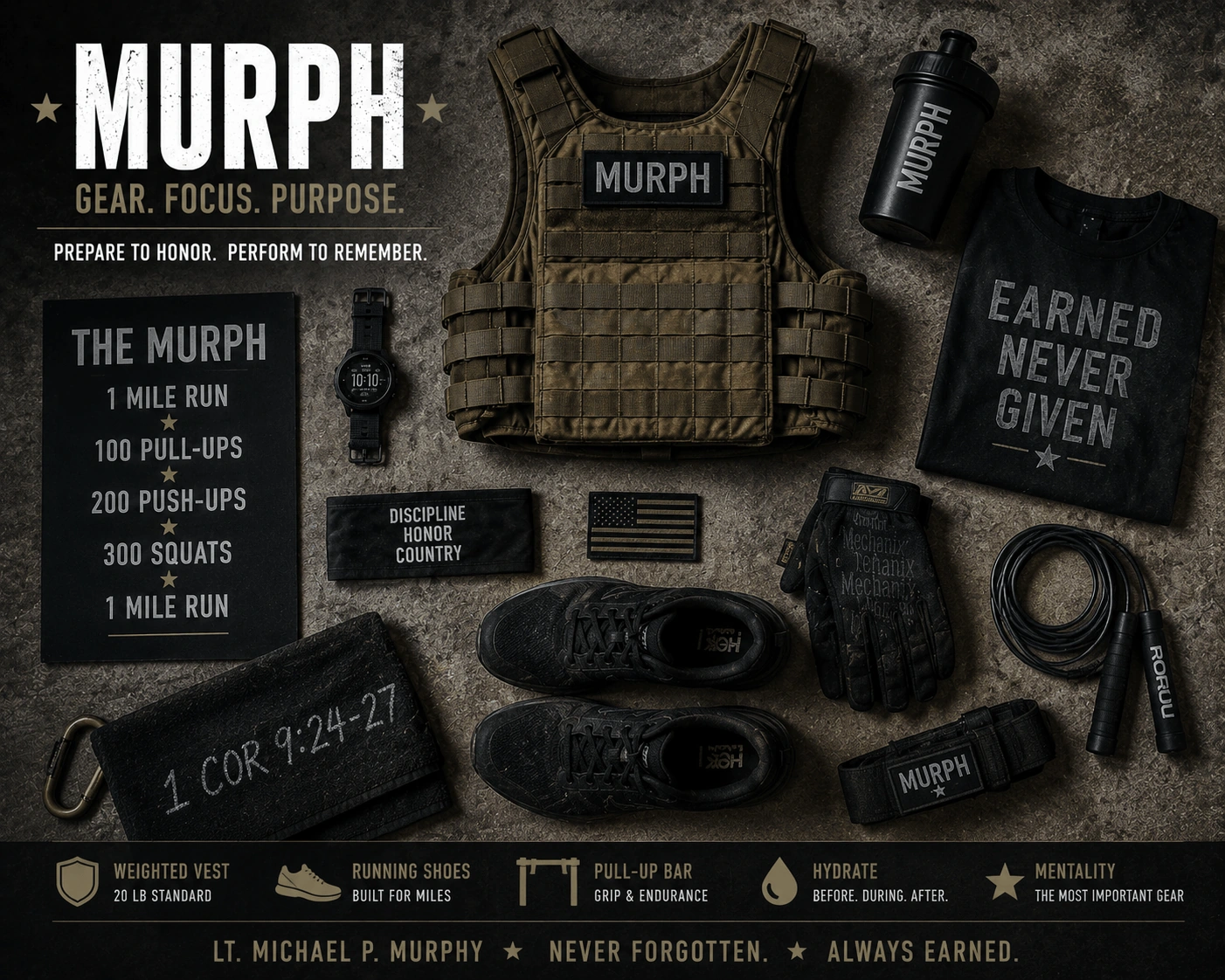
Body Armor Standard is the prescribed load requirement that defines the Murph at its full tactical intensity. Per the CrossFit benchmark standard, the requirement is a 20-pound weighted vest for men and a 14-pound vest for women, worn continuously throughout the entire workout, including both 1-mile runs. Without the vest, the workout remains a demanding conditioning effort. With it, the demand on the cardiovascular system and postural muscles increases significantly, mirroring real operational stress carried by law enforcement and military personnel in body armor and duty gear.
- Men: 20 lb vest
- Women: 14 lb vest
- Duration: Worn for the full workout, including both mile runs. No exceptions at sanctioned events.
How an athlete distributes accumulated fatigue across 600 total reps determines whether they finish strong or stall. That's where rep partitioning strategies become critical.
Partition Strategies
Cindy's Partition
Cindy's Partition is a rep-management strategy for completing the Murph workout: breaking the 100 pull-ups, 200 push-ups, and 300 air squats into 20 identical rounds of 5 pull-ups, 10 push-ups, and 15 squats. According to NASM, this 5-10-15 scheme is the most common approach for beginners and intermediates because it distributes muscular load evenly, preventing any single movement pattern from reaching failure early.
Partitioned Method
Partitioned Method is the structured approach of cycling through sub-maximal sets of pull-ups, push-ups, and squats in sequence across multiple rounds, rather than completing all reps of one movement before advancing. Partitioning rotates the stress load across opposing muscle groups, preserving grip endurance and pressing capacity deep into the workout.
Unpartitioned Method
Unpartitioned Method is the straight-through approach of completing all 100 pull-ups, then all 200 push-ups, then all 300 squats before the final run. Also referred to as "Straight Through" or "Smoker" style, this format drives severe localized muscle fatigue by exhausting each movement pattern completely before transitioning. The 2015 CrossFit Games required athletes to perform the Murph unpartitioned in extreme heat, underscoring that this is the ultimate test of strength endurance and mental discipline. Partitioning distributes fatigue across muscle groups. Unpartitioned eliminates that relief entirely. This method is generally reserved for elite-level athletes who have built the requisite work capacity.
Elite Performance Benchmarks
Sub-40 Benchmark
Sub-40 Benchmark is the gold standard completion time for competitive tactical athletes performing the Murph at full RX intensity. A sub-40 minute finish signals elite-level conditioning, raw strength endurance, and superior pacing discipline under load.
RX Weighted Vest Impact
Completing the Murph with a 20-pound vest adds significant systemic fatigue, typically increasing total completion time by 10 to 20 minutes compared to an unweighted attempt. Vest selection and fit directly affect heat management and movement efficiency across all three modalities.
Competitive Tactical Benchmark
For law enforcement, military, and serious tactical athletes:
- Under 50 minutes with a vest: strong performance
- Under 45 minutes: top-tier functional fitness
- Sub-40 minutes: exceptional, requiring optimized pull-up efficiency, push-up volume capacity, and disciplined run pacing
Unweighted Elite Standard
Athletes performing Murph without a vest who finish under 35 minutes demonstrate high-level bodyweight competency. This time does not qualify as RX performance for competition or official benchmark tracking.
Hero WOD
Hero WOD (Definition)
A Hero WOD is a CrossFit benchmark workout named after a fallen service member or first responder, designed to honor their sacrifice through physical demand. Each Hero WOD carries the name of a specific individual, making every rep an act of remembrance.
Murph (Hero WOD)
The Murph is the most recognized Hero WOD globally. The workout: a 1-mile run, 100 pull-ups, 200 push-ups, 300 air squats, and a final 1-mile run, performed in a weighted vest. The CrossFit Murph origin story documents that Lt. Murphy originally called this workout "Body Armor" and performed it regularly as part of his personal training regimen. After his death, the CrossFit community renamed it in his honor.
Tribute Through Suffering
Tribute Through Suffering is the psychological framework underlying Hero WODs. The deliberate discomfort of the workout connects the athlete to the hardship endured by the individual being honored. The physical challenge is intentional, not incidental.
Kipping Pull-Up
Kipping Pull-Up (Definition)
A Kipping Pull-Up is a full-body, dynamic pull-up variation that uses a coordinated hip drive and swing to generate momentum, converting horizontal force into vertical pulling power. In the Murph, kipping allows athletes to cycle through all 100 pull-ups without the neuromuscular fatigue that strict reps accumulate well before that rep count.
Kip
The kip is the foundational hip-swing mechanic underlying the kipping pull-up, initiated by a hollow-to-arch body position that loads the shoulders and lats like a spring before the upward pull phase begins.
Efficiency Gain
The practical output advantage of kipping over strict pull-ups: reduced time under tension per rep and lower peak muscular demand, allowing higher rep volumes to be sustained.
Strict Pull-Up
A Strict Pull-Up is a dead-hang pull-up performed with no body swing or momentum. Strict reps are more demanding per repetition and become unsustainable at volume without advanced pulling strength.
Shoulder Stability Requirement
The prerequisite joint integrity needed before performing high-volume kipping. Athletes without an established strict pull-up base risk shoulder impingement or rotator cuff stress when kipping at scale. Build a strict pull-up base first.
Lt. Michael P. Murphy
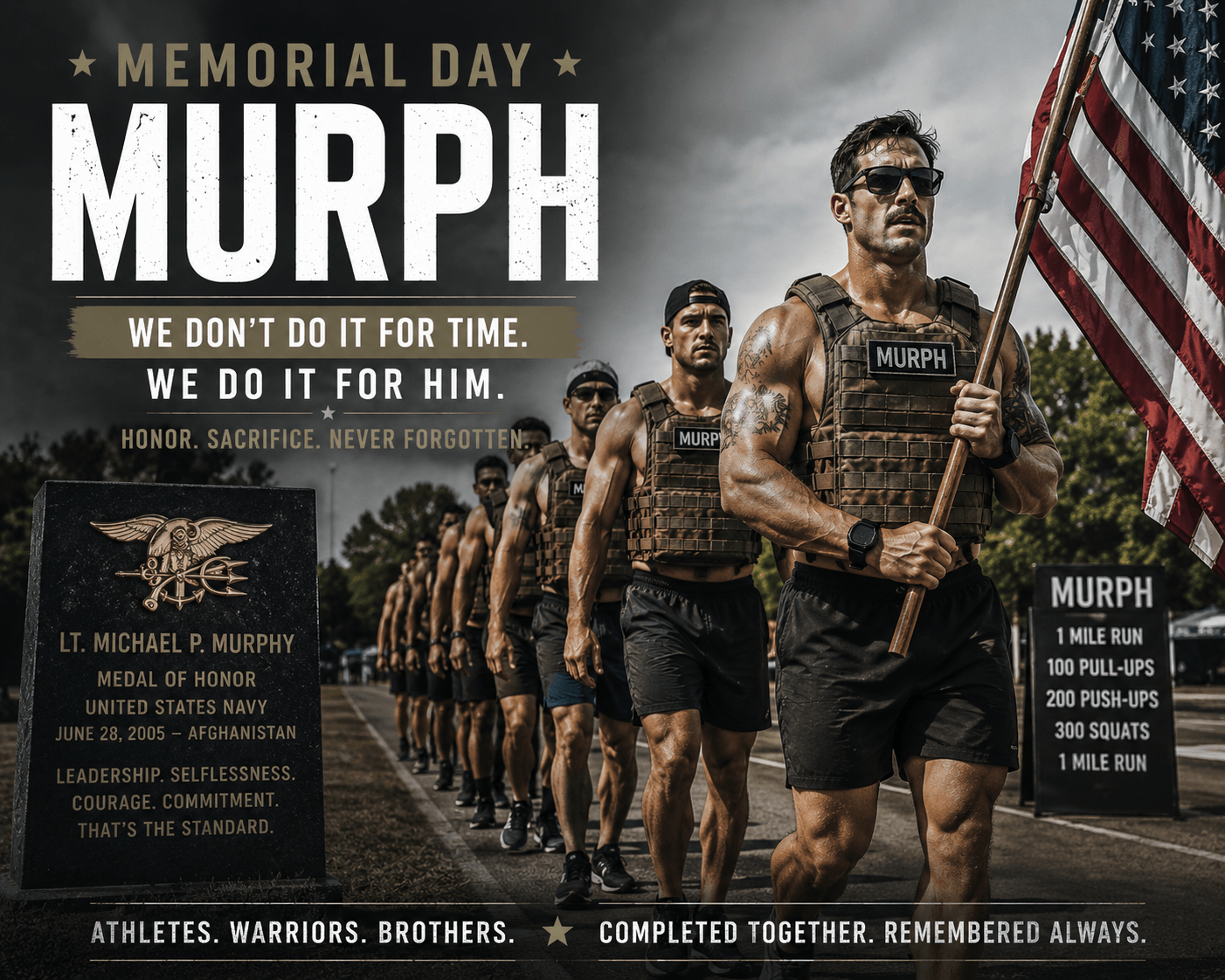
Lt. Michael P. Murphy was a U.S. Navy SEAL and Medal of Honor recipient killed in action in Afghanistan on June 28, 2005, during Operation Red Wings. According to CrossFit's account of the workout's origin, Murphy called the workout "Body Armor" and performed it regularly as part of his personal training regimen. After his death, the CrossFit community renamed it "Murph" in his honor. The workout's structure, including the weighted vest, reflects the load Murphy carried during training.
Memorial Day Murph
Memorial Day Murph (Definition)
The Memorial Day Murph is the annual tradition of completing the Murph workout on the last Monday of May, honoring Lt. Michael P. Murphy and all fallen service members. What began as a CrossFit community observance has grown into a global event with hundreds of thousands of participants each year, from affiliate gyms to forward operating bases.
The Murph Challenge
The Murph Challenge is the official organized event coordinating Memorial Day Murph participation and fundraising. Proceeds benefit the Lt. Michael P. Murphy Memorial Scholarship Foundation, directing funds toward veterans' families and related charities. Registration through the official challenge platform is how most participants log their effort and contribute financially.
Murph Weighted Vest
A Murph Weighted Vest is a body armor-equivalent load carrier, typically 20 lbs. for men and 14 lbs. for women, worn throughout the entire workout to replicate the operational weight Lt. Murphy carried. Completing the Memorial Day Murph with a weighted vest is considered the RX standard and significantly increases both the physical and commemorative weight of the effort.
Unit Murph
A Unit Murph is a formation-style execution of the Memorial Day Murph performed collectively by military units, law enforcement agencies, or first responder departments. The community format reinforces unit cohesion while maintaining the workout's commemorative purpose.
Metabolic Conditioning
Afterburn Effect (EPOC)
EPOC (Excess Post-exercise Oxygen Consumption) is the elevated metabolic rate that persists after high-intensity training ends. The Murph's combination of volume and load sustains caloric expenditure well beyond the final mile.
Caloric Demand
Participants burn between 500 and 1,000 calories per session depending on bodyweight, intensity, and vest load, according to the ISSA's analysis of the Murph workout's metabolic output. That range reflects genuine metabolic stress, not incidental activity.
Cardiovascular Output
The sustained elevation of heart rate across 300-plus reps and two miles of running places continuous demand on the aerobic system, a direct analog to prolonged field exertion.
Work Capacity
Work Capacity is the ability to perform meaningful physical output over time, the primary fitness attribute the Murph develops. For tactical personnel, work capacity translates directly to operational endurance under load.
Mile Run
Mile Run, Opening
The mandatory 1-mile run that initiates the Murph workout, establishing cardiovascular demand before a single rep of calisthenics is performed. Per the CrossFit benchmark standard, the workout begins and ends with a 1-mile run, totaling 2 miles of cardiovascular work. This bookend structure is non-negotiable in sanctioned attempts.
Mile Run, Closing
The second and final 1-mile run, completed after 100 pull-ups, 200 push-ups, and 300 air squats. Commonly called running on "jello legs," a term for the severe neuromuscular fatigue that follows high-volume calisthenics, making even a controlled pace psychologically and physically demanding.
Bookend Structure
Bookend Structure is the design principle placing identical movements at the start and finish of the workout. In Murph, the mile run serves as both the opening and closing bookend, ensuring aerobic capacity is tested in a pre-fatigued and fully-fatigued state.
Standardized Distance
A fixed, measured 1-mile course used to maintain benchmark consistency across all attempts and locations. Accurate distance measurement via GPS, a certified track, or a measured route is required for any result submitted for comparison. Estimating distance undermines the integrity of the benchmark.
Operation Red Wings
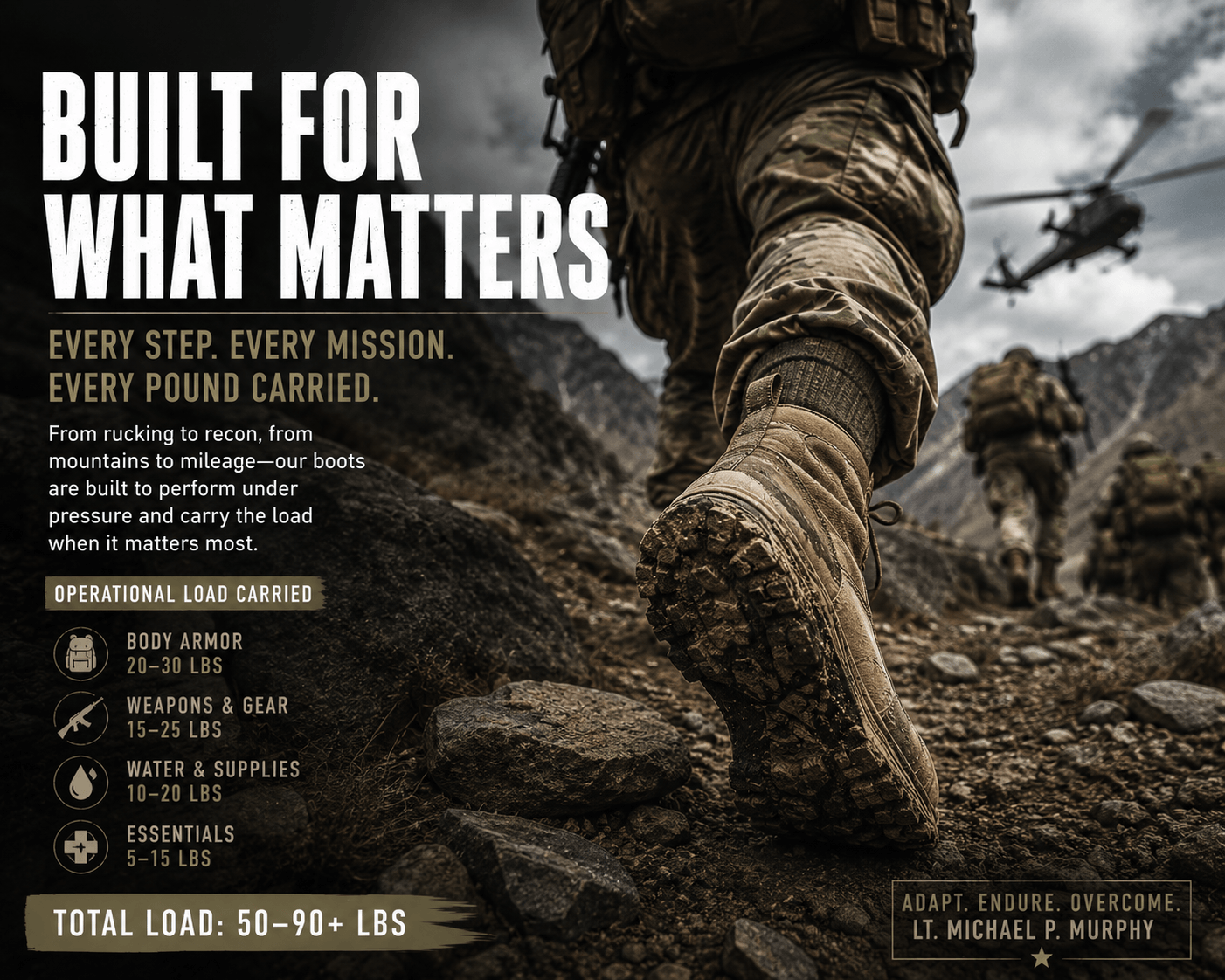
Operation Red Wings was a June 2005 counter-insurgency mission in the Kunar Province of Afghanistan, targeting a senior Taliban commander. A four-man SEAL reconnaissance team, including Lt. Michael P. Murphy, was inserted into hostile terrain and subsequently compromised, triggering one of the deadliest single-day losses of Naval Special Warfare personnel in U.S. history.
SEAL Reconnaissance Element
The four-operator direct action team inserted during Operation Red Wings, consisting of Lt. Murphy, Petty Officers Marcus Luttrell, Danny Dietz, and Matthew Axelson. Three of the four were killed in action during the ensuing firefight. Lt. Murphy was posthumously awarded the Medal of Honor, the nation's highest military decoration, for exposing himself to enemy fire to transmit a distress call that saved the life of sole survivor Marcus Luttrell.
Push-Up Standards
Chest-to-Deck
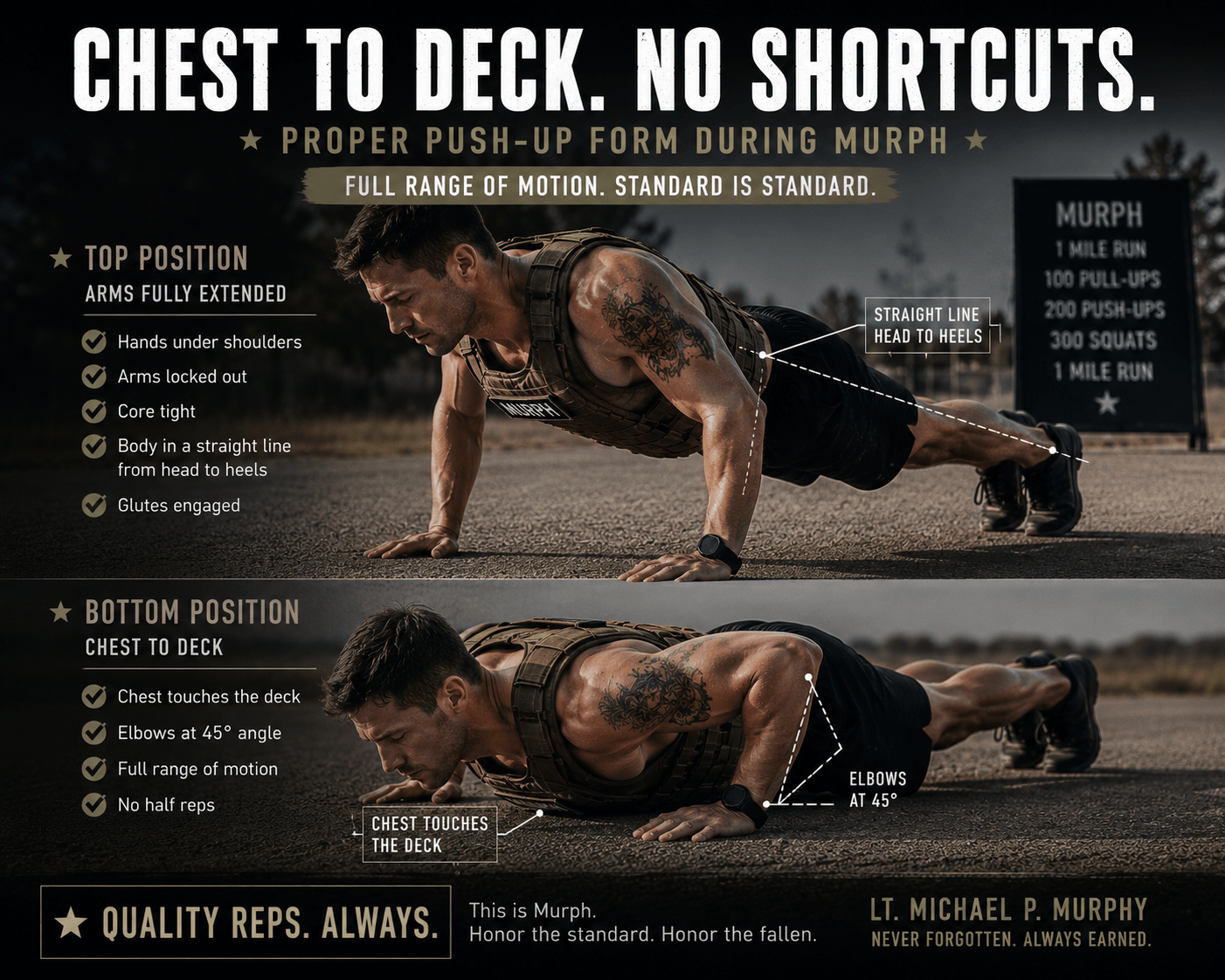
Chest-to-Deck is the minimum valid range of motion for a push-up repetition in Murph. The chest must make contact with the ground on every rep. Partial reps do not count toward the standard 200-rep total.
Lockout
Lockout is full elbow extension at the top of each push-up rep. Failing to achieve complete lockout is one of the most common form breaks as fatigue accumulates across 200 reps.
Midline Stability
Midline Stability is maintaining a rigid, plank-aligned body position from head to heel throughout the entire push-up movement. A sagging or piked hip line signals midline failure and compromises both rep validity and spinal loading.
Worming
Worming is a common push-up fault in which the hips lead the descent or the chest drops independently of a rigid body line. Worming typically appears after rep 100 when muscular fatigue overrides positional discipline, and disqualifies the repetition under strict standards.
No-Rep
A No-Rep is a repetition that fails to meet the required range of motion or positional standard. In a self-judged Murph, honest no-rep calls on push-ups are the difference between a meaningful training stimulus and an inflated count.
 Proper chest-to-deck push-up form during Murph workout showing full range of motion standard
RX Standard
RX (Definition)
RX is short for "as prescribed." Completing the Murph RX means executing the workout exactly as written, with no modifications to movement standards, rep volume, or equipment requirements. Per The Murph Challenge, RX requires a 20 lb vest for men and a 14 lb vest for women worn for the entire duration, from the opening mile run through the final run.
RX Rep Volume
The unmodified repetition standard: 100 pull-ups, 200 push-ups, and 300 air squats, completed in full between two 1-mile runs. Reducing any total removes the workout from RX status.
RX Movement Standard
Each rep must meet the full range-of-motion criteria: chest to deck on push-ups, chin over bar on pull-ups, and hip crease below parallel on air squats. Partial reps do not count toward the RX total regardless of vest compliance.
Vest Compliance
Vest Compliance is the requirement that the weighted vest remain on throughout the entire workout. Removing the vest at any point, even during the runs, disqualifies the attempt from RX status.
Scaled Version
Scaled Version (Definition)
A Scaled Version is a structured modification of the RX Murph that reduces volume, removes the weighted vest, or substitutes movements, used to build the physical capacity required to eventually complete the full tactical standard. As NASM notes, scaling allows beginners to develop the necessary foundation to progress toward an unmodified Murph.
Volume Reduction
Volume Reduction means cutting total reps, for example, running 400 meters instead of a full mile, or performing 50 pull-ups, 100 push-ups, and 150 air squats, to match a trainee's current work capacity without compromising movement quality.
Vest Removal
Completing Murph without the 20 lb weighted vest is the standard progression entry point for athletes who cannot yet sustain proper mechanics under load across the full rep scheme.
Movement Substitution
Movement Substitution means replacing a prescribed movement with a mechanically similar alternative: ring rows or jumping pull-ups instead of strict pull-ups, knee push-ups instead of chest-to-deck, to maintain intensity while managing injury risk.
Progression Pathway
The Progression Pathway is the deliberate, phased approach of increasing volume, load, or movement complexity over successive training cycles until the athlete can perform the full RX standard safely and consistently.
FAQs
What is the Murph workout?
The Murph workout is a Hero WOD consisting of a 1-mile run, 100 pull-ups, 200 push-ups, 300 air squats, and a final 1-mile run, performed in a weighted vest (20 lb for men, 14 lb for women). It is named after Navy SEAL Lt. Michael P. Murphy, killed in action on June 28, 2005, during Operation Red Wings in Afghanistan.
What weight vest do you use for the Murph?
The RX standard for the Murph is a 20-pound weighted vest for men and a 14-pound weighted vest for women, worn for the entire workout including both mile runs. Removing the vest at any point disqualifies the attempt from RX status.
Can you partition the Murph workout?
Yes. The most common approach is Cindy's Partition: 20 rounds of 5 pull-ups, 10 push-ups, and 15 air squats. This distributes muscular load evenly across the middle volume. The alternative is the unpartitioned method, completing all 100 pull-ups, then all 200 push-ups, then all 300 squats straight through. Unpartitioned is significantly more demanding and is generally reserved for elite athletes.
What is a good Murph time?
For RX performance with a vest: under 50 minutes is solid for tactical athletes, under 45 minutes is top-tier, and sub-40 minutes is elite. Without a vest, under 35 minutes indicates high-level bodyweight fitness but does not count as RX for competitive tracking.
Who was Lt. Michael P. Murphy?
Lt. Michael P. Murphy was a U.S. Navy SEAL officer and Medal of Honor recipient. He was killed in action on June 28, 2005, during Operation Red Wings in the Kunar Province of Afghanistan, after exposing himself to enemy fire to transmit a distress call that saved sole survivor Marcus Luttrell. The workout he called "Body Armor" was renamed "Murph" in his honor by the CrossFit community.
When is the Memorial Day Murph?
The Memorial Day Murph is performed annually on Memorial Day, the last Monday of May. Participants can register through The Murph Challenge, which raises funds for the Lt. Michael P. Murphy Memorial Scholarship Foundation.
What is the difference between RX and scaled Murph?
RX Murph requires the full rep volume (100 pull-ups, 200 push-ups, 300 air squats, two 1-mile runs) with a weighted vest and all reps meeting the prescribed range of motion. A scaled version reduces volume, removes the vest, or substitutes movements to match the athlete's current capacity. Scaling is a legitimate progression pathway toward the full RX standard.