Listen to this article
Table of Contents
- The Most Accurate & Clear Views: Comparing Red Dot, Holographic, and Iron Sights
- The Importance of Sighting Systems for Shooters
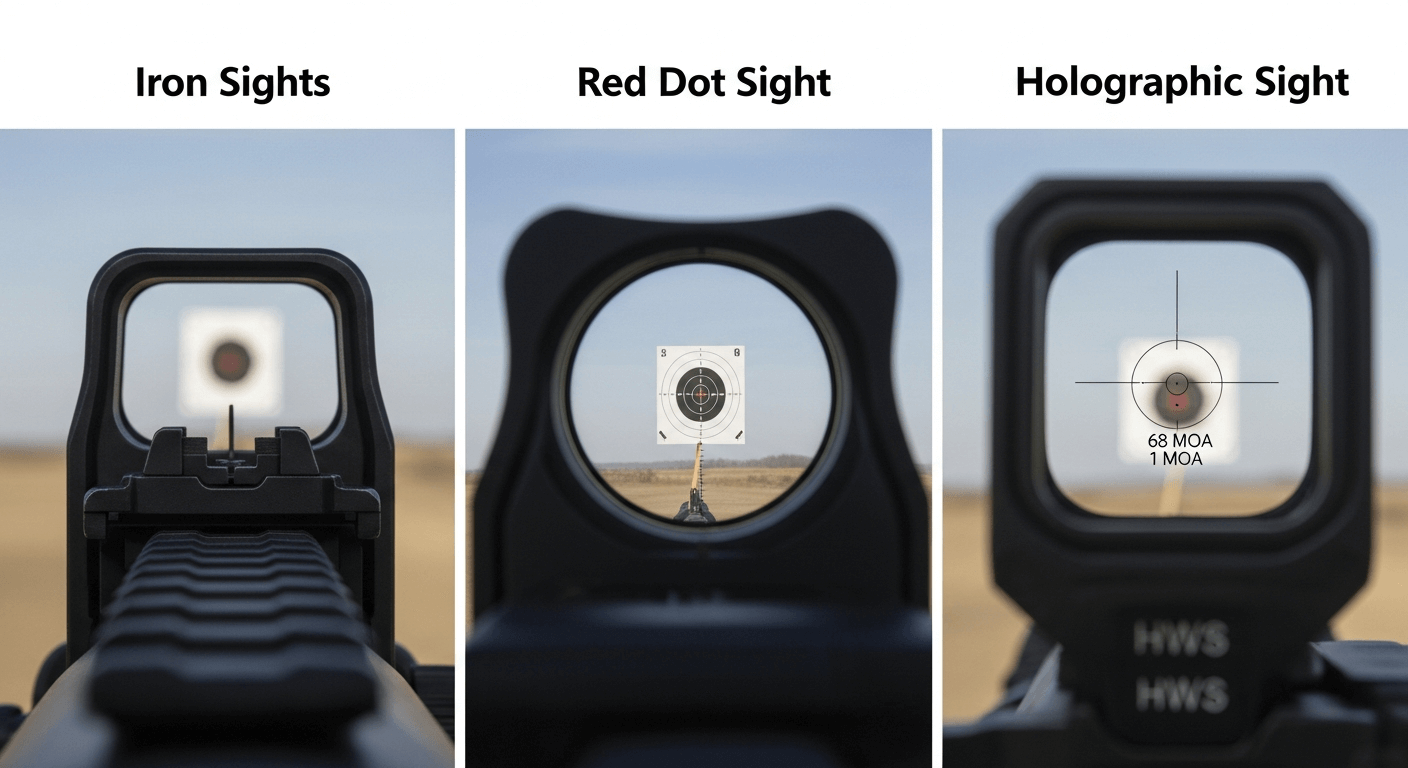
- Overview of Sights: Iron, Red Dot, and HolographicA shooter's-eye view comparing the sight picture of Iron Sights (requiring alignment of three focal planes) with the single-plane focus of Red Dot and Holographic sights.
- What This Guide Will Cover: A Comparative Analysis for Clarity and Accuracy
- Understanding the Fundamentals of Aiming
- Iron Sights: The Timeless Foundation
- Red Dot Sights: Modern Efficiency
- Holographic Sights: Advanced Precision
- Direct Comparison: Accuracy, Clarity, and Performance Metrics
- Choosing Your Ideal Sighting System: Scenario-Based Recommendations
- Maximizing Performance with Your Chosen Sight
- Comparing Iron, Red Dot, and Holographic Sights
- FAQs
The Most Accurate & Clear Views: Comparing Red Dot, Holographic, and Iron Sights
Precision in marksmanship is as old as projectile weapons. Accurate shooting is essential for self-defense, hunting, competition, or sport. The sighting system connects the shooter's eye, firearm, and target. Aiming technology has evolved from simple iron sights to advanced electronic optics like red dot and holographic sights. Each system offers a unique way to achieve a clear sight picture. Understanding these systems helps shooters improve performance, speed, and accuracy. This guide compares iron sights, red dot sights, and holographic sights, explaining their mechanics, pros and cons, and real-world use to help you choose the best aiming solution.
The Importance of Sighting Systems for Shooters
The sighting system links the shooter directly to the target by providing a reference point for aim. Without it, even accurate firearms and ammo are ineffective. It affects how fast and precisely a shooter can aim and maintain focus under different conditions. For pistols or rifles, the sighting system impacts the shot's outcome, whether hunting, home defense, or competition. The shift from iron sights to electronic optics shows the ongoing effort to improve speed, accuracy, and ease of use for all shooters.
Overview of Sights: Iron, Red Dot, and Holographic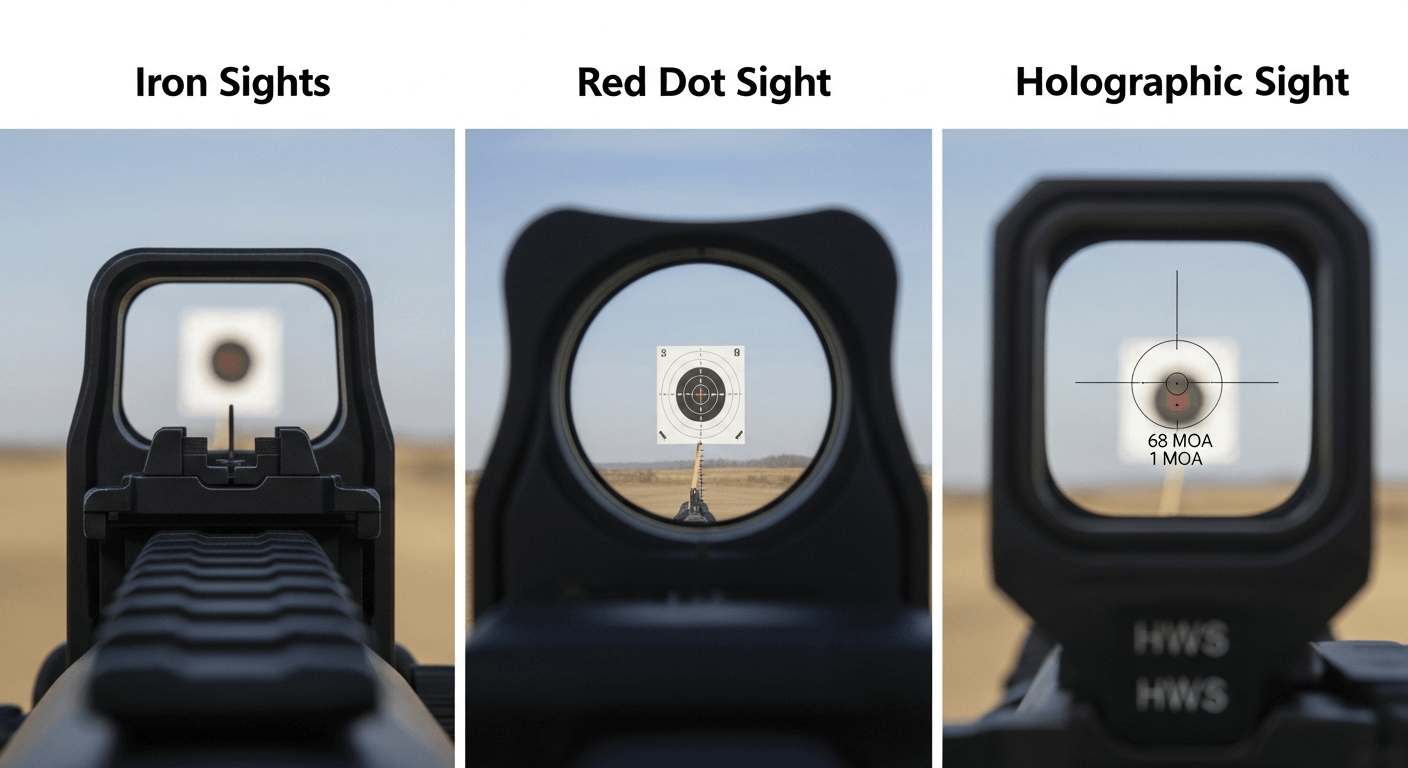 A shooter's-eye view comparing the sight picture of Iron Sights (requiring alignment of three focal planes) with the single-plane focus of Red Dot and Holographic sights.
All sighting systems align the firearm with the target but use different methods. Iron sights have a front post and rear notch that the shooter aligns with the target. Red dot sights project a red LED dot onto a lens, seen over the target, usually parallax-free for quick aiming with both eyes open. Holographic sights use lasers and mirrors to project a 3D reticle on a window, offering durability, a wider view, and complex reticles. Each type provides a different visual experience and performance, so choice depends on the shooter's needs and preferences.
What This Guide Will Cover: A Comparative Analysis for Clarity and Accuracy
This guide provides shooters with a detailed understanding of three main aiming systems: iron sights, red dot sights, and holographic sights. It explains sight picture and alignment, showing why target visibility differs among sights. The guide covers each sight's mechanics, pros, cons, and best uses for firearms like rifles and pistols. It compares accuracy, speed, clarity, durability, performance in tough conditions, learning curve, cost, and weight. Finally, it offers scenario-based advice and tips on zeroing and training. This analysis helps you choose the best sight and understand how they compare to options like telescopic sights.
Understanding the Fundamentals of Aiming
Effective marksmanship is built upon a foundation of understanding core aiming principles. These principles remain constant regardless of the sighting system employed, but how each system presents them to the shooter can drastically alter the speed and accuracy of the shot. The goal is always to achieve a precise sight picture—the visual relationship between the front sight, rear sight (or reticle in electronic sights), and the target.
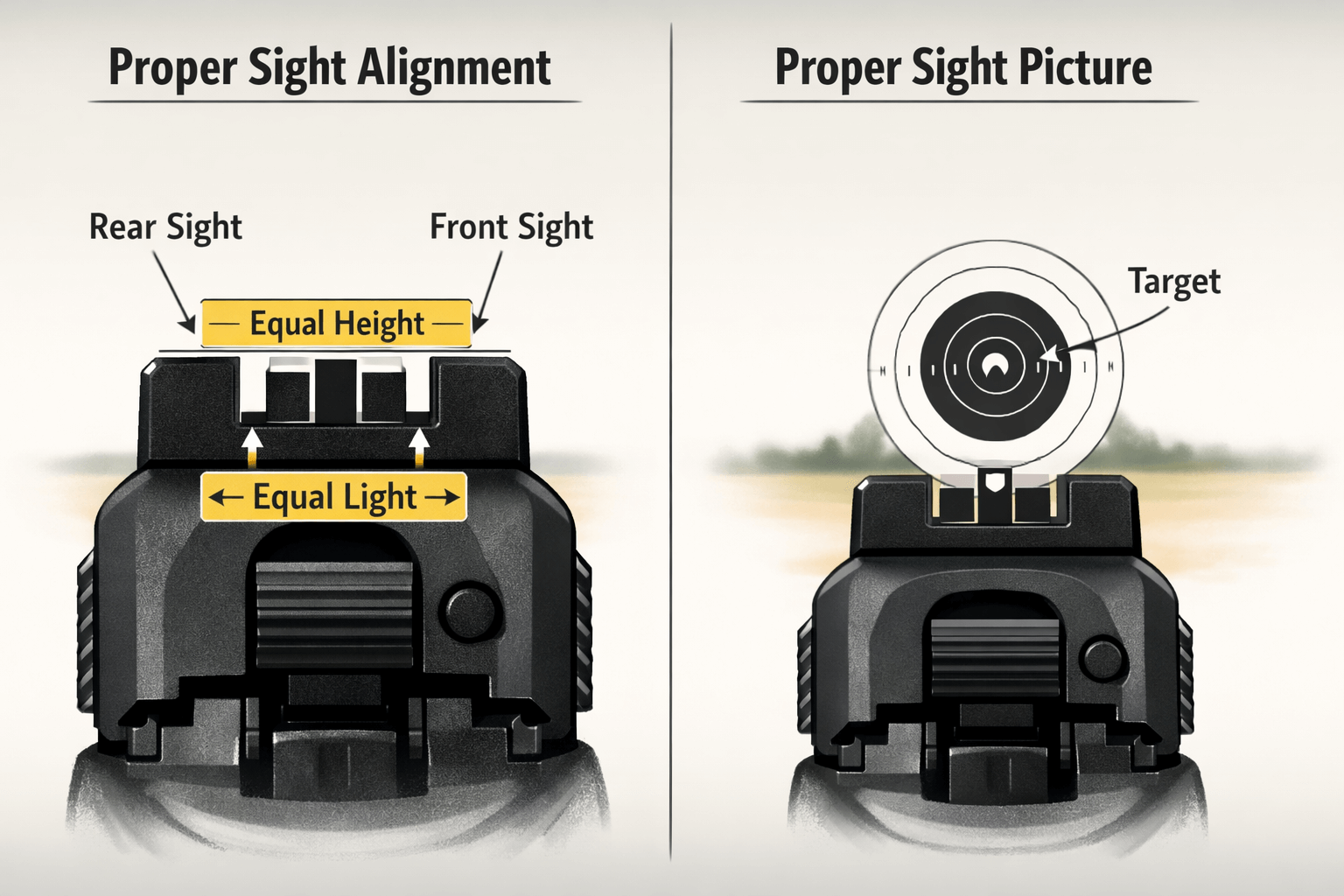 Proper Sight Alignment and Sight Picture
Essential Concepts for Accurate Shooting
The quality of a sight picture is paramount. For iron sights, this means aligning the top of the front sight post with the center of the rear sight notch, while simultaneously keeping both the front and rear sights in focus and positioned correctly relative to the target. This requires a delicate balance, as the eye can only sharply focus on one plane at a time. Consequently, experienced shooters learn to maintain a consistent focus on the front sight while allowing the rear sight and target to remain slightly softer. This precise alignment is crucial for accurate shooting, especially at longer ranges.
Red dot and holographic sights show a single aiming point—the reticle—over the target. Designed to be parallax-free or nearly so, they let shooters focus on the reticle without aligning multiple parts. Their "both-eyes-open" design helps faster target acquisition and a natural sight picture. Which sight is most accurate or offers the best view depends on context, skill, and scenario. Iron sights need precise alignment, while modern electronic optics often give a clearer, direct target view, aiding accuracy under time pressure. Red dots work best at close to medium ranges for speed, while telescopic sights with magnification suit long-range precision.
Iron Sights: The Timeless Foundation
Iron sights represent the most fundamental and enduring form of aiming apparatus for firearms. Their simplicity, reliability, and strength have made them important for centuries. They are still a key part of many shooters' gear. Shooters use them especially for basic training and backup.
What Are Iron Sights and How They Work
Iron sights have two parts: a front sight (post, blade, or bead near the muzzle) and a rear sight (notch or aperture near the eye). The shooter aligns the front sight's top with the rear sight's center, then places this over the target. Proper sight picture requires focusing on the front sight centered in the rear notch and aiming at the target point. Common types include open rear sights with U-shaped or square notches and ghost-ring sights with small apertures for faster, precise aiming.
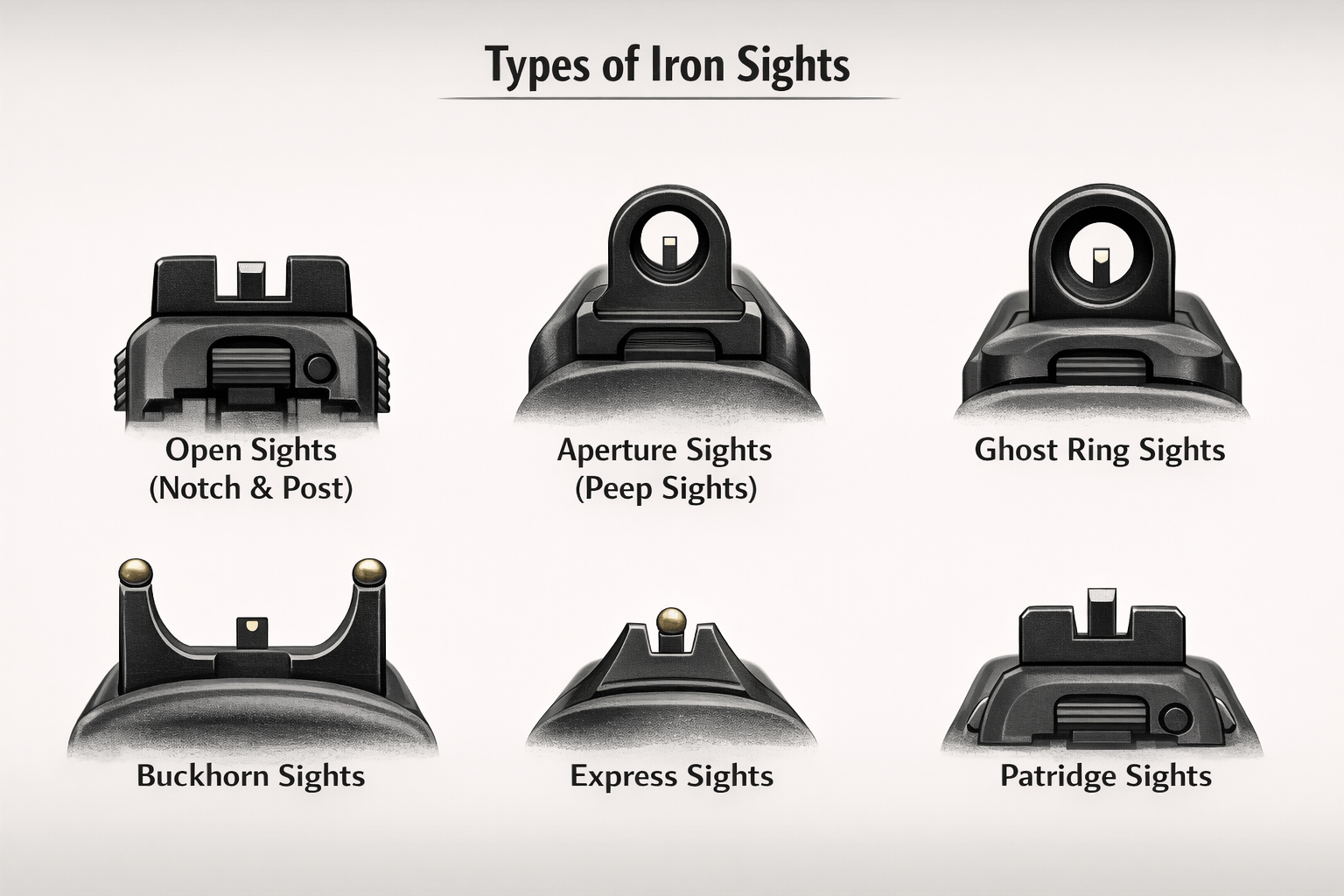 The various types of Iron Sights that you will see across weapons.
Advantages of Iron Sights
The primary advantage of iron sights is their inherent simplicity and reliability. They require no batteries, power sources, or electronic components, making them impervious to electronic failure or the need for maintenance related to power. This makes them exceptionally durable and resistant to extreme environmental conditions, such as heavy rain, dust, or extreme temperatures, which can affect other types of Optics. Their low cost and widespread availability also make them an accessible option for all shooters, especially those on a budget or just beginning their training. Furthermore, for certain applications, particularly with a pistol at close range, iron sights can offer sufficient accuracy. They also provide an excellent foundation for learning fundamental marksmanship principles, such as consistent sight alignment and trigger control, without the distraction of complex features.
Disadvantages of Iron Sights
Iron sights have limits, mainly needing precise alignment of the front sight, rear sight, and target, which can be slower than other systems, especially for new shooters or under pressure. Seeing the sights clearly is hard in low light, even with tritium or fiber optic inserts, and they don't match illuminated electronic sights. Their narrow view and need to focus on the front sight can be drawbacks. Adjusting windage and elevation often requires tools, making quick changes harder than with red dot or holographic sights.
Ideal Use Cases for Iron Sights
Iron sights are great for training new shooters because they teach sight alignment and picture basics. They serve as reliable backups on rifles and pistols if primary optics fail. For close defense or quick shots at short range, their simplicity and reliability make them suitable. Hunters often prefer them for moderate distances due to their toughness. For those wanting a simple, dependable sight that resists weather and needs no batteries, iron sights remain a good choice.
Red Dot Sights: Modern Efficiency
Red dot sights have changed how many shooters find targets. They are fast, simple, and effective. This makes them very popular for many uses, from personal defense to shooting sports.
What Are Red Dot Sights?
A red dot sight is a non-magnifying optic that projects an adjustable red LED dot onto a lens, appearing to float on the target. Most modern red dots are parallax-free, so the dot stays on target regardless of eye position within the viewing window. This lets shooters keep both eyes open, improving awareness and speed. Common reticles are simple 3- or 5-MOA dots, but circles, triangles, and combinations also exist.
Advantages of Red Dot Sights
Red dot sights offer unmatched speed in target acquisition. The illuminated dot gives a clear aiming point that the eye naturally seeks, letting shooters quickly place it on the target without the precise alignment iron sights need. Shooting with both eyes open boosts speed and peripheral vision, vital for awareness in changing situations. They're easier to learn and use than iron sights, fitting both new and experienced shooters. Red dots work well at typical pistol and rifle carbine ranges, providing enough accuracy for defense and recreation. Unlike magnified scopes, they're lightweight and compact, adding little bulk to firearms.
Disadvantages of Red Dot Sights
Red dot sights depend on batteries to power the illuminated reticle. If the battery dies, the sight stops working, turning it into a useless optic. This requires regular battery checks and replacements, and battery quality affects performance and life. While many red dots are parallax-free, cheaper or older models may have parallax error, shifting the impact point if the shooter's eye isn't centered. Without magnification, they're less suited for long-range precision than telescopic sights. Dirt or debris can block the reticle, and in bright sunlight, some LEDs may not be bright enough against glare.
Ideal Use Cases for Red Dot Sights
Red dot sights are exceptionally versatile and excel in a wide range of applications. They are a dominant choice for home defense and personal self-defense firearms, where rapid target engagement under stress is paramount. For pistol shooters, red dot sights mounted on slides have become increasingly popular for competition and concealed carry. On Rifles, particularly carbines and modern sporting rifles, red dots offer a significant advantage for general-purpose use, tactical applications, and shooting sports like 3-Gun. They are also highly effective for hunting scenarios where quick, close-to-medium-range shots are common, such as in dense woods or during drives. Their ease of use makes them a great option for shooters of all skill levels looking for a significant improvement in speed and intuitive aiming over traditional iron sights.
Holographic Sights: Advanced Precision
Holographic sights are the best in modern optical technology. They give shooters a strong and advanced tool. Shooters get great performance, clear views, and durability. They build upon the principles of electronic sights but utilize a more sophisticated projection system to create their aiming reticle.
How Holographic Sights Project 3D Reticles
A holographic sight uses a laser diode and mirrors to project a 3D holographic reticle on a front window. Unlike red dots that show a simple dot, holographic sights display complex reticles, often a central dot inside a circle or shapes. The reticle forms by recording interference patterns from laser beams on a transparent medium. When on, a laser re-illuminates this to recreate the 3D image. This tech offers almost no parallax regardless of eye position and often a wider view than many red dots. The reticle is bright green or red, with controls to adjust brightness for ambient light.
Advantages of Holographic Sights
Holographic sights are known for their durability and reliability, often surpassing traditional red dot sights. Their strong build and advanced parts handle heavy recoil and tough conditions, making them popular for tactical and professional use. The holographic reticle is very clear and often easier to see in poor lighting than a simple red dot. Its 3D image helps shooters get a natural, faster sight picture without straining to focus on the reticle. Many models offer multiple reticle options, letting shooters pick patterns that fit their style and improve precision.
Disadvantages of Holographic Sights
The primary disadvantage of holographic sights is their significantly higher cost compared to both iron sights and most red dot sights. The advanced technology and complex manufacturing processes involved make them a premium product. They are also generally bulkier and heavier than many red dot sights, which can be a consideration for shooters prioritizing a lightweight setup. Like red dot sights, holographic sights are battery-dependent, requiring a power source to illuminate the reticle. While they are typically built with robust internal components, battery failure will render the sight unusable. The sophisticated laser system also means they can be more susceptible to damage from impacts or improper handling than simpler iron sights.
Ideal Use Cases for Holographic Sights
Holographic sights are very durable and perform well. They are perfect for professional and tactical uses. These include law enforcement, military work, and serious self-defense where equipment must not fail. They are also a top-tier choice for high-end competitive shooting sports, particularly disciplines that demand speed, precision, and ruggedness. For Rifle platforms that are expected to endure harsh use, extreme recoil, or challenging environmental conditions, a holographic sight provides a superior level of reliability. These sights have advanced reticle options and a clear view. They work well for close fights and medium-distance shots. They combine speed and accuracy. They fill the gap between simple red dots and magnified scopes.
Direct Comparison: Accuracy, Clarity, and Performance Metrics
When comparing iron sights, red dot sights, and holographic sights, it's crucial to evaluate them across several key performance metrics. Each system offers a unique balance of advantages and disadvantages, making the "best" choice highly subjective and dependent on the individual shooter's needs and intended use.
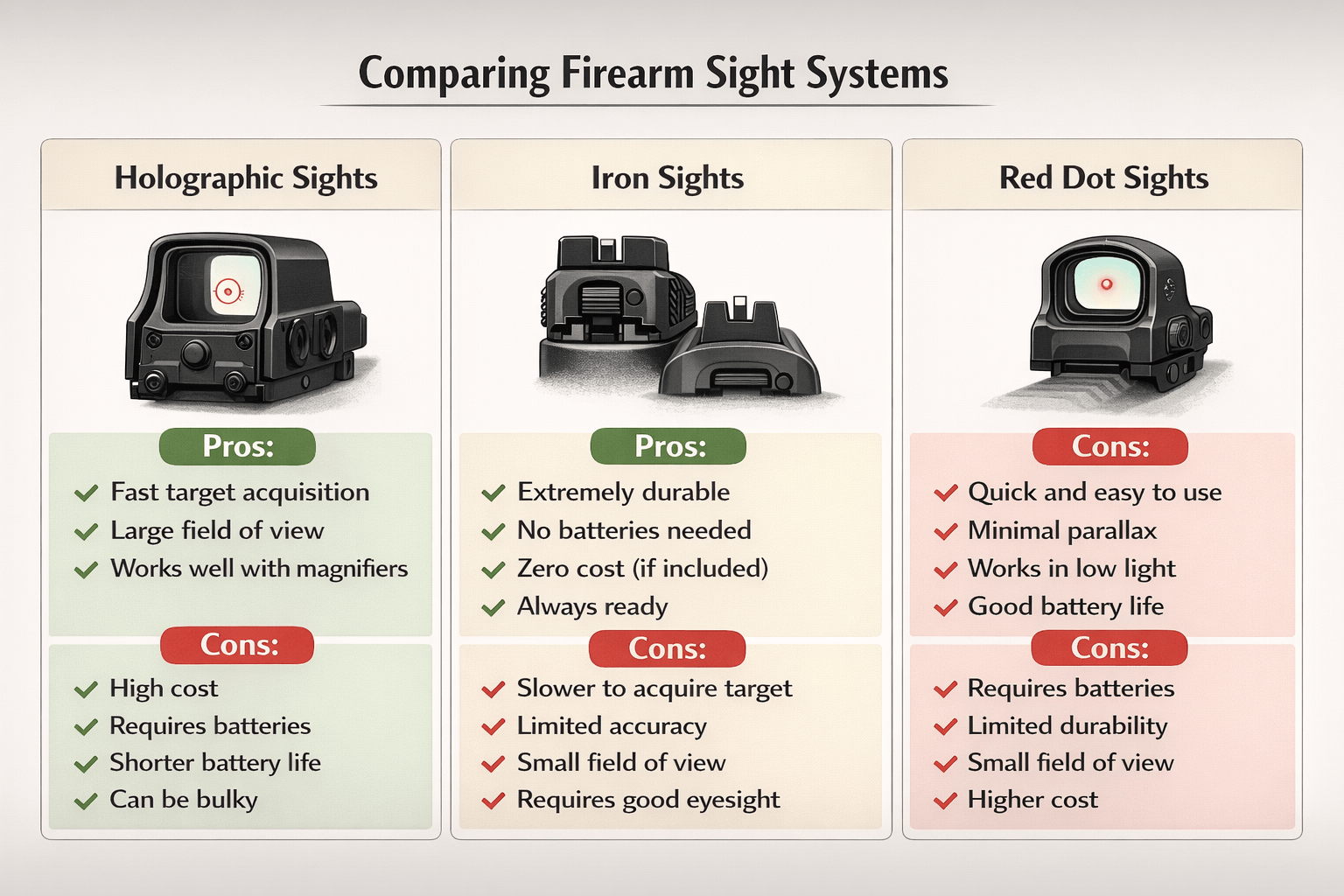 Pros and Cons of Holographic, Iron and Red Dot Sights.
Sight Picture and Clarity
Iron sights require aligning the front sight, rear sight, and target, which can clutter the view and be hard under pressure or low light. Red dot sights simplify this by projecting a single dot on the target, giving a cleaner, easier sight picture. Shooters can keep both eyes open, focusing with the dominant eye and using the other for peripheral awareness. Holographic sights offer similar clarity with less distortion and a 3D reticle that feels more natural, possibly aiding speed and aiming. Both red dot and holographic sights keep the target clear since they don’t require focusing on a front sight post that can block the view.
Speed of Target Acquisition
In terms of speed, red dot sights and holographic sights generally outperform iron sights. The illuminated reticle in electronic sights allows shooters to rapidly bring their firearm onto the target without the meticulous alignment process required for iron sights. Most red dots and holographic sights let you keep both eyes open. This helps you find and follow the target faster because your natural binocular vision works better. For dynamic shooting scenarios where time is critical, electronic sights offer a distinct advantage. Iron sights, while capable of rapid acquisition once mastered, demand more deliberate effort and practice to achieve comparable speed.
Accuracy Potential and Precision
Accuracy depends on the optics, firearm, ammo, and shooter. For close to medium ranges (up to 100-200 yards for pistols and carbines), red dot and holographic sights often offer precision equal or better than iron sights due to ease and speed. High-quality electronic sights are parallax-free, so accuracy stays consistent even if the eye isn’t perfectly centered. For long-range precision, magnified scopes are better. Some red dots have limited magnification or can use magnifiers, but they’re designed for faster shooting at moderate distances, not extreme precision. Skilled shooters can achieve great accuracy with iron sights at short ranges.
Performance in Adverse Conditions
Iron sights are inherently robust and perform reliably in most adverse conditions, unaffected by battery failure or electronic malfunctions. However, their visibility can be severely compromised in low light, fog, or heavy precipitation. Red dot sights and holographic sights offer illuminated reticles that greatly enhance visibility in low light. However, they are susceptible to battery failure, and extreme environmental conditions like heavy fog or snow can obscure the reticle or lenses. High-quality holographic sights, due to their robust construction, often perform better in extreme conditions than many red dots. The quality of the lens coatings and sealing also plays a significant role in how well any electronic sight performs in rain or dust.
Durability, Reliability, and Maintenance
Iron sights are the pinnacle of durability and reliability due to their mechanical nature and lack of sensitive components. They are virtually maintenance-free beyond occasional cleaning. Red dot sights vary widely in durability; while many are ruggedized and shockproof, they are still electronic devices. Battery life is a key consideration, typically ranging from a few thousand hours to tens of thousands of hours on lower settings, but it requires proactive management. Holographic sights are generally considered the most durable among electronic Optics, built to withstand significant abuse and recoil. However, they are also battery-dependent and, due to their complexity, might be more susceptible to internal electronic failure than a simple red dot.
Learning Curve and Ease of Use
The learning curve for iron sights can be steep for new shooters, as it requires diligent practice to master consistent sight alignment and sight picture. Red dot sights offer a dramatically reduced learning curve. Their intuitive nature and ease of use allow most shooters to become proficient very quickly. Holographic sights share this ease of use with red dots, providing a similarly intuitive aiming experience. For shooters looking for the quickest path to accurate shooting, electronic sights are generally the better option.
Cost, Weight, and Size
In terms of cost, iron sights are the most budget-friendly, often coming standard on firearms or available for a relatively low price. Red dot sights span a wide price range, from affordable entry-level models to high-end units costing several hundred dollars. Holographic sights are typically the most expensive option, with prices often exceeding $500 and reaching over $700 for premium models. Weight and size also vary, with iron sights being the lightest and smallest. Red dot sights are generally compact and lightweight, though larger models exist. Holographic sights tend to be bulkier and heavier than most red dots due to their advanced internal construction.
Choosing Your Ideal Sighting System: Scenario-Based Recommendations
The choice between iron sights, red dot sights, and holographic sights is not about finding a universally "best" option, but rather the optimal solution for a specific shooter, firearm, and intended application. Understanding common scenarios can help guide this decision-making process.
For Self-Defense and Home Protection (Pistol/Rifle)
For home defense and personal self-defense, speed and ease of use are paramount. Red dot sights are an excellent choice for both pistols and Rifles. They help you find targets quickly, especially in low light at home. Shooting with both eyes open improves your awareness of the situation. Their intuitive nature means less training is required to achieve proficiency under stress. While iron sights can suffice, they are slower to acquire. Holographic sights also offer superb performance but may be overkill for many home defense setups due to their cost and size, though their durability is a plus.
For Hunting (Varying Ranges and Environments)
Hunting presents diverse requirements. For dense woods where quick shots are common at moderate ranges, red dot sights excel with their speed and ease of use. For longer-range hunting that requires precise shot placement at distances exceeding 100-200 yards, a magnified telescopic sight is typically the better choice. However, hybrid solutions exist, like a red dot paired with a flip-to-side magnifier. Iron sights are still a good and reliable choice for traditional hunting. They are useful when battery life matters or the environment is harsh. However, they do not work well in low light. Some specialized iron sights with fiber optics or tritium offer improved low-light visibility.
For Shooting Sports and Competition (Speed and Precision)
In competitive shooting sports, the demands vary. For action shooting disciplines like 3-Gun or speed steel, red dot sights and holographic sights are almost mandatory due to the speed advantage they provide. The choice between the two often comes down to personal preference and budget, with holographic sights potentially offering an edge in ruggedness for harsh competition environments. For precision-based competitions at longer ranges, a high-quality Scope or telescopic sight is essential. People still use iron sights in some areas. These include historical firearms contests and certain precision rifle matches. They use iron sights because they are simple and reliable.
For Tactical Riflescopes and Professional Applications
Law enforcement and military work often need equipment that is durable, reliable, and works well in tough conditions. Holographic sights are frequently favored here due to their robust construction, excellent clarity, and ability to withstand harsh use and recoil. Many also feature complex reticles suitable for various tactical scenarios. Red dot sights are also widely used, especially on carbines, due to their speed and lightweight profile, but the highest-end, ruggedized models are often preferred. Iron sights serve as crucial backup systems. When you need magnification for long distances or close observation, you must use a telescopic sight or a magnified optic like a Low Power Variable Optic (LPVO). People often use these with a red dot or iron sights for close fighting.
For Beginners and Budget-Conscious Shooters
For shooters just starting out or those on a tight budget, iron sights are an excellent, cost-effective choice. They provide a fundamental understanding of aiming principles without the expense of electronic Optics. Once foundational skills are established, a good quality red dot sight offers a significant upgrade in speed and ease of use at a relatively accessible price point for many reputable brands. Entry-level red dots can be found for under $100, though investing a bit more will yield better performance and durability. Holographic sights are generally not recommended for beginners solely due to their high cost.
Maximizing Performance with Your Chosen Sight
Selecting the right sighting system is only the first step in achieving optimal performance. Proper setup, calibration, and continuous training are essential to unlock the full potential of any sight, whether it's iron sights, a red dot sight, or a holographic sight.
The Importance of Proper Zeroing and Sighting In
Zeroing your sights ensures your firearm shoots where you aim by setting the exact point your ammo hits relative to your aim at a set range. For iron sights, adjust the windage and elevation screws on the rear (and sometimes front) sight to move the impact point. Red dot and holographic sights use similar adjustments to align the reticle. Use consistent ammo during zeroing since different loads behave differently. Typically, pistols are zeroed at 25 yards, rifles at 50 or 100 yards depending on use and caliber. Many shooters bore sight first to get sights close before live firing, saving time and ammo.
Ongoing Training and Skill Development
The most advanced Optics will not compensate for a lack of skill. Consistent training is paramount for any shooter. This includes both dry-fire practice and live-fire drills. Dry-fire practice allows shooters to work on fundamentals like drawing from a holster, sight acquisition, trigger control, and follow-through without expending ammunition. Live-fire drills should include real-world scenarios. These drills focus on quick target shooting, switching between targets, and shooting from different positions. For iron sights, practice is key to developing speed and consistency in alignment. With red dot sights and holographic sights, training should focus on quickly placing the reticle on target and maintaining a stable sight picture while executing the shot. Understanding how your chosen sight behaves under stress and in dynamic situations is a vital part of marksmanship development.
When to Consider a Magnifier or Scope (Beyond the Core Three)
Iron sights, red dots, and holographic sights work well for many uses. But sometimes, extra magnification is helpful or needed. A magnifier can be used in conjunction with a red dot or holographic sight, typically mounted behind it on a flip-to-side mount. This allows the shooter to quickly switch between a non-magnified, fast-acquisition mode and a magnified mode for increased precision at intermediate ranges.
For serious long-range precision shooting, a dedicated telescopic sight is the standard. These Scopes offer a wide range of magnifications, allowing shooters to clearly identify and engage targets at distances far beyond the effective range of unmagnified electronic sights or iron sights. The reticle designs in Scopes are often more complex, incorporating features like ballistic drop compensators (BDC) and ranging reticles to aid in precise aiming at extended distances. Knowing the differences between a simple red dot, a holographic sight, and a true telescopic sight helps you pick the right optics. Using a mix of these systems can make a firearm very versatile.
Comparing Iron, Red Dot, and Holographic Sights
The journey to mastering marksmanship is continuous, and the choice of sighting system is a pivotal element in that progression. We have looked at the main differences between iron sights, red dot sights, and holographic sights. We showed how each helps a shooter find a target clearly and accurately. Iron sights remain the timeless foundation, offering unparalleled reliability and serving as an indispensable tool for training. Red dot sights deliver modern efficiency, democratizing speed and intuitive aiming for a broad range of applications. Holographic sights improve performance. They offer great durability and clear views in tough environments.
The intelligence gathered throughout this analysis reveals that the "most accurate" or "clearest" view is not absolute but context-dependent. For the beginner, the simple clarity of iron sights and the discipline they instill are invaluable. For the defender or competitor prioritizing speed, the immediate sight picture provided by red dot sights or holographic sights is often transformative. For the long-range enthusiast, the magnification of a telescopic sight becomes essential.
Ultimately, the best sighting system is the one that best suits your individual needs, skill level, firearm platform, and budget. It is the system that allows you to achieve your desired sight picture reliably, acquire your target quickly, and place your ammunition precisely where intended. We suggest you think about the situations and performance points we discussed. Try different options if you can. Also, get good training to improve your skills. By understanding these systems, you empower yourself to make informed decisions, enhancing your confidence and effectiveness as a shooter. The quest for perfect aim is an ongoing pursuit, and with the right knowledge and tools, your journey will be met with greater clarity and accuracy.
FAQs
What’s the main difference between red dot and holographic sights?
Red dot sights use an LED to project a simple dot onto a lens, while holographic sights use a laser to create a more complex reticle that appears to float in space. Red dots are lighter and have longer battery life, while holographics offer faster target acquisition and better performance with magnifiers. Your choice depends on whether you prioritize simplicity or advanced reticle clarity.
Are holographic sights more accurate than red dots?
Not inherently. Both are extremely accurate within typical engagement distances. Holographic sights can feel faster for some shooters because the reticle remains crisp even with astigmatism and works well under magnification. Red dots excel in simplicity and precision for general shooting.
Why do some shooters still prefer iron sights?
Iron sights are durable, battery‑free, and nearly impossible to break. They’re also lightweight and great for training fundamentals. While optics are faster, irons remain a reliable backup and are preferred by shooters who want a no‑fail solution.
Which sight is best for beginners?
Most beginners find red dot sights the easiest to learn because the “put the dot on the target and shoot” concept is intuitive. Iron sights require more alignment skills, and holographic sights are usually more expensive. A basic red dot is often the best entry point.
Do red dots or holographic sights work better with astigmatism?
Holographic sights typically look clearer for people with astigmatism because their reticles don’t distort as much. Many shooters with astigmatism see red dots as starbursts or smears. Trying both in person is the best way to know what your eyes prefer.
Are holographic sights worth the higher price?
They can be if you value fast target transitions, a crisp reticle, and strong performance with magnifiers. For casual shooting or budget builds, a red dot usually offers better value. Holographics shine in demanding or tactical environments.
Do I need backup iron sights if I’m running a red dot or holographic sight?
Backup irons are recommended but not mandatory. They give you a fail‑safe option if your optic breaks or the battery dies. Many shooters run “co‑witnessed” irons so they can transition instantly without removing the optic.
Which sight is best for low‑light shooting?
Red dots and holographic sights both outperform iron sights in low light because they provide an illuminated aiming point. Holographic reticles can be easier to see against cluttered backgrounds, but both are excellent choices for dim environments.
Can I use a magnifier with red dot or holographic sights?
Yes. Both work with magnifiers, but holographic sights tend to maintain reticle clarity and size better under magnification. Red dots can appear distorted or enlarged when magnified, depending on the model and the shooter’s eyesight.
Are iron sights still reliable for home defense?
Absolutely. Iron sights never run out of batteries and are extremely durable. However, optics offer faster target acquisition in stressful situations. Many shooters pair a red dot with backup irons for the best of both worlds.
Which sight is best for long‑range shooting?
Neither red dots nor holographic sights are designed for true long‑range precision. They excel at close to mid‑range distances. For long‑range accuracy, a low‑power variable optic (LPVO) or traditional scope is a better fit.
Do red dot and holographic sights hold zero well?
Quality optics from reputable brands hold zero extremely well, even under recoil or rough handling. Budget optics can lose zero more easily. Iron sights are the most stable overall, but modern optics are very reliable when properly mounted.
How long do red dot and holographic sight batteries last?
Red dots often run for thousands of hours on a single battery—sometimes years. Holographic sights use more power and typically last hundreds of hours. Many shooters replace batteries annually as a precaution.
Are these sights legal to use for hunting?
In most places, yes, but regulations vary by state and game type. Some states restrict electronic sights for certain seasons or species. Always check your local hunting laws before heading out.
Which sight is fastest for target acquisition?
Holographic sights generally feel the fastest because their reticles remain crisp and easy to track, even when moving. Red dots are close behind and still extremely fast. Iron sights require more alignment, so they’re typically slower under stress.