Listen to this article
Table of Contents
- Introduction: Why Clear Communication Matters
- A Brief History of Communication Clarity: From Battlefield to Global Standard
- The Full NATO Phonetic Alphabet List: Alpha to Zulu and Beyond
- Where the Military Alphabet is Used Today: Critical Applications
- Beyond the Military: Everyday Applications for Civilians
- Mastering the Military Alphabet: Tips and Techniques for Learning and Practice
- Conclusion: The Enduring Power of Clear Communication
Introduction: Why Clear Communication Matters
In a world saturated with digital information and high-speed communication, clarity can still be the first casualty of noise. A simple mistake of one letter over a crackling radio or bad phone line can cause many problems. These problems can range from a failed customer service call to a serious failure in a high-risk military operation. The inherent ambiguity of spoken language, where letters like "B," "P," "D," and "T" can sound deceptively similar, creates a persistent challenge. This is where a simple yet profoundly effective tool comes into play: the military alphabet.
The Unseen Language of Precision
Often heard in movies and news reports but rarely understood in its full scope, the military alphabet—officially known as the NATO phonetic alphabet—is more than just a list of code words. It is a meticulously designed system for eliminating ambiguity. It serves as a universal translator for spelling, ensuring that critical information is transmitted and received with absolute certainty, regardless of background noise, signal quality, or linguistic accents. This system is the bedrock of precise communication in fields where a single mistake is not an option.
A Universal Standard for Clarity
While its origins are military, its applications have expanded dramatically. From an air traffic controller guiding a jumbo jet to a police dispatcher coordinating an emergency response, this phonetic standard ensures that every piece of data is conveyed accurately. It’s a low-tech solution to a high-tech problem, providing a human-centric layer of security and support that modern technology alone cannot guarantee. In a professional context, poor communication can be a significant source of stress, with 51% of workers admitting it increases their stress levels. The military alphabet is a direct countermeasure to this kind of operational friction.
Comprehensive Guide to Military Alphabet History and Usage
This guide serves as an authoritative resource on the military alphabet. We will delve into its fascinating history, from early, fragmented attempts at standardization to the globally recognized system used today. We will give the full list of letters and numbers with pronunciation help. We will look at its important uses in military, government, and civilian areas. We will also share practical ways to learn and master this valuable skill. By the end, you will have a comprehensive knowledge of this essential communication tool and its enduring relevance in our modern world.
A Brief History of Communication Clarity: From Battlefield to Global Standard
The need for a standardized phonetic alphabet was not born in a boardroom; it was forged in the crucible of conflict and technological limitation. As communication technology evolved from visual signals to radio waves, the inherent flaws in spoken language became glaringly apparent, often with life-or-death consequences.
Early Attempts and the Need for Standardization
In the early 20th century, as radio telephony became more common, various organizations developed their own informal spelling alphabets. The British Royal Navy used a system starting with "Apples, Butter, Charlie," while the United States military had its own versions that changed over time, such as the "Able, Baker, Charlie" alphabet used during World War II. These disparate systems created confusion between allied forces and international operators. A message relayed from a US ship to a British one could be easily garbled, turning vital information into a dangerous guessing game. The problem was clear: a universal source for phonetic spelling was needed.
The Birth of the ICAO/NATO Phonetic Alphabet
The true push for a global standard came from the world of aviation. The International Civil Aviation Organization (ICAO) saw the big risk of miscommunication between pilots and air traffic controllers from different countries. It did a major study in the late 1940s. The goal was to create a single, universal alphabet where each code word was easily distinguishable and pronounceable for speakers of many languages.
After extensive testing involving speakers from dozens of countries, the ICAO finalized a preliminary version in 1951. However, some words proved problematic. A final revision was made, and in 1956, the alphabet we know today—beginning with Alfa, Bravo, Charlie—was established. The North Atlantic Treaty Organization (NATO) adopted this ICAO standard shortly thereafter, leading to its common name, the NATO phonetic alphabet.
Evolution and Adoption by International Bodies
Once NATO adopted the ICAO standard, its use became widespread among member nations, solidifying its role in military and government communications. The International Telecommunication Union (ITU) is the United Nations agency for information and communication technologies. It formally adopted it. This made it the worldwide standard for radiotelephony. This broad adoption transformed it from a military-specific tool into a global language of precision for aviation, maritime, and emergency services. The United States and its allies had a big role in making this standard. North America still leads the global military communication market. It is expected to have about 48.30% of the market in 2025.
Why Standardization Was Critical: Avoiding Costly Errors
Before a universal standard, the potential for error was immense. Consider the letters "M" and "N," which are nearly indistinguishable over a noisy radio channel. A command to move to "grid point M" could be heard as "grid point N," sending troops into a potential ambush. In aviation, mistaking a runway designator like "30-D" for "30-B" could lead to a collision.
Standardization was a matter of operational security and safety. By ensuring that every letter had a unique, easily understood code word, the new alphabet drastically reduced the margin of error. This was especially critical in an era before the robust digital error-correction found in modern devices. The phonetic alphabet helped secure communication when coordinating naval fleets, sending air support, or sharing secret intelligence. It made sure the information sent stayed correct. The investment in such systems reflects their importance; in 2023, the military communication market reached a valuation of approximately USD 36.30 billion, a testament to the high value placed on clarity and security.
The Full NATO Phonetic Alphabet List: Alpha to Zulu and Beyond
At its core, the NATO phonetic alphabet is a simple substitution system. However, its design is the result of rigorous linguistic science aimed at maximizing clarity and minimizing confusion across different languages and accents.
Understanding the Structure and Purpose
Each word in the alphabet was chosen based on three primary criteria:
- Distinctiveness: The word must sound unique and not be easily confused with any other word in the list, even when distorted by poor signal quality.
- Pronounceability: It must be easy for non-native English speakers to pronounce. This is why some spellings, like "Alfa" and "Juliett," deviate from standard English to encourage correct pronunciation.
- Recognition: The words should be common enough to be easily recognized by operators worldwide.
The purpose is to replace the ambiguous sound of a letter name with the clear, unmistakable sound of a full word, turning a potential point of failure into a point of certainty.
The Complete Letter-by-Letter Breakdown
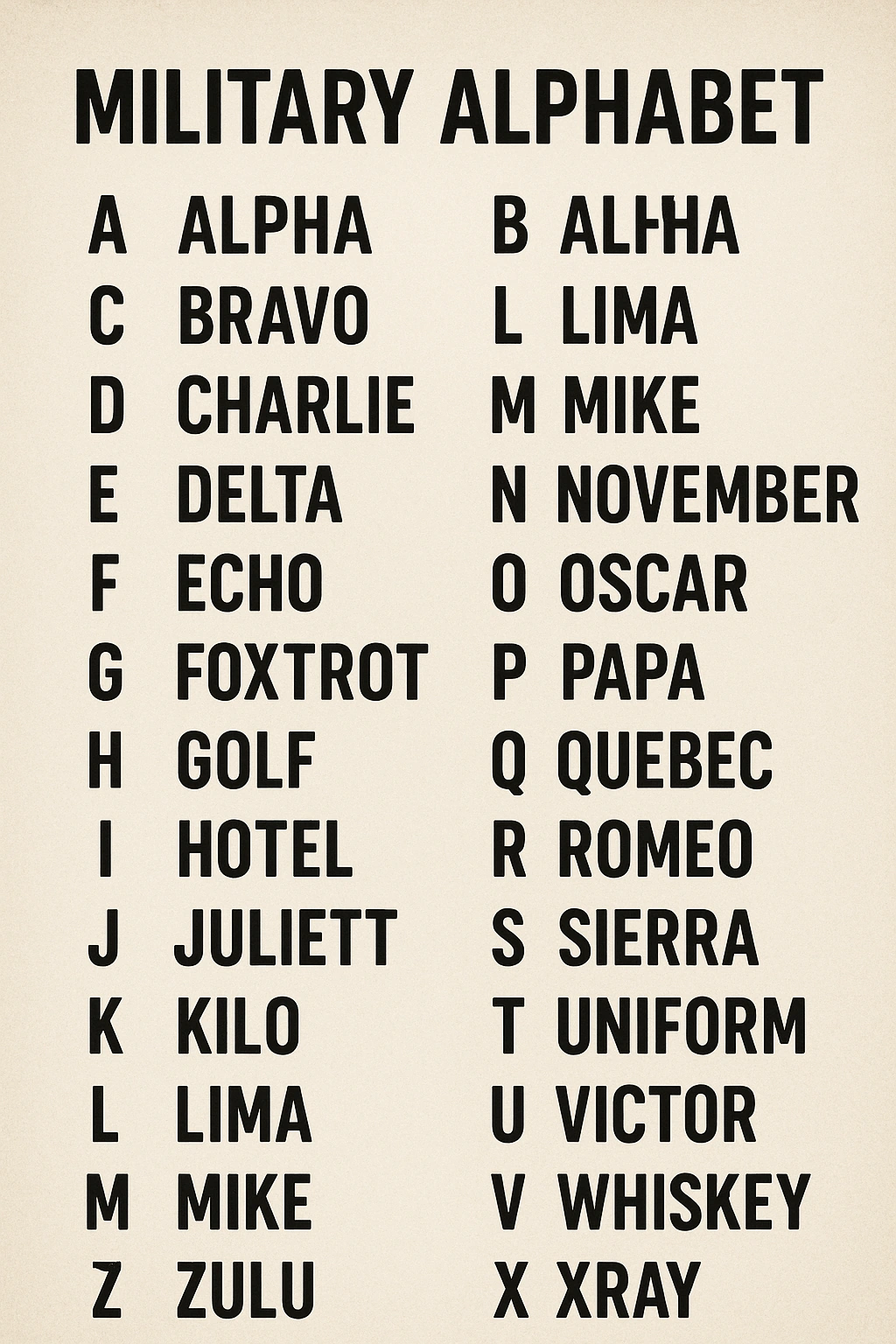
Below is the complete, official NATO phonetic alphabet. Note the spelling of "Alfa" and "Juliett," which are intentionally altered to ensure non-English speakers do not drop the final vowel sounds.
- A - Alfa (AL-fah)
- B - Bravo (BRAH-voh)
- C - Charlie (CHAR-lee)
- D - Delta (DELL-tah)
- E - Echo (ECK-oh)
- F - Foxtrot (FOKS-trot)
- G - Golf (GOLF)
- H - Hotel (hoh-TELL)
- I - India (IN-dee-ah)
- J - Juliett (JEW-lee-ett)
- K - Kilo (KEY-loh)
- L - Lima (LEE-mah)
- M - Mike (MIKE)
- N - November (no-VEM-ber)
- O - Oscar (OSS-cah)
- P - Papa (pah-PAH)
- Q - Quebec (keh-BECK)
- R - Romeo (ROW-me-oh)
- S - Sierra (see-AIR-ah)
- T - Tango (TANG-go)
- U - Uniform (YOU-nee-form)
- V - Victor (VIK-tah)
- W - Whiskey (WISS-key)
- X - X-ray (ECKS-ray)
- Y - Yankee (YANG-key)
- Z - Zulu (ZOO-loo)
Here is an image that can be printed out to use as a reference guide for the military Alphabet:
Standardized Number Pronunciation for Unambiguous Clarity
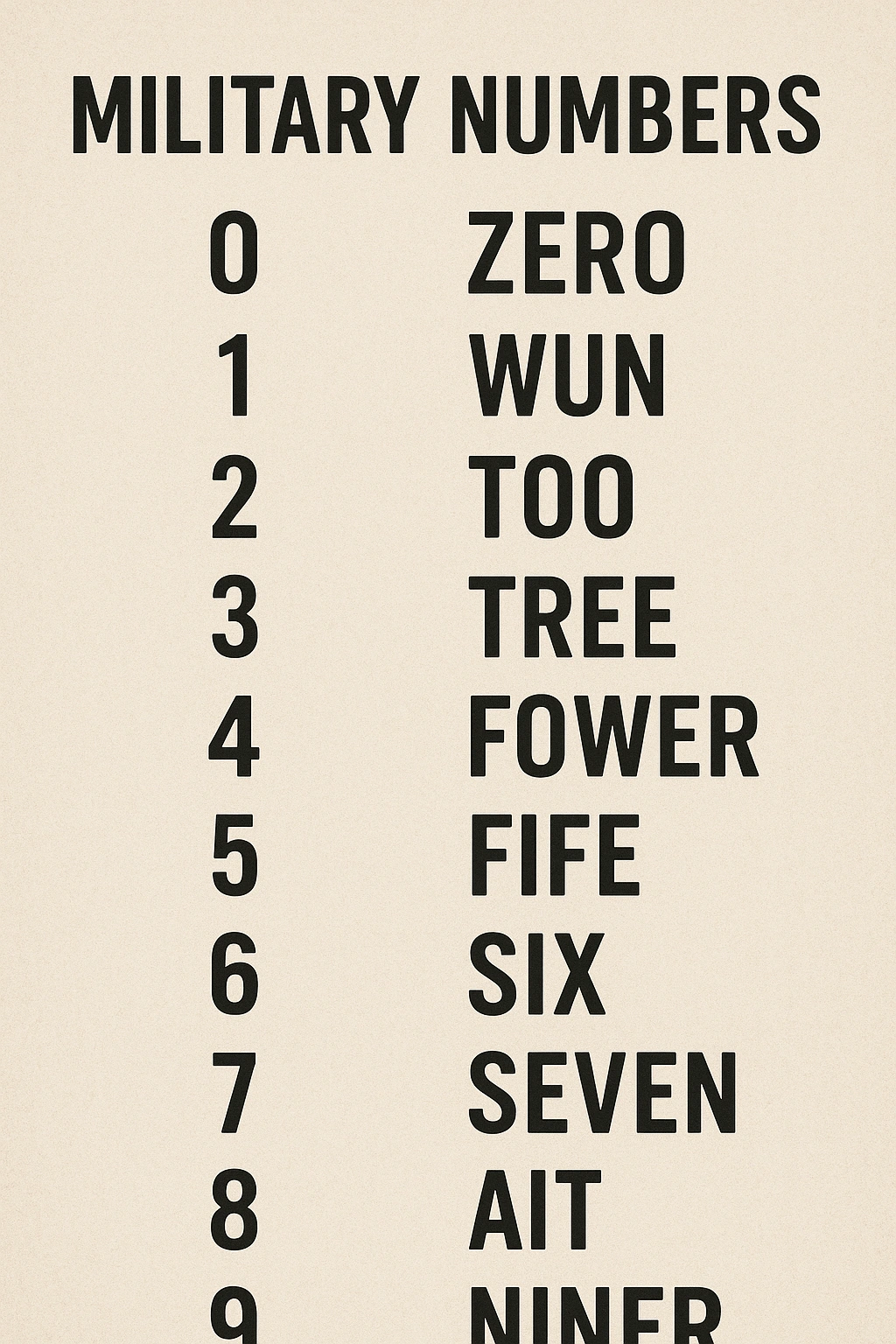
Just as letters can be misheard, numbers are also a common source of confusion. The words "five" and "nine" can sound similar, especially over a noisy connection. To solve this, the NATO alphabet includes standardized pronunciations for digits 0 through 9. The emphasis is on elongated vowels and distinct consonants to ensure there is no room for interpretation.
- 0 - Zero (ZE-RO) - Pronounced with two distinct syllables.
- 1 - Wun (WUN) - Using a "W" sound to avoid confusion with "fun."
- 2 - Too (TOO) - Emphasizing the "oo" sound.
- 3 - Tree (TREE) - Using a hard "tr" sound to differentiate it from "free."
- 4 - Fower (FOW-er) - Pronounced with two syllables to distinguish it from the word "for."
- 5 - Fife (FIFE) - Using a long "i" sound to avoid confusion with "nine."
- 6 - Six (SIX) - Standard pronunciation.
- 7 - Seven (SEV-en) - Standard pronunciation.
- 8 - Ait (AIT) - Emphasizing a long "a" sound.
- 9 - Niner (NINE-er) - Using two syllables to clearly distinguish it from "five."
This system for numbers is just as crucial as the one for letters. When relaying coordinates, frequencies, or quantities, precision is paramount. A pilot receiving clearance for "Runway Niner" instead of "Runway Five" receives unambiguous information, which is a critical element of flight safety.
Here is a reference guide for military numbers that can be printed out:
Where the Military Alphabet is Used Today: Critical Applications
The NATO phonetic alphabet sounds like it is only for the military. But it is one of the best examples of a military idea used widely by civilians and businesses. Its applications span dozens of industries where clear communication is non-negotiable.
Military Operations and National Security
The original and most critical application remains within the armed forces of the United States and other NATO countries. From the Pentagon command center to a forward operating base, the alphabet is the linguistic backbone of operations. It is used to:
- Relay Coordinates: Specifying locations with absolute precision.
- Identify Units: "Bravo Company, move to checkpoint Zulu."
- Transmit Coded Messages: Spelling out encrypted alphanumeric strings where a single error would render the message useless.
- Provide Support: Coordinating air support, medical evacuations (medevac), and logistical supply drops.
- Enhance Security: Ensuring that sensitive intelligence and commands are not misinterpreted. The increasing use of advanced technology, with approximately 38% of military deployments now utilizing encrypted radios, still relies on the human element of phonetic spelling for verification and clarity when voice communication is required. This system is a core component of federal government communications security.
Aviation and Air Traffic Control (ICAO Standard)
In the civilian world, aviation is the most visible user of the phonetic alphabet. The ICAO, which developed the standard, mandates its use globally for all international flights. Pilots and air traffic controllers use it constantly to:
- Identify Aircraft: Aircraft tail numbers (e.g., "November-Seven-Seven-Five-Papa-Uniform") are always read phonetically.
- Assign Runways and Taxiways: "Taxi to runway Two-Fife via taxiway Delta."
- Communicate Flight Plans: Spelling out waypoints, airways, and other navigational information.
This standardized language ensures a pilot from Japan can communicate flawlessly with a controller in Spain, creating a universal bubble of safety in the skies.
NATO Alphabet in Maritime Radio Communications
At sea, radio communication can be hampered by engine noise, weather, and vast distances. The International Maritime Organization mandates the use of the NATO alphabet for all ship-to-ship and ship-to-shore communications. It is used for:
- Spelling Ship Names: Especially crucial for ships with non-native or complex names.
- Relaying Positional Data: Transmitting latitude and longitude coordinates for navigation and distress calls.
- Coordinating Port Operations: Guiding vessels into harbors and docking safely.
Emergency Services and Public Safety
For police, fire departments, and emergency medical services, radio is the lifeline of their operations. In chaotic and urgent situations, the phonetic alphabet provides order and clarity.
- Police Dispatch: Officers use it to read license plate numbers ("Sierra-Mike-India-Tree-Hotel-Fife"), spell street names, and verify personal information like driver's license numbers.
- Fire Departments: Coordinating units and equipment at a fire scene, ensuring the right resources are sent to the right location (e.g., "Engine Fife, proceed to Sector Niner").
- 911 Operators: Using the alphabet to confirm addresses and names with callers who may be distressed or difficult to understand. This emergency information is vital for a swift response.
Industrial and Logistics Applications
In the world of supply chain management and large-scale industry, tracking millions of items requires precision. The phonetic alphabet is a valuable tool for:
- Warehouse Operations: Reading serial numbers, SKU codes, and bin locations over noisy intercoms or radios.
- Logistics and Shipping: Confirming tracking numbers and consignment details over the phone, ensuring that a package addressed to "B. Smith" isn't confused with one for "V. Smith." This can apply to anything from shipping electronic components to coordinating deliveries of essential goods like food.
- IT Support and Technology: Technicians and support staff use it to relay complex product keys, error codes, or network IDs to customers and colleagues, preventing costly data entry errors.
Beyond the Military: Everyday Applications for Civilians
The utility of the military alphabet is not confined to professional careers. Knowledge of this system is a practical life skill that can enhance clarity and reduce frustration in everyday situations. In a world where communication disorders are not uncommon—with approximately 1 in 14 U.S. children having a disorder related to voice, speech, or language—having a tool to ensure you are understood is invaluable.
When and Why Civilians Should Know It
Anyone who has struggled to spell their name, address, or a confirmation number over the phone can immediately appreciate the value of the phonetic alphabet. Common scenarios include:
- Customer Service Calls: Providing your account number or spelling your last name ("S as in Sierra, M as in Mike…") to an agent in a noisy call center.
- Making Reservations: Ensuring your name is spelled correctly for a flight, hotel, or restaurant booking to avoid problems at check-in.
- Providing Information in an Emergency: Clearly communicating a license plate number or street name to a 911 operator.
- Technical Support: Reading a long Wi-Fi password or software serial key over the phone to a support technician. On modern devices like an iPhone, this can be the difference between a quick fix and a lengthy, frustrating call.
Knowing the alphabet empowers you to take control of communication, preempting errors before they happen. It’s a simple skill that projects confidence and ensures your information is received correctly the first time.
Mastering the Military Alphabet: Tips and Techniques for Learning and Practice
Learning the 26 words of the NATO phonetic alphabet is a straightforward process that can be accomplished with a few simple techniques. Like any new skill, consistency and practice are key to achieving fluency.
Effective Memorization Strategies
The goal is not just to know the words but to recall them instantly. Several methods can help solidify the alphabet in your memory:
- Mnemonics and Association: Create a funny or memorable image in your mind for each word. For "Foxtrot," picture a fox dancing. For "Tango," imagine two people dancing the tango. The more vivid the mental picture, the stronger the neural connection.
- Flashcards: A classic and effective method. Write the letter on one side and the phonetic word on the other. Run through the deck daily until you can recall each word without hesitation.
- Chunking: Don't try to learn all 26 at once. Break the alphabet into smaller groups of five or six letters. Master one group before moving on to the next (e.g., Alfa to Echo, then Foxtrot to Kilo).
Developing Pronunciation Accuracy
Correct pronunciation is just as important as knowing the words themselves. The system is designed for universal clarity, so adopting the standard pronunciation is crucial.
- Listen to Examples: Find audio or video recordings of the NATO alphabet being spoken by pilots, air traffic controllers, or military personnel. Pay close attention to the emphasized syllables (e.g., "no-VEM-ber," "hoh-TELL").
- Practice Aloud: Recite the alphabet out loud regularly. Hearing yourself say the words helps reinforce both the memory and the correct pronunciation. Spell your name, the names of family members, or random words you see throughout the day.
Online Resources and Practice Tools
The digital age provides a wealth of tools to accelerate your learning. Many developers have created software and apps to help master this skill.
- Interactive Quizzes: Websites and mobile apps offer quizzes that test your recall speed and accuracy. Many gamify the experience, making practice more engaging.
- Reference Guides: Keep a digital or printed copy of the alphabet handy. Websites like Wikipedia provide a reliable source for the official list and its history.
- Mobile Apps: Search your phone's app store for "NATO phonetic alphabet" to find dedicated learning apps, many of which include audio pronunciations and practice drills.
Integrating it into Your Daily Routine for Fluency
The fastest way to achieve fluency is to make the phonetic alphabet a part of your daily life.
- Spell Everything: As you go about your day, mentally spell out words you see on signs, in books, or on screens. Spell your grocery list ("Mike-India-Lima-Kilo"). Spell the name of the next bus stop.
- Use It in Real Life: The next time you're on the phone with customer support, use the alphabet to spell your information. Start with just your last name. As you grow more confident, use it for longer strings of information. This practical application is the ultimate test and reinforcer of your knowledge.
Conclusion: The Enduring Power of Clear Communication
From the battlefields of the 20th century to the complex, interconnected world of today, the military alphabet has remained an indispensable tool. Its journey from a military necessity to a global standard for clarity is a testament to its simple, effective, and elegant design.
Recap of Its Importance and Versatility
We’ve seen how this system dismantles ambiguity, providing a common language for soldiers, pilots, police officers, and IT professionals alike. It is a basic part of security in government and military work. It is a key safety rule in aviation and sea travel. It is also a useful tool to improve efficiency in many industries. Its principles are so universal that they aid civilians in everyday tasks, empowering them with the ability to communicate with absolute precision. This is not just a collection of code words; it is a repository of shared knowledge designed to prevent error.
A Simple Tool, Profound Impact
Today, advanced technology and digital devices control how we communicate. The military alphabet reminds us how important the human part is. It acts as a final, analog check—a mental calculator for clarity—ensuring that the information transmitted between people is exactly the information received. The NATO phonetic alphabet is a simple tool. It helps avoid mistakes in complex military actions. It also helps make sure your food delivery goes to the right place. It has a big and lasting effect on our world.