Listen to this article
Table of Contents
- What does pistol action mean?
- What is a single action pistol?
- What is a double action pistol?
- What is a double action only pistol?
- Striker-fired vs hammer-fired pistols
- Trigger pull differences and what they mean for accuracy and speed
- Manual safeties, decockers, and carry condition
- Which action type is better for duty, concealed carry, home defense, and training?
- Pros and cons of single action, DA/SA, DAO, and striker-fired pistols
- Bottom line: which pistol action should you choose?
- FAQs
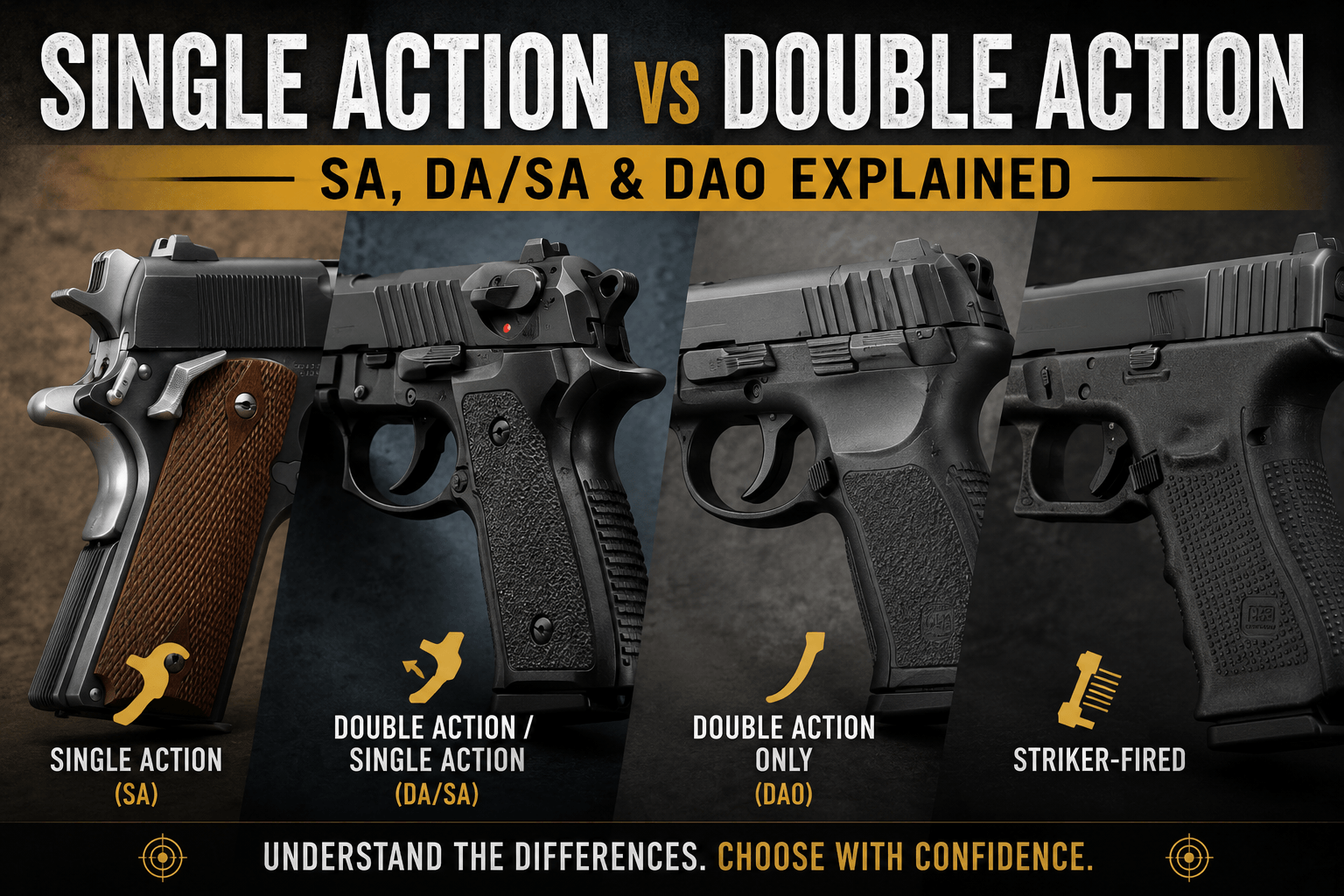
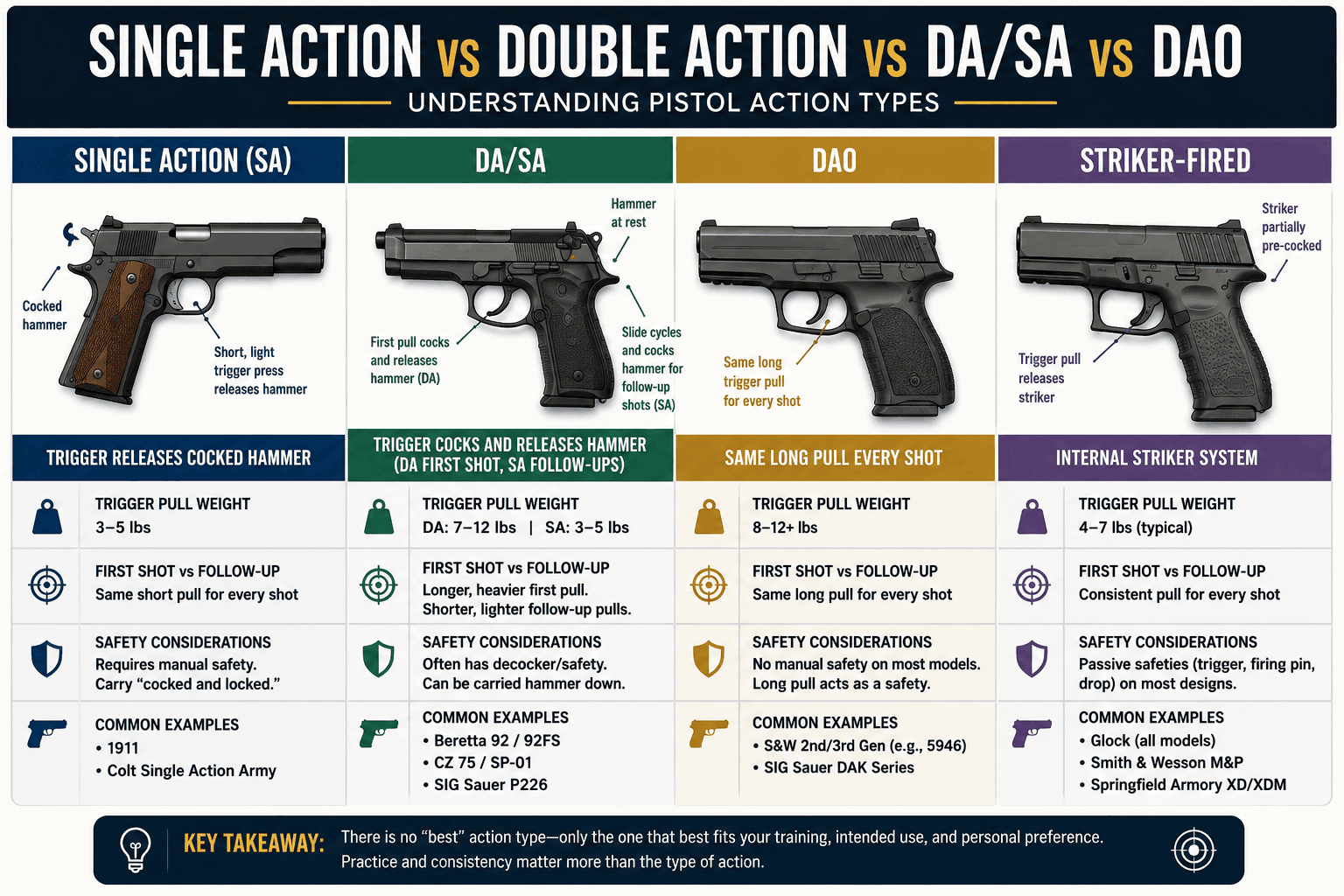
Single action vs double action comes down to what the trigger does. A single action trigger releases a cocked hammer or striker. A double action trigger both cocks and releases the hammer, either for the first shot only on a DA/SA pistol or for every shot on a DAO pistol.
For most modern buyers, the right answer is not one universal action type. Single action pistols can offer the cleanest trigger, DA/SA pistols give a deliberate first pull followed by lighter follow-up shots, DAO pistols keep every pull consistent and heavier, and striker-fired pistols usually prioritize simplicity and consistency.
| Action type | Typical trigger feel | First shot vs follow-up shots | Safety considerations | Common examples |
|---|---|---|---|---|
| Single Action, SA | Short, light, crisp | Same light pull after the hammer is cocked | Often paired with a manual safety. Shooter must manage cocked carry safely. | 1911-style pistols, Colt Single Action Army |
| Double Action/Single Action, DA/SA | Long, heavier first pull. Shorter, lighter follow-up pulls | First shot is double action, slide cycles and cocks the hammer for single action follow-ups | Often uses a decocker or safety/decocker. Requires training through two trigger pulls. | Beretta 92FS, CZ 75 B, SIG Sauer P226 |
| Double Action Only, DAO | Long, consistent, usually heavier | Every shot uses the same double action pull | No single-action mode. Often chosen where simplicity and administrative safety matter. | S&W 5946, SIG DAK variants, Beretta 92D |
| Striker-fired | Consistent, medium pull on many designs | Usually the same pull for every shot | Often uses internal passive safeties rather than a manual thumb safety. | Glock pistols and many modern polymer pistols |
What does pistol action mean?
A pistol action is the system that cocks and releases the firing mechanism. In a hammer-fired pistol, the hammer hits a firing pin or transfer system. In a striker-fired pistol, a spring-loaded striker moves forward to ignite the cartridge primer.
The action type matters because it changes trigger length, trigger weight, reset, carry condition, and the way the user handles the gun under stress. It also affects holster choice, safety controls, and training priorities. At LA Police Gear, we outfit officers, first responders, security professionals, and armed citizens with holsters and accessories across all three major handgun action types.
Action type is not a substitute for safe handling. A light trigger is not automatically unsafe, and a heavy trigger is not automatically safe. The important question is whether the user understands the system and trains with it.
What is a single action pistol?
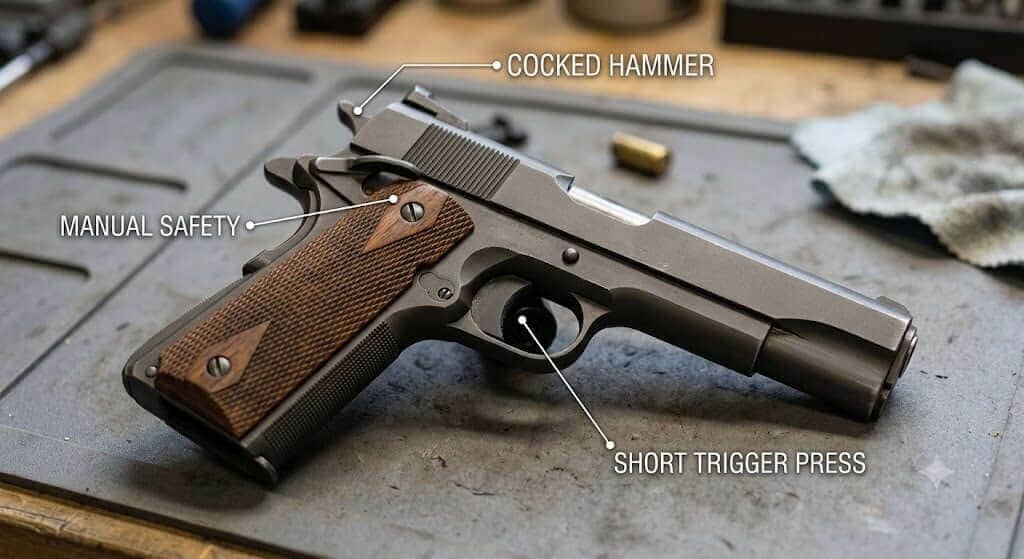
A single action pistol is a handgun where the trigger performs one primary action. It releases a hammer or striker that has already been cocked. On a classic 1911, the hammer must be cocked before the trigger can fire the pistol. After each shot, the cycling slide cocks the hammer again.
This is why the 1911 is commonly described as a single-action pistol. Many 1911-style pistols are designed to be carried with the hammer cocked and the manual thumb safety engaged. That carry method requires a holster that protects the trigger guard, retains the pistol securely, and allows the shooter to disengage the safety deliberately during the draw. See [link to LAPG category: holsters] for holster options.
Single action triggers are popular because the trigger press can be short and clean. Ruger describes its SR1911 line as single action, and 1911-style pistols are commonly built around grip safeties and manual thumb safeties. Ruger SR1911 product information
The Colt Single Action Army is the historic revolver example. It requires the hammer to be manually cocked before firing. The name says what the system does. It is single action only.
Single action pistols are best for shooters who value precision and a crisp trigger
Single action pistols can be excellent for competition, range training, and users who are committed to mastering a manual safety. The trigger is usually the easiest to shoot well because there is less trigger movement before the shot breaks.
The tradeoff is administrative discipline. A single action duty or carry pistol usually demands consistent safety manipulation. The shooter must practice drawing, disengaging the safety, firing, re-engaging the safety when appropriate, and reholstering with full control.
What is a double action pistol?
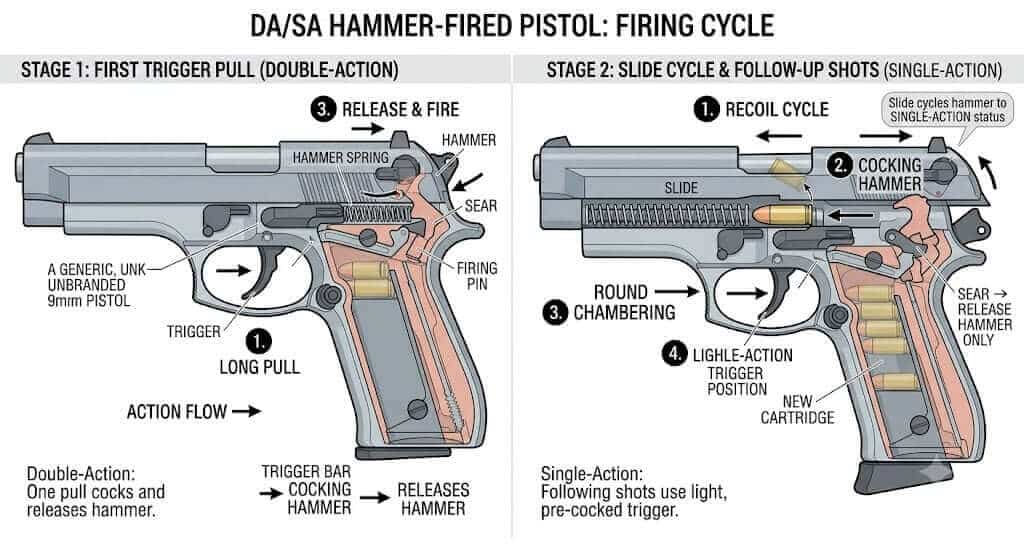
A double action trigger performs two actions. It cocks the hammer and then releases it. In common handgun language, “double action pistol” often refers to a DA/SA semi-automatic pistol. The first trigger press is double action. After the shot, the slide cycles and cocks the hammer, so follow-up shots are single action.
The Beretta 92FS is a classic DA/SA pistol family example. Beretta’s 92-series variants have long been associated with double-action/single-action operation, and the 92G-SD technical data lists a double-action trigger pull range of 9.9 to 16.1 pounds and a single-action range of 4.0 to 6.4 pounds. Beretta 92G-SD technical data summary
The CZ 75 B is another major DA/SA example. CZ’s product page describes the CZ 75 B as having a DA/SA trigger mechanism and notes that the “B” model includes a firing pin block safety. CZ 75 B product page
The SIG Sauer P226 is also widely known as a DA/SA service pistol, with DAK and other variants existing in the broader P226 family. SIG Sauer P226 overview
DA/SA pistols reward training through the first-shot transition
The main challenge with DA/SA is the transition between two trigger pulls. The first pull is longer and heavier. The second pull is shorter and lighter. That shift can cause low or inconsistent hits if the shooter does not train through it.
For trained users, the system has real advantages. The heavier first pull can feel reassuring for duty carry, home defense, and appendix or strong-side concealed carry. Follow-up shots can still be fast because the single-action pull is lighter.
What is a double action only pistol?
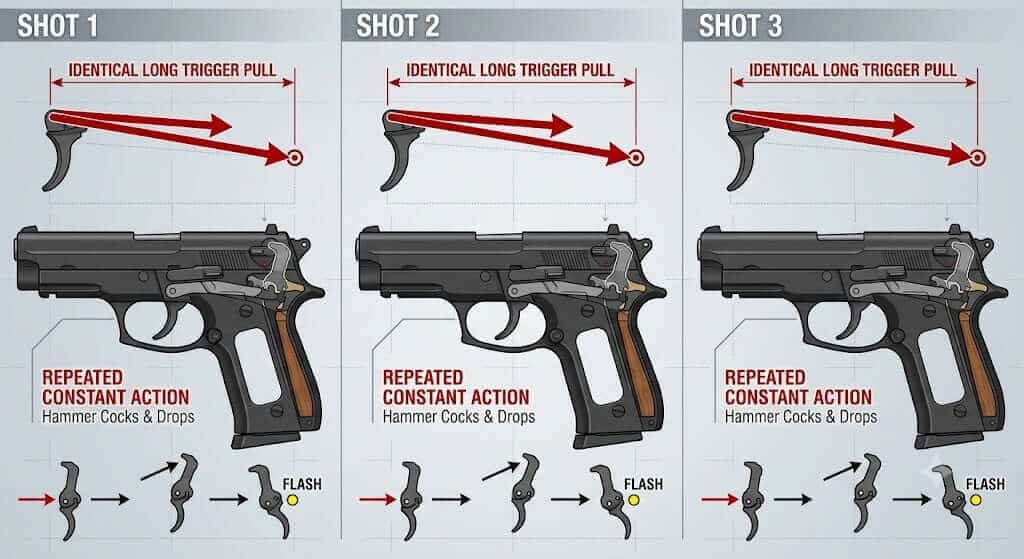
A double action only pistol, or DAO pistol, uses a double action trigger pull for every shot. The trigger cocks and releases the hammer or striker each time. There is no lighter single-action follow-up shot.
DAO pistols were common in law enforcement during periods when agencies wanted a consistent trigger pull with fewer external controls. The Smith & Wesson Model 5946 is an older DAO example from the third-generation S&W pistol era. The SIG Sauer P239 was also offered in DAO and DAK variants, and the P226 family has included DAK variants. SIG Sauer P239 overview
DAO can be slower to shoot precisely because the trigger is generally longer and heavier than a single-action pull. The benefit is consistency. Every shot feels the same. There is no safety lever to disengage and no DA-to-SA transition to master.
DAO pistols are best when consistency and simple controls matter more than a light trigger
DAO is not the dominant modern consumer pistol format, but it still makes sense in certain roles. Some agencies and individuals prefer the long, consistent pull because it mirrors the deliberate feel of a double-action revolver.
The downside is that many shooters need more practice to maintain accuracy at speed. A long trigger press magnifies poor finger placement and grip instability. Dry fire and live fire training matter more with DAO than with almost any other action type.
Striker-fired vs hammer-fired pistols
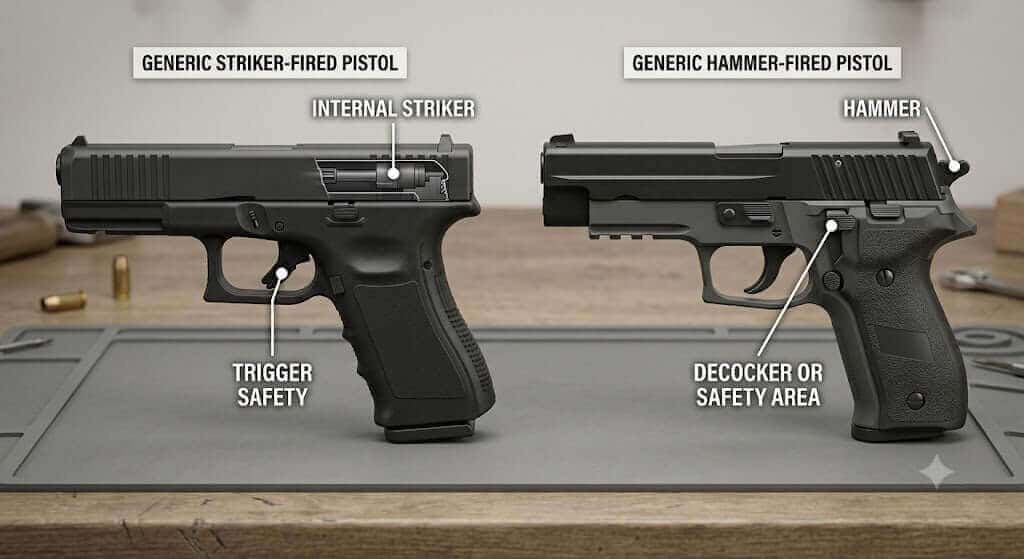
Striker-fired vs hammer-fired is related to action type, but it is not the same question. A hammer-fired pistol uses a visible or internal hammer. A striker-fired pistol uses a spring-loaded striker instead of a traditional hammer.
Glock pistols are the most common example people think of when they hear striker-fired. Glock describes its Safe Action system as providing a consistent trigger pull from the first round to the last, with three automatic mechanical safeties built into the fire control system. Glock Safe Action System
Most modern polymer striker-fired pistols are chosen because they are simple to operate. The trigger pull is usually consistent from shot to shot, the manual of arms is easy to teach, and there may be no external thumb safety to manipulate. That is why striker-fired pistols dominate many concealed carry, training, and duty holster discussions.
That does not make striker-fired pistols “single action” or “double action” in a universal way. Different manufacturers use different striker systems. Some are partially pre-cocked by slide movement. Some are closer to true double action. When comparing striker-fired vs hammer-fired pistols, evaluate the actual model rather than assuming the label tells the whole story.
Trigger pull differences and what they mean for accuracy and speed
Trigger pull affects two practical things. It affects how easily the shooter can fire without disturbing the sights, and it affects how fast the shooter can fire controlled follow-up shots.
A single action trigger is often easiest for precision. The shorter press reduces movement before the break. This helps on bullseye targets, longer-range pistol work, and competition stages.
A DA/SA pistol asks more from the shooter on the first shot. The long first pull can move the sights if the shooter presses unevenly. Once the pistol cycles, the lighter single-action pull usually supports faster follow-up shots.
A DAO trigger keeps every shot the same. That consistency is useful, but the longer pull can slow some shooters down. It is not a problem if the user trains correctly. It is a problem if the user buys the gun, fires one box of ammo, and assumes the system will manage itself.
A striker-fired trigger usually sits in the middle. It tends to be more consistent than DA/SA and less crisp than a tuned single action trigger. For many defensive users, that middle ground is the appeal.
Manual safeties, decockers, and carry condition
A manual safety is a control the shooter must intentionally disengage before firing. Many single action pistols use one. A decocker is different. A decocker safely lowers the hammer from the cocked position without firing the pistol.
DA/SA pistols often use decockers because the pistol may be loaded and ready with the hammer down. After firing, the slide leaves the hammer cocked. The shooter then uses the decocker before holstering or returning the pistol to duty condition.
Some pistols combine a safety and decocker. Others are decocker only. Others use a frame-mounted safety that allows cocked-and-locked carry. The exact control layout matters when choosing a holster, training plan, and storage setup.
For concealed carry and duty carry, the holster must fully cover the trigger guard, support the specific pistol and light combination, and retain the firearm during movement. Browse [link to LAPG category: holsters], [link to LAPG category: pistol mag pouches], and [link to LAPG category: tactical belts] when setting up a complete carry system.
Which action type is better for duty, concealed carry, home defense, and training?
Duty carry
Duty carry favors reliability, safe holstering, consistent training, and holster availability. DA/SA pistols have a long service history in duty roles, while modern striker-fired pistols are now extremely common because of their simpler manual of arms. Single action duty pistols can work well for trained users, especially 1911-style platforms, but they require strict safety manipulation.
Concealed carry
For concealed carry, the best action type is the one the user can operate safely from concealment under stress. Striker-fired pistols are popular because every shot feels similar and there are fewer external controls. DA/SA pistols remain a strong choice for users who want a deliberate first pull. Single action pistols require strong confidence with the manual safety.
Home defense
Home defense puts a premium on safe storage, clear operation, and confidence in low-light or high-stress conditions. Action type matters, but setup matters too. A quality holster, secure storage solution, weapon light where appropriate, spare magazines, and training plan are more important than chasing a theoretical “best” trigger system. See [link to LAPG category: accessories] for compatible accessories.
Competition
Competition shooters often appreciate single action triggers because they support speed and precision. DA/SA pistols are also common in certain divisions because they combine strong ergonomics with fast single-action follow-ups. DAO is less common in competition because the long pull can be a disadvantage against lighter trigger systems.
Training
Training should match the action type. Single action users need safety manipulation reps. DA/SA users need first-shot and transition reps. DAO users need smooth trigger control through the full pull. Striker-fired users need disciplined trigger management and careful reholstering habits.
Pros and cons of single action, DA/SA, DAO, and striker-fired pistols
Single action pros
- Usually the cleanest trigger press.
- Excellent precision potential.
- Strong choice for competition and trained 1911 users.
Single action cons
- Often requires manual safety management.
- Less forgiving of poor administrative handling.
- Not ideal for users who will not train regularly.
DA/SA pros
- Deliberate first pull with lighter follow-up shots.
- Long duty and service pistol track record.
- Works well for users who train the transition.
DA/SA cons
- Two trigger pulls to master.
- Decocker or safety controls vary by model.
- First-shot accuracy can suffer without practice.
DAO pros
- Same pull every time.
- No single-action mode to manage.
- Simple control layout on many models.
DAO cons
- Longer and heavier pull can slow accurate shooting.
- Fewer modern model choices.
- Less popular for competition or precision-focused shooting.
Striker-fired pros
- Consistent trigger feel from shot to shot.
- Simple manual of arms.
- Excellent holster and accessory availability for many models.
Striker-fired cons
- Less tactile hammer status feedback.
- Trigger discipline during reholstering is critical.
- Trigger feel varies widely by brand and model.
Bottom line: which pistol action should you choose?
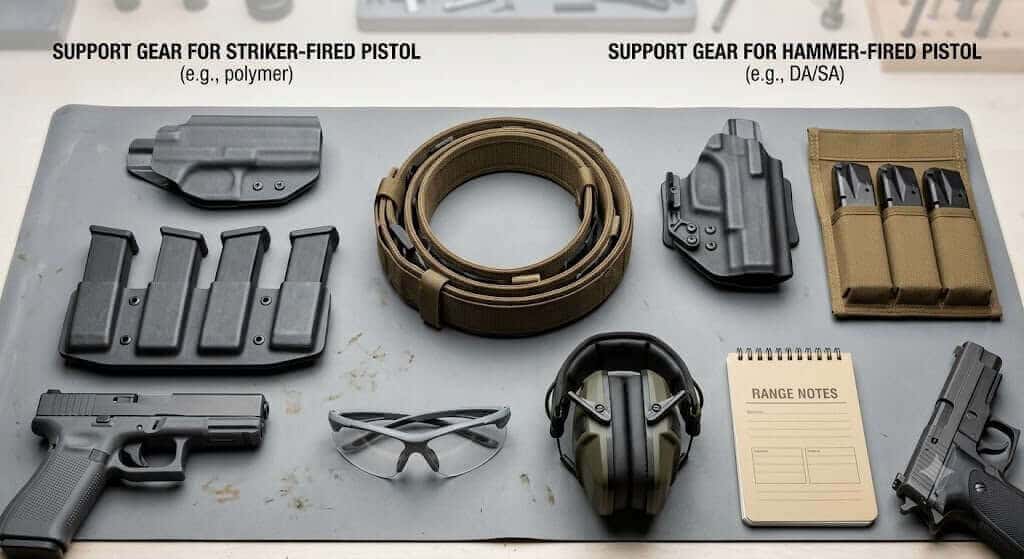
Choose single action if you want the cleanest trigger and are willing to train manual safety use. Choose DA/SA if you like a deliberate first pull and fast follow-up shots. Choose DAO if you want the same long pull every time. Choose striker-fired if you want a simple, consistent system with broad holster and accessory support.
The best choice is the pistol you can handle safely, shoot accurately, and support with the right gear. Once you know which action type fits your needs, visit lapolicegear.com to shop holsters, magazines, mag pouches, range gear, and accessories that match your carry or training setup.