Listen to this article
Table of Contents
- Introduction: Navigating Firearm Ownership in the United States
- Federal Firearm Laws: The Baseline for All Purchases
- The Role of the Federal Firearm Licensee (FFL)
- Understanding the Federal Background Check Process
- Navigating State Firearm Regulations: Where Laws Diverge
- The Importance of State-Specific Research
- State-Mandated Waiting Periods for Firearm Purchases
- State Licensing and Permit Requirements (e.g., Purchase Permits, Firearm Owner's Identification Cards)
- State-Specific Firearm Restrictions (e.g., High-Capacity Semiautomatic Firearms, "Assault Weapons")
- State Regulations on Private Firearm Transfer
- Domestic Violence Firearms Laws: State-Level Prohibitions and Reporting
- Concealed Carry Laws: A Brief Overview of Permit Requirements
- Step-by-Step: The Process of Buying a Firearm
- Next Steps After Completing Firearm Purchase Requirements
- Download for State Firearm Restrictions
- FAQs
Navigating the landscape of firearm ownership in the United States requires a clear understanding of a complex, multi-layered legal system. The right to keep and bear arms is governed by a framework of federal, state, and local laws designed to ensure firearms are purchased and possessed safely and lawfully. For any prospective buyer, the process can seem daunting. About 32% of American adults own at least one firearm. In 2024, over 16.1 million firearms were sold in the U.S. Many people follow the rules to buy guns. This guide is designed to demystify that process. Understanding firearm ownership in the U.S. means knowing a complex legal system. The Second Amendment protects the right to bear arms, but this right is limited by federal, state, and local laws to ensure safe and legal possession. Buyers face many rules, background checks, and varying regulations depending on location. This guide explains the universal federal rules, important state differences, and how to legally buy a gun. It provides the knowledge needed to navigate the process confidently and responsibly from start to finish.
Introduction: Navigating Firearm Ownership in the United States
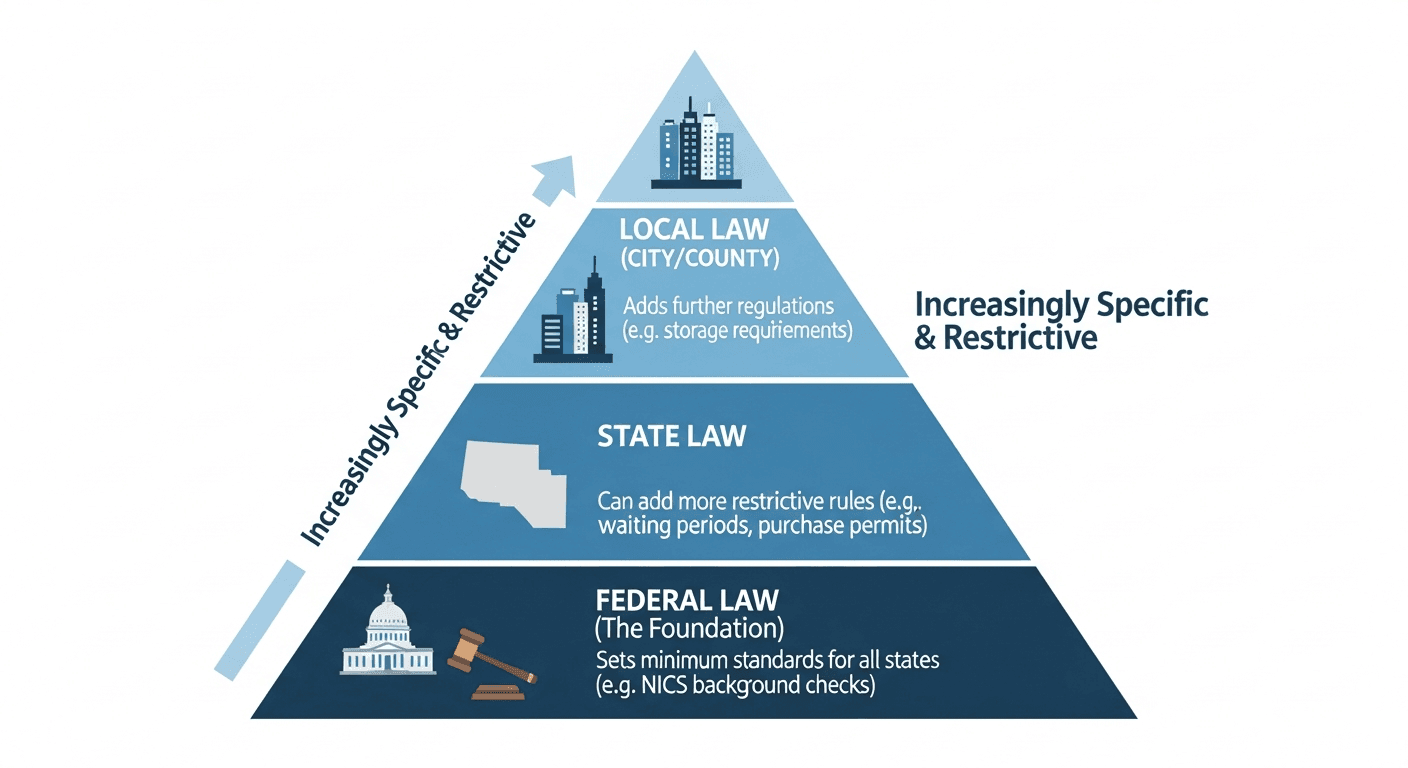
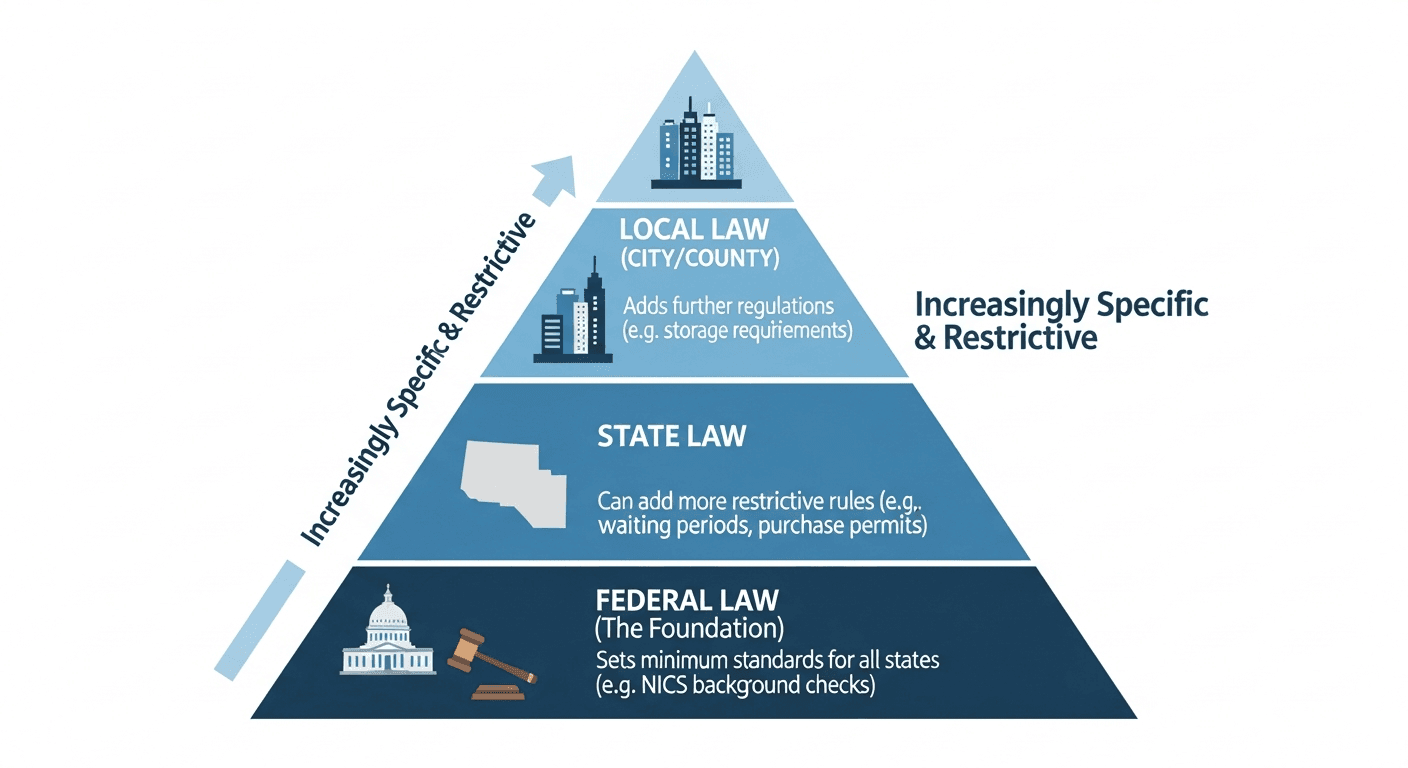 U.S. firearm laws are layered. Federal law creates a national baseline, while state and local laws can add more specific and stricter requirements.
Firearm purchases are governed by a multi-layered legal system, with federal law setting the foundation and state and local laws adding specific requirements. This guide will provide a clear path through these regulations.
Purpose of this Guide: Your Path to Legal Firearm Acquisition - How to buy a gun
This guide aims to clearly explain the legal steps to buy a firearm in the U.S. It covers federal laws that apply to all purchases and how state laws add extra rules. Whether you're a first-time buyer or moving to a new state, this guide helps you understand the process. It explains licensed dealers' roles, mandatory background checks, state permits, and who cannot legally own firearms. By the end, you'll understand the entire buying process and be equipped to make a lawful purchase.
Emphasizing Responsibility: Understanding Your Rights and Obligations
Owning a firearm is a serious responsibility beyond just buying it. It requires safety, secure storage, training, and knowing the laws about use and carrying. This guide focuses on buying but stresses responsibility throughout. Following the law is the first step to safe ownership. Knowing your legal duties helps ensure a smooth purchase and supports safe handling that protects you and others. Rules about prohibited persons, background checks, and waiting periods are an attempt to keep guns from those who might cause harm. Meeting your legal duties shows you respect the responsibility of your Second Amendment rights.
Federal Firearm Laws: The Baseline for All Purchases
Every firearm purchase in the United States, regardless of the state in which it occurs, is subject to a baseline of federal firearm laws. These regulations establish the minimum legal standards for who can buy and sell firearms, the process required for a legal transfer, and the age requirements for different types of guns. Think of federal law as the foundation upon which all 50 states build their own, often more restrictive, sets of rules. Buyers must understand federal rules. These rules control most gun sales.
The Gun Control Act of 1968: Establishing the Framework
The Gun Control Act of 1968 (GCA) is the main federal law regulating firearm commerce. It controls interstate gun trafficking and stops high-risk people from getting guns. The GCA created the Federal Firearms Licensee (FFL) system, requiring licensed dealers for gun sales. It defined "prohibited persons" who can't buy or own guns, set age limits, and required serial numbers on firearms for tracing. The GCA is still the foundation of federal Gun Control and firearm legislation today.
Who Can Legally Purchase a Firearm? (Prohibited Persons)
Federal law, mainly the GCA and laws like the Brady Handgun Violence Prevention Act, clearly lists who cannot ship, transport, receive, or have firearms or ammunition. The background check stops people with violent or criminal histories from getting guns. These rules are very important. A person is federally prohibited if they:
- Have been convicted of a felony (a crime punishable by imprisonment for a term exceeding one year), or any other crime for which the judge could have imprisoned them for more than a year.
- Are a fugitive from justice.
- Are an unlawful user of or addicted to any controlled substance.
- Have been adjudicated as a "mental defective" or have been committed to a mental institution. The interpretation of these Mental Health-related terms is a subject of ongoing legal and social discussion, particularly concerning the rights of individuals who have sought voluntary treatment for a Mental Illness.
- Are an illegal alien or are in the U.S. unlawfully.
- Have been dishonorably discharged from the Armed Forces.
- Have renounced their U.S. citizenship.
- Are subject to a court order that restrains them from harassing, stalking, or threatening an intimate partner or child.
- Have been convicted of a misdemeanor crime of domestic violence.
This list of prohibitions is the backbone of federal efforts to reduce gun violence by screening purchasers based on their Criminal Records and other risk factors.
Federal Firearm Purchase Age Minimums: Handguns vs. Long Guns
Federal law establishes two different minimum age requirements for purchasing firearms from a Federal Firearm Licensee (FFL). It is crucial to distinguish between handguns and long guns (rifles and shotguns) as the rules differ significantly.
- Handguns: An individual must be at least 21 years old to purchase a handgun from an FFL. This includes all firearms with a short stock designed to be held and fired with one hand, such as semi-automatic pistols and revolvers.
- Long Guns: An individual must be at least 18 years old to purchase a long gun—a rifle or a shotgun—from an FFL.
These federal Firearm Purchase Age Minimums apply specifically to sales from licensed dealers. The laws regarding the private transfer of firearms between unlicensed individuals can vary by state, and some states have established higher age restrictions.
Under federal law, the purchase age minimum for firearms from licensed dealers differs between handguns and long guns. Specifically, an individual must be at least 21 years old to purchase a handgun from a federally licensed dealer. In contrast, long guns, which include rifles and shotguns, can be purchased by individuals who are at least 18 years old.
It is important to note that these age requirements apply to transactions conducted through licensed firearms dealers, also known as Federal Firearms Licensees (FFLs). However, the process for private sales, or the transfer of firearms between unlicensed individuals, is not regulated by federal law and can vary significantly from state to state. Some states impose their own regulations on private sales, and in several cases, have established higher age minimums than those mandated federally.
For instance, certain states might require individuals to be 21 to purchase any type of firearm, regardless of whether it is a handgun or a long gun. Additionally, some areas have specific laws governing the sale and possession of firearms by individuals below certain age thresholds, incorporating factors such as juvenile criminal records or incidents of mental health adjudications.
Furthermore, understanding the intricacies of state laws is equally important, as states may implement additional conditions such as firearm safety courses
Restricted Firearms at the Federal Level (Historical Context, e.g., Federal Assault Weapons Ban's expiration)
While most standard firearms are regulated under the GCA, certain types are subject to heightened regulation under the National Firearms Act (NFA) of 1934. These include machine guns, short-barreled rifles, and suppressors. Purchasing these requires a more extensive application and background check with the ATF.
The Role of the Federal Firearm Licensee (FFL)
The Federal Firearm Licensee, or FFL, is the cornerstone of the legal firearm purchasing process in the United States. An FFL is a person or business that holds a license issued by the ATF to engage in the business of manufacturing or selling firearms. From large sporting goods stores to small, home-based dealers, these licensees are the only channel through which a manufacturer can legally distribute new guns to the public. They must check the buyer's identity. They also fill out the needed paperwork. They help with the required background check.
Why You Must Buy Through an FFL: The Lawful Channel
Because of the Gun Control Act of 1968, most gun sales must go through an FFL. This creates a regulated, traceable system. The FFL makes buyers fill out ATF Form 4473, a sworn statement about their eligibility. The FFL also runs a background check through the National Instant Criminal Background Check System (NICS) before selling a gun. This helps stop prohibited people from buying guns legally. Buying a gun for someone banned, called a "straw purchase," is a serious federal crime. The FFL enforces federal and state gun laws, serving as a critical checkpoint to prevent illegal Gun Trafficking and ensure firearms do not enter the Illegal Firearms Market.
Types of Transactions Requiring an FFL Transfer
An FFL transfer is required for more than just buying a new gun from a store's inventory. The law covers many situations. It keeps the system honest and stops illegal gun sales. Generally, an FFL must facilitate the transfer in the following scenarios:
- Purchasing a new or used firearm from a dealer's inventory: This is the most common type of transaction across all Firearms Markets.
- Purchasing a firearm online: When you buy a gun from an online retailer, it cannot be shipped directly to your home. You must arrange for the seller to ship the firearm to a local FFL in your state. You will then visit that FFL, complete the Form 4473 and background check, and the FFL will legally transfer the gun to you. They typically charge a fee for this service.
- Interstate transfers between private citizens: If you are a resident of one state and wish to purchase a firearm from a private, unlicensed resident of another state, the transfer must go through an FFL. The seller typically ships the firearm to an FFL in the buyer's state of residence, where the buyer completes the background check and takes legal possession.
Understanding the Federal Background Check Process
The federal background check is the most critical checkpoint in the firearm purchasing process. Its purpose is to verify, in near real-time, whether a prospective buyer is legally prohibited from owning a gun under federal or state law. This system, known as the National Instant Criminal Background Check System (NICS), is operated by the FBI and is accessed by every FFL for every transaction. The process begins the moment a buyer decides on a firearm and declares their intent to purchase it from a licensed dealer.
Completing ATF Form 4473: Your Official Declaration
Before a background check, you must complete and sign ATF Form 4473, the "Firearms Transaction Record." This six-page sworn form makes lying a felony punishable by up to 10 years in prison and fines. You provide your name, address, birth date, and ID. The form asks yes/no questions about prohibited person categories, like being a felon or drug user. The process asks about your mental health history. It also asks about any stays in mental institutions. The dealer checks your government photo ID with your current address. After you finish the form, the FFL starts the background check.
The National Instant Criminal Background Check System (NICS)
With your completed Form 4473, the FFL contacts the NICS. The FFL provides your information to the system, which checks several massive databases. These databases have criminal records from federal, state, and local police. They also have records of mental health decisions, domestic violence restraining orders, and other reasons that stop people from owning guns. The scale of this operation is immense; from January 1 to May 31, 2025, NSSF-adjusted NICS background checks totaled 6,063,240. The system provides one of three responses, often within minutes:
- Proceed: No disqualifying information was found. The dealer can transfer the firearm (unless a state waiting period applies).
- Denied: A prohibiting record was found. The dealer cannot transfer the firearm.
- Delayed: The system needs more time for review. An FBI examiner will conduct a manual review. If a final decision is not made within three business days, federal law allows the dealer to proceed with the transfer at their discretion (though some state laws prohibit this).
Common Reasons for NICS Delays or Denials
A denial from NICS means the system found a definitive record that prohibits you from owning a firearm. People are banned for reasons like felony convictions or domestic violence misdemeanors. Appealing a denial requires the buyer to prove the record is inaccurate.
Delays are more common and can occur for various reasons. They often happen when a buyer's name and identifying information are similar to those of a prohibited person. An FBI examiner must then manually review the records. Other common reasons for delays include:
- Incomplete or outdated Criminal Records: An arrest record might exist without a final disposition (e.g., conviction, acquittal).
- Misspelled names or incorrect data entry.
- State or local agency databases that are slow to respond.
A delay does not mean you are prohibited, but it does require patience as law enforcement agencies verify your information.
Navigating State Firearm Regulations: Where Laws Diverge
While federal law provides a universal baseline, it is only half of the legal equation. States have broad authority to enact their own firearm legislation, and as a result, the rules governing gun sales vary dramatically. Some states mirror the federal framework, while others have implemented comprehensive regulations that go far beyond federal mandates. The laws vary by state. Buyers must learn their state's rules before buying a firearm. This is very important.
The Importance of State-Specific Research
Failing to comply with state firearm laws can result in serious legal consequences. Ignorance of the law is not a valid defense. Before visiting a dealer, you must research your state's regulations on waiting periods, purchase permits, and restrictions on specific types of firearms. A firearm that is legal to purchase in one state may be illegal in another. Information can typically be found on the websites of your state police or attorney general's office. This research is not an optional step; it is a fundamental requirement for a lawful firearm purchase.
State-Mandated Waiting Periods for Firearm Purchases
A waiting period is a state-imposed delay between the purchase of a firearm and when the buyer can take possession of it. Federal law does not mandate a waiting period, but a number of states have enacted them. The length and applicability vary. Supporters of waiting periods say they give a needed "cooling-off" time. This can help stop sudden gun violence, especially firearm suicide. It also gives police more time to finish a background check. These claims are up for debate though and haven't proven to be successful.
State Licensing and Permit Requirements (e.g., Purchase Permits, Firearm Owner's Identification Cards)
Several states require a prospective buyer to obtain a license or permit before they can legally purchase a firearm. These are in addition to the federal NICS check. Common examples include:
- Firearm Owner's Identification (FOID) Card: In states like Illinois, a resident must first apply for and receive a FOID card from the state police. This card must be presented to purchase any firearm or ammunition.
- Permit to Purchase: Other states, such as New Jersey, require a permit to purchase a handgun. Buyers must apply with their local law enforcement agency, undergo a background check, and be issued the permit before they can initiate a purchase at an FFL.
State-Specific Firearm Restrictions (e.g., High-Capacity Semiautomatic Firearms, "Assault Weapons")
Since the federal assault weapons ban expired in 2004, several states have passed laws banning or restricting certain semi-automatic firearms and magazines. These laws define "assault weapons" by features like pistol grips or folding stocks. States like California, New York, and Massachusetts have comprehensive bans. Many also ban "large-capacity" or "high-capacity" magazines holding over 10 or 15 rounds. It is critical to know your state's laws, as possessing a banned firearm or magazine can be a felony. States with high homicide rates often limit high-capacity semiautomatic firearms. They do this to reduce firearm homicides although that does not seem to actually work. Furthermore, some states are now enacting legislation to regulate or ban so-called "ghost guns"—unserialized firearms that can be assembled from kits, making them untraceable.
State Regulations on Private Firearm Transfer
Federal law doesn't require background checks for firearm sales between private, unlicensed citizens in the same state, known as the "private sale exemption" or "gun show loophole." However, many states have "universal background check" laws closing this gap. In these states, private firearm transfers must go through a licensed dealer who processes Form 4473 and runs a NICS background check before completing the sale. This helps prevent prohibited individuals from bypassing background checks via private sales, a key strategy for Gun Violence Prevention.
Domestic Violence Firearms Laws: State-Level Prohibitions and Reporting
Federal law stops people convicted of domestic violence misdemeanors or under final domestic violence restraining orders from having guns. Many states have added more rules to protect people. State laws may broaden the definition of a "domestic violence" crime or establish mechanisms to ensure the surrender of firearms once a person becomes prohibited. States differ in how well they send domestic violence records to the NICS database. This affects how well background checks stop abusers from getting guns.
Concealed Carry Laws: A Brief Overview of Permit Requirements
This guide focuses on buying firearms but briefly covers Concealed Carry Laws, a related topic. Owning a firearm and carrying it concealed are separate legal acts with different laws. Every state issues permits or licenses for concealed carry ("CCW" permits). The rules to get a permit differ a lot. In "shall-issue" states, police must give a permit if you meet the law. In "may-issue" states, officials can decide if you get a permit. In "constitutional carry" states, you do not need a permit to carry a gun. In some states, a valid CCW permit can exempt a person from the point-of-sale NICS check, as the permit's background check is equally or more thorough.
Step-by-Step: The Process of Buying a Firearm
With a firm grasp of the federal and state legal frameworks, we can now outline the practical, step-by-step process of purchasing a firearm. This sequence is generally consistent, though specific steps may be added or modified based on your state's unique laws.
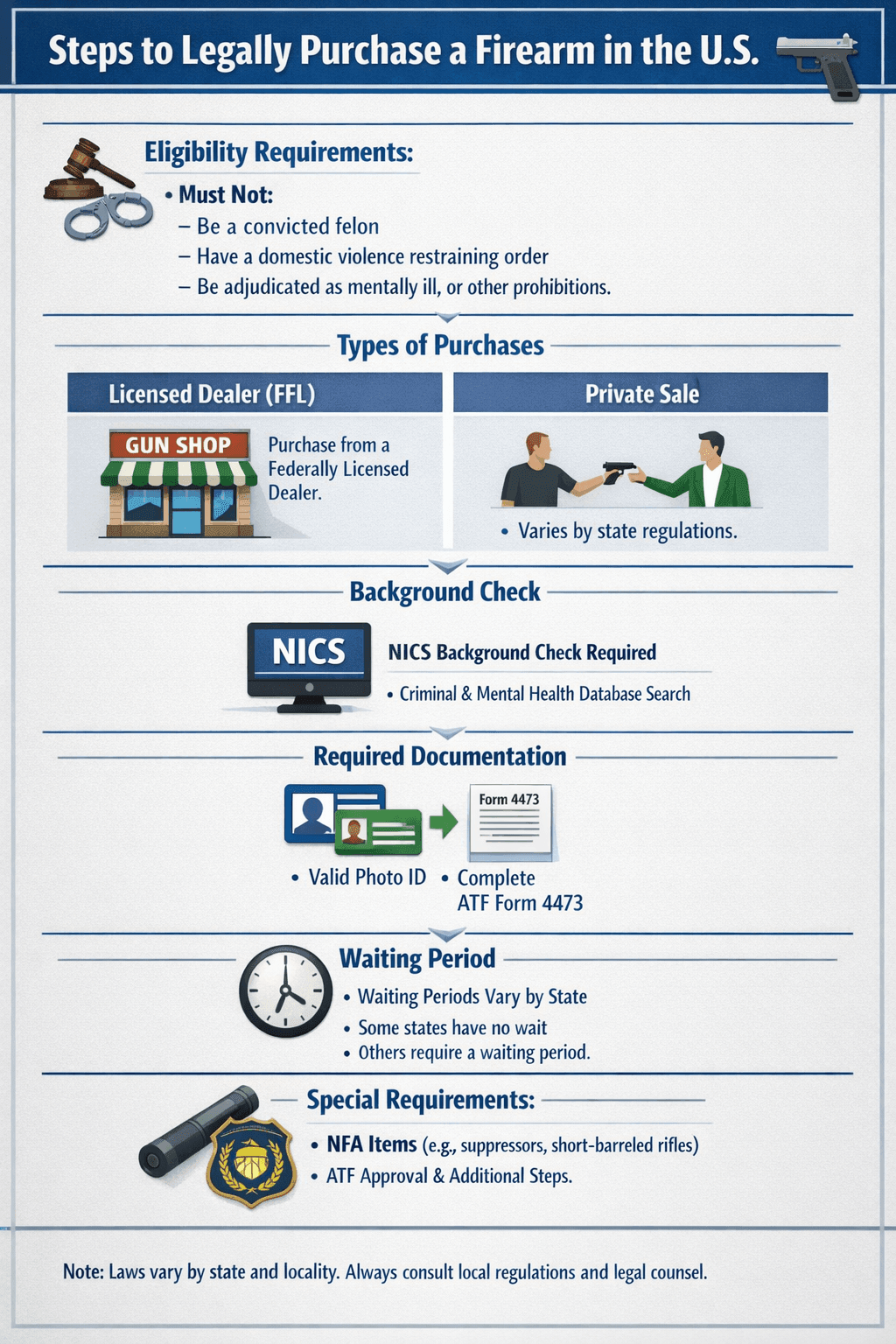
Step 1: Understand Federal and Your State's Laws
This is the foundational and most critical step. Before you do anything else, you must determine your eligibility and understand the specific rules in your jurisdiction.
- Confirm Your Eligibility: Review the federal list of "prohibited persons." If you fall into any of those categories, you cannot legally purchase a firearm.
- Research State Requirements: Investigate your state's laws thoroughly. Do you need a permit to purchase? Is there a waiting period? Are the types of firearms or magazines you are considering legal in your state? Check the official website of your state police or attorney general.
- Obtain Necessary Permits: If your state requires a purchase permit or a firearm owner's identification card, complete this application process and receive your documentation before proceeding.
Step 2: Choose Your Firearm and Locate a Reputable FFL Dealer
Once you are confident you are legally eligible and understand the requirements, you can select your firearm and the dealer who will handle the transfer.
- Select a Firearm: Make an informed decision based on your intended use (e.g., target shooting, hunting, self-defense).
- Find an FFL: Locate a Federal Firearm Licensee in your area. If you are purchasing a firearm online, you will still need to have it shipped to a local FFL to complete the legal transfer.
- Present Your Documentation: When you go to the FFL, you will need to bring a valid, government-issued photo ID with your current residential address. Some states may require additional documentation.
Step 3: Complete ATF Form 4473 at the FFL
At the dealer's place of business, you will be given the ATF Form 4473. This is the official application for the firearm transfer.
- Fill Out Your Section Accurately: Take your time and fill out your section of the form carefully and truthfully.
- Swear and Sign: By signing the form, you are attesting under penalty of law that all your answers are true. Providing false information on Form 4473 is a federal felony.
- Dealer Verification: The FFL will review your form and your ID to ensure the information is consistent and complete.
Step 4: Undergo the NICS Background Check
After you complete the Form 4473, the FFL will use your information to initiate the background check with the FBI's NICS.
- The Check is Initiated: The dealer will contact NICS either online or by phone. This process typically only takes a few minutes.
- Await the Response: You will wait for one of three possible outcomes: "Proceed," "Denied," or "Delayed."
- Understand the Outcome: If you receive a "Proceed," you can move to the next step. If "Denied," the transaction is terminated. If "Delayed," the FFL must wait for a resolution or until three business days have passed, at which point they may legally transfer the firearm (unless prohibited by state law).
Step 5: Observe Any State-Mandated Waiting Periods
If you received a "Proceed" on your background check, the final step before taking possession of your firearm is to satisfy any applicable state waiting period.
- Determine if a Waiting Period Applies: If your state has a waiting period, the clock starts after you have successfully completed the background check and paid for the firearm.
- Wait the Required Time: The FFL will hold your firearm for the legally mandated period.
- Take Possession: Once the waiting period has elapsed, you can return to the FFL to pick up your firearm. Ensure you have a safe and legal way to transport the firearm home.
Next Steps After Completing Firearm Purchase Requirements
By following this guide, you have done the key tasks. You learned about federal and state laws, checked if you can legally own a gun, and completed steps at a Federal Firearm Licensee. These steps include filling out ATF Form 4473 and passing the NICS background check. You understand the important state rules like waiting periods, purchase permits, and limits on some firearms. These rules help make sure transactions follow the law. They address issues like firearm homicides and suicides.
This purchase is the first step in a lifelong commitment to responsible firearm ownership. Your immediate next steps should focus on safety and proficiency.
- Secure Storage: Your absolute first priority is to secure your firearm in a way that it is inaccessible to unauthorized individuals, especially children. A quality gun safe or lockbox is a crucial investment.
- Training: Seek out professional firearm safety training. A basic safety course is essential for new owners, and even experienced shooters benefit from regular practice and advanced training.
- Understand Use-of-Force Laws: The laws governing when you can legally use a firearm for self-defense are complex and vary by state. It is your responsibility to learn and understand them.
- Stay Informed: Firearm laws can and do change. Stay current on federal and state regulations to ensure you remain a lawful and responsible gun owner.
Download for State Firearm Restrictions
We have prepared a comprehensive state by state guide to U.S. State Firearm Regulations, as of 2024. This was sourced from the Tufts State Firearm Law Database. This helpful excel (XLSX) spreadsheet breaks it down by state and tier of restrictiveness. It includes information on background checks, waiting periods, UBC (Universal Background Check) scopes, concealed carry laws, open carry laws, and more. Download it here:
Download State Firearm Regulations Spreadsheet > Important Note: This includes notes for the year 2024, law may have changed after 2024 or may be enjoined/under litigation. The information provided in this article is for general informational purposes only and does not constitute legal advice. Firearm laws and regulations vary by state and are subject to change. LA Police Gear makes no representations or warranties regarding the accuracy, completeness, or current validity of the information contained herein and assumes no responsibility or liability for any errors or omissions. Readers are solely responsible for verifying applicable laws and regulations and for ensuring their own compliance. Consult a qualified attorney or appropriate government authority for legal guidance specific to your situation.
FAQs
Who Can Legally Purchase a Firearm?
Federal law, mainly the GCA and laws like the Brady Handgun Violence Prevention Act, clearly lists who cannot ship, transport, receive, or have firearms or ammunition. The background check stops people with violent or criminal histories from getting guns. These rules are very important. A person is federally prohibited if they:
- Have been convicted of a felony (a crime punishable by imprisonment for a term exceeding one year), or any other crime for which the judge could have imprisoned them for more than a year.
- Are a fugitive from justice.
- Are an unlawful user of or addicted to any controlled substance.
- Have been adjudicated as a "mental defective" or have been committed to a mental institution. The interpretation of these Mental Health-related terms is a subject of ongoing legal and social discussion, particularly concerning the rights of individuals who have sought voluntary treatment for a Mental Illness.
- Are an illegal alien or are in the U.S. unlawfully.
- Have been dishonorably discharged from the Armed Forces.
- Have renounced their U.S. citizenship.
- Are subject to a court order that restrains them from harassing, stalking, or threatening an intimate partner or child.
- Have been convicted of a misdemeanor crime of domestic violence.
What type of transactions require an FFL Transfer?
- Purchasing a new or used firearm from a dealer's inventory: This is the most common type of transaction across all Firearms Markets.
- Purchasing a firearm online: When you buy a gun from an online retailer, it cannot be shipped directly to your home. You must arrange for the seller to ship the firearm to a local FFL in your state. You will then visit that FFL, complete the Form 4473 and background check, and the FFL will legally transfer the gun to you. They typically charge a fee for this service.
- Interstate transfers between private citizens: If you are a resident of one state and wish to purchase a firearm from a private, unlicensed resident of another state, the transfer must go through an FFL. The seller typically ships the firearm to an FFL in the buyer's state of residence, where the buyer completes the background check and takes legal possession.
What are common reasons for NICS Delays or Denials?
- Incomplete or outdated Criminal Records: An arrest record might exist without a final disposition (e.g., conviction, acquittal).
- Misspelled names or incorrect data entry.
- State or local agency databases that are slow to respond.
Do I need a background check to buy a gun in the US?
Yes — for most purchases. Federal law requires background checks for all firearm sales through licensed gun dealers (FFLs). Some states also require checks for private sales or transfers, while others do not. The only exceptions at the federal level are certain temporary loans or transfers, but state laws may still apply.
What’s the difference between federal gun laws and state gun laws?
Federal laws set the baseline rules for who can buy a gun and how dealers must operate. States can add additional requirements like permits, waiting periods, registration, or mandatory training. When both apply, you must follow whichever rule is stricter.
Can I buy a gun without a permit?
In many states, yes — no permit is required to purchase a firearm. However, states like Illinois, Massachusetts, New Jersey, and others require a firearm ID card or purchase permit. Handgun purchases often have stricter permit rules than long guns.
What is the “gun show loophole”?
This term refers to private sellers who are not required under federal law to run background checks. These sales can happen at gun shows, online, or between individuals. Some states have closed this gap by requiring checks for all transfers, regardless of where they occur.
How long does it take to buy a gun?
If you pass the background check instantly, you can often walk out with your firearm the same day — unless your state has a mandatory waiting period. Waiting periods range from 24 hours to 10 days depending on the state and firearm type.
What disqualifies someone from buying a gun?
Federal law prohibits purchases by individuals with felony convictions, certain domestic violence misdemeanors, restraining orders, unlawful drug use, mental health adjudications, and several other categories. States may add additional disqualifiers, such as DUIs or violent misdemeanors.
Do I need to register my gun?
Most states do not require firearm registration. A handful — such as California, Hawaii, New York, and Washington D.C. — require registration for some or all firearms. Federal law does not require a national gun registry.
Can I buy a gun online?
Yes, but it must be shipped to a licensed dealer (FFL). You’ll complete the background check and paperwork in person before taking possession. Direct-to-door firearm shipments are not allowed for standard consumer purchases.
What’s the minimum age to buy a gun?
Federal law sets the minimum age at 18 for rifles and shotguns, and 21 for handguns purchased from licensed dealers. Some states raise these minimums or apply the 21-year rule to all firearm types.
Do I need training before buying a gun?
Federal law does not require training, but many states do. States like Maryland, Connecticut, and Massachusetts require safety courses or certification before purchasing certain firearms. Even where not required, training is strongly recommended.
Are waiting periods required when buying a gun?
It depends on the state. Federal law does not mandate waiting periods, but states like California, Illinois, and Florida do. Waiting periods are typically intended to provide a “cooling-off” window and ensure background checks are completed.
Can I buy a gun in another state?
Generally, no — federal law restricts interstate firearm purchases. Handguns must be purchased in your state of residence. Long guns can sometimes be purchased out of state, but only if both states’ laws allow it and the sale goes through an FFL.