Listen to this article
Table of Contents
- Types of Range Bags: Which Style Fits Your Needs?
- Key Features to Evaluate Before You Buy
- Best Range Bags in 2026: Full Reviews
- Top Brand Spotlights
- Range Bag Comparison Chart
- Packing & Safety Guide
- Shooter-Specific Recommendations
- Who Makes the Best Range Bags?
- How Big Should My Range Bag Be?
- Is a Range Bag Worth It?
- What Should Your Gun Cleaning Kit or Range Bag Consist Of?
- Key Takeaways
- FAQs
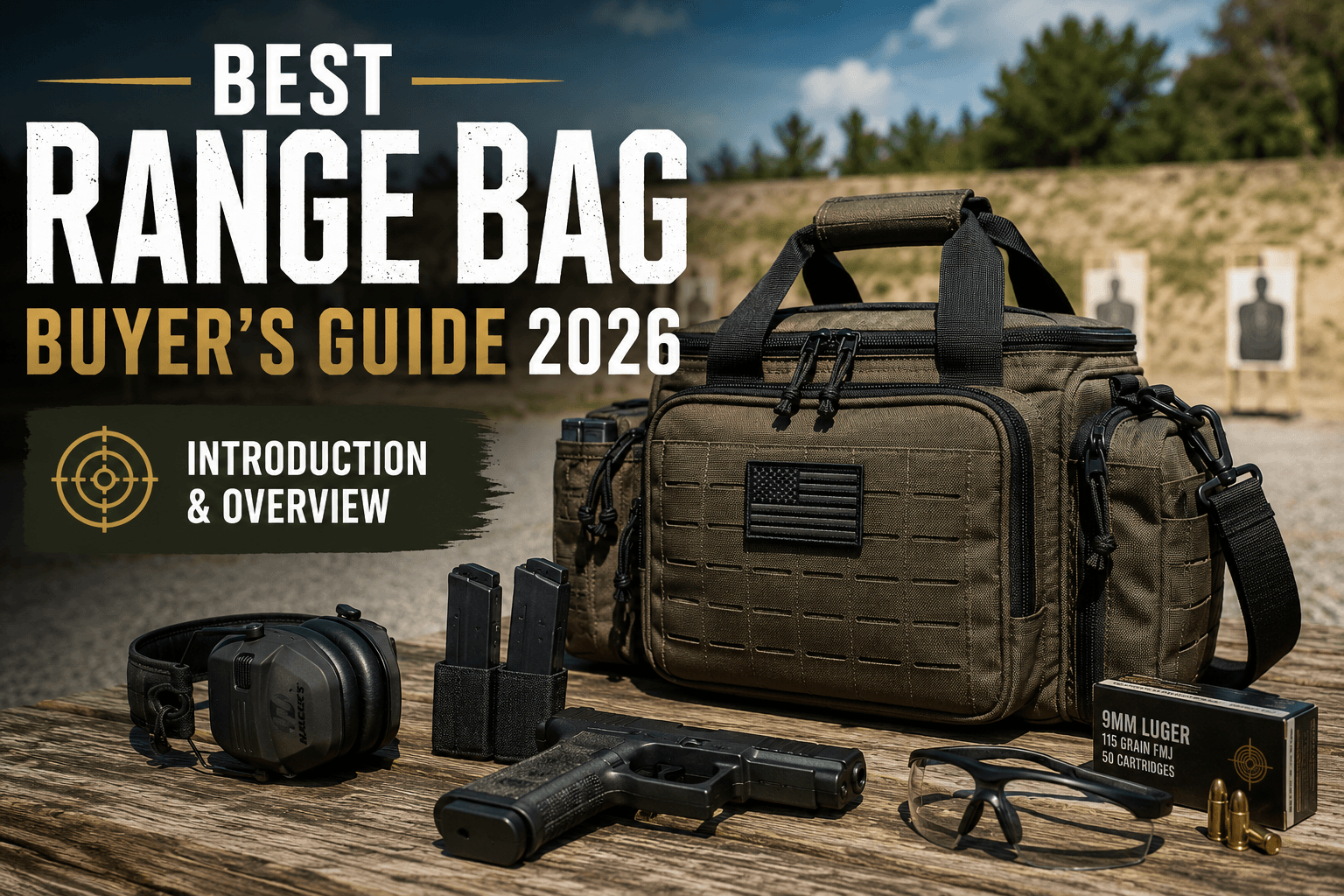
The range bag you carry signals something to every shooter on the line — and in 2026, what it signals matters more than ever. Gear technology has advanced faster in the past three years than in the previous decade, and the shooters who haven't updated their kit are feeling the gap.
From Canvas to Modular Tactical Systems
The trajectory from basic canvas duffels to purpose-built, modular carriers has accelerated significantly. Modern range bags now integrate MOLLE webbing, dedicated mag pouch attachment points, lockable zippers rated for TSA and state-level transport compliance, and internal organization systems that would have looked overbuilt just five years ago. What was once a glorified gym bag is now a functional tactical ecosystem designed for real operational demands.
Why 2026 Is a Compliance Inflection Point
Storage and transport regulations across multiple states have tightened, and the days of throwing firearms into any available bag without consequence are narrowing. A purpose-built range bag addresses hard-sided compartment requirements, locking mechanisms, and ammunition separation standards that generic alternatives cannot reliably meet. Choosing the wrong bag is not just an inconvenience — in certain jurisdictions, it creates a legal exposure that no LEO or serious shooter should accept.
How This Guide Is Structured
This guide moves with intention. It does not assume you are starting from zero, but it does assume you want to make a deliberate, informed decision rather than a reactive one. According to Gun University's range bag buyer's guide, the most common mistake shooters make is prioritizing price over purpose-fit — a calculus that costs more in the long run.
The sections ahead break down bag styles, construction standards, capacity, and feature sets by use case. The first decision point is style — because the right range bag architecture determines everything else that follows.
Types of Range Bags: Which Style Fits Your Needs?
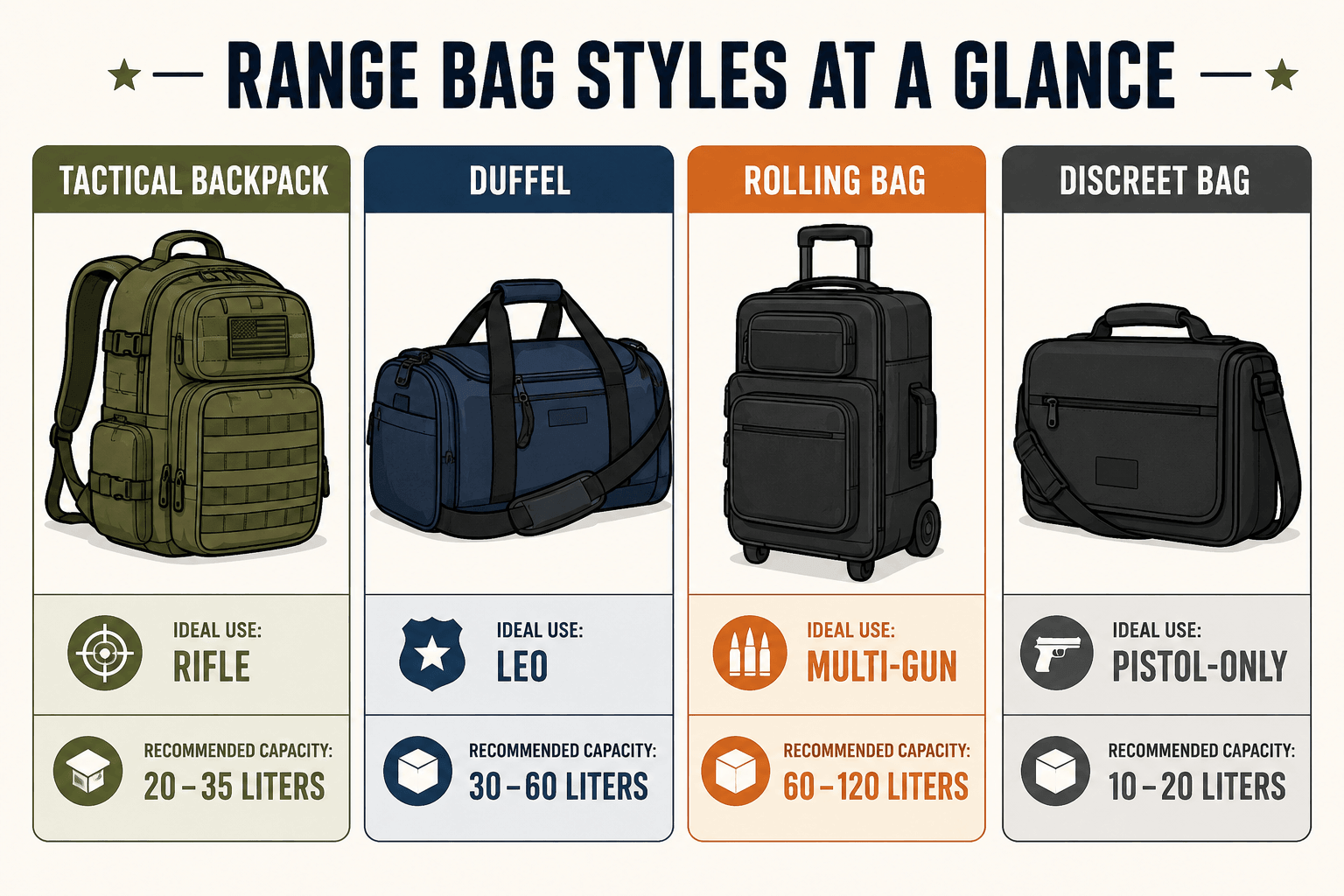
Not every shooter operates the same way — and the range bag market in 2026 reflects that reality with greater precision than ever before. Before evaluating materials and hardware (covered in the next section), the foundational decision is form factor. The wrong style creates friction at every stage of your session, from the parking lot to the firing line.
Tactical Backpacks: Hands-Free Mobility for Rugged Terrain
The tactical backpack format has seen significant adoption among outdoor range shooters who navigate uneven terrain, multi-station courses, or 3-gun stages requiring movement between positions. Bilateral weight distribution reduces fatigue on long competition days, and integrated MOLLE webbing on exterior panels allows for modular attachment of IFAKs, magazine pouches, or hydration carriers. For LEOs and military personnel who already operate in load-bearing configurations, this format translates naturally to range environments.
Traditional Duffel Styles: Volume and Accessibility
High-volume shooters — those running extended training blocks with bulk ammunition — consistently favor the open-top duffel configuration. The wide aperture provides immediate access to gear without the constraint of a zipper panel, and the generous interior volume accommodates large-format caliber ammunition, multiple pistols, and range consumables without forced organization. Pew Pew Tactical's hands-on evaluation confirms that duffel-style range bags remain the dominant choice for shooters prioritizing raw capacity over compartmentalization.
Rolling Range Bags: A 2026 Growth Trend
Heavy-duty wheeled range bags are gaining measurable traction in 2026, particularly among competitive shooters with long-distance bay setups and older shooters managing joint load. Modern rolling designs now integrate reinforced axle mounts and rigid-shell lower sections that prevent chassis flex under heavy lead loads — a meaningful structural upgrade over previous iterations.
Discreet/Low-Vis Options: Urban Transport Considerations
Urban carriers and plainclothes professionals are driving demand for range bags that present as standard athletic or commuter bags. The operational logic is straightforward: a bag that doesn't broadcast its contents reduces unnecessary attention during transit. Construction quality in this category varies widely, making material and hardware evaluation critical — exactly what the next section addresses.
Key Features to Evaluate Before You Buy
Choosing the right range bag comes down to specific construction details — not brand recognition or visual appeal. Whether you're configuring a range bag for rifles, handguns, or a multi-gun competition setup, these four engineering criteria separate gear that performs under operational stress from gear that fails at the worst moment.
Material Science: 1000D Cordura vs. Lightweight Polymers
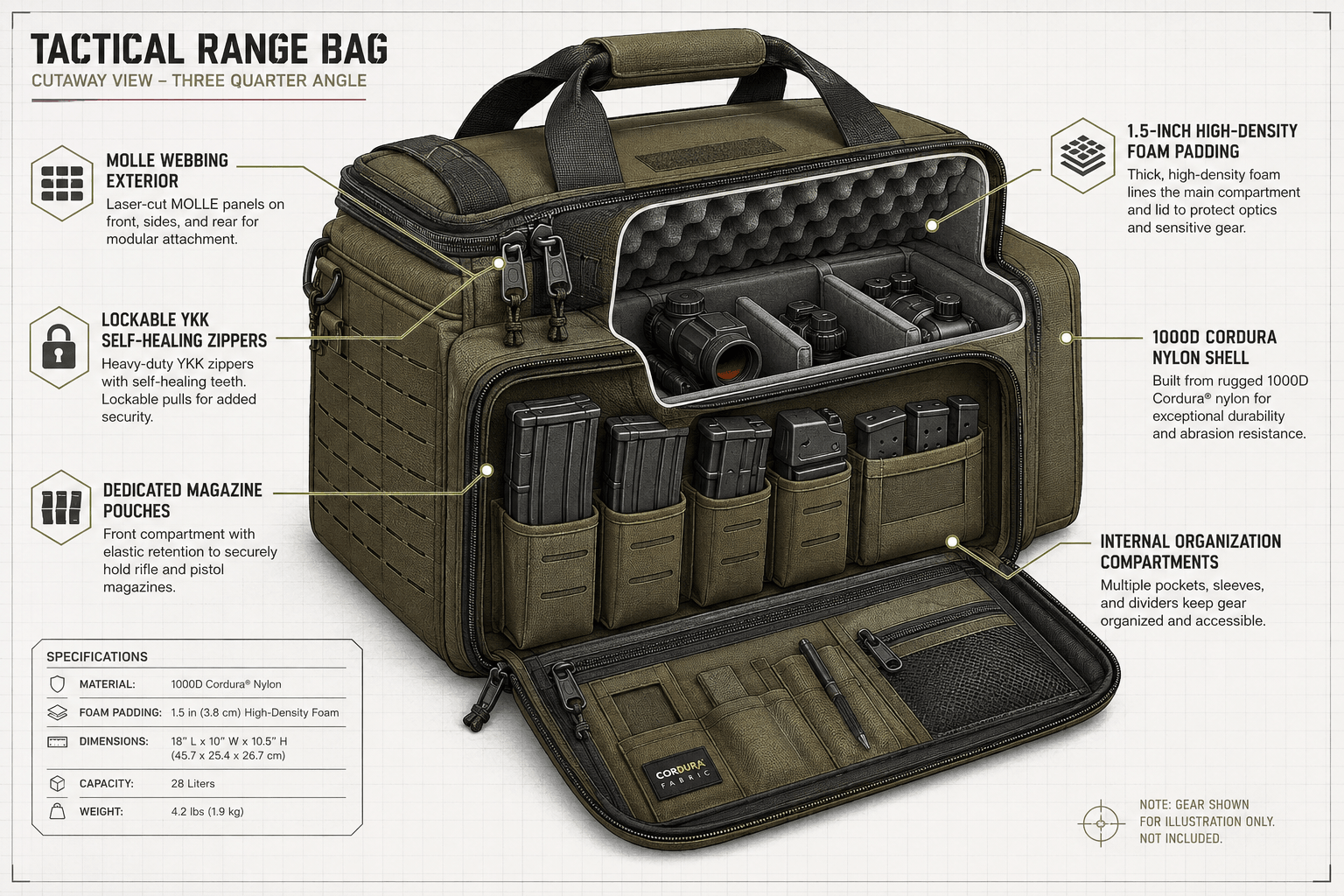
1000D Cordura nylon remains the benchmark for abrasion resistance and tensile strength in 2026. It handles rough vehicle transport, concrete range floors, and repeated heavy loading without fiber breakdown. However, newer lightweight puncture-resistant polymer composites — increasingly standard in premium bags this year — offer a meaningful weight reduction without sacrificing structural integrity. In practice, polymer-reinforced fabrics excel when total carry weight is already high due to ammunition and optics. For shooters who prioritize durability above all else, 1000D Cordura is still the defensible choice. For those managing load fatigue over long range days, the newer polymer options warrant serious evaluation.
Hardware Integrity: Zippers and Handles
YKK self-healing zippers are non-negotiable on a working range bag. Under field conditions — grit, moisture, repetitive cycling — inferior zippers bind, separate, and eventually fail. YKK's self-healing design realigns the coil structure under minor stress, maintaining closure integrity across thousands of cycles. Equally critical are box-stitched handles, specifically on bags carrying substantial lead loads. Box stitching distributes handle stress across a reinforced stitch pattern rather than concentrating load at a single seam — a distinction that matters immediately when you're moving 40+ pounds of ammunition and gear across a parking lot.
Customization: Laser-Cut MOLLE vs. Hook-and-Loop Panels
Laser-cut MOLLE systems provide modular external attachment without added webbing weight, allowing precise accessory placement using standard MOLLE-compatible pouches. This approach suits LEOs and tactical users who configure gear based on mission requirements. Internal hook-and-loop organizational panels, on the other hand, offer faster reconfiguration and are well-suited to competition shooters who swap gear configurations between stages. Neither system is universally superior — the right choice depends on how frequently and deeply you reconfigure your loadout.
Protection: Foam Padding for Optic Preservation
High-density foam padding rated at a minimum of 1.5 inches on impact surfaces is the practical standard for preventing optic zero-shift during transit. A scope or red dot that shifts zero between the truck and the firing line creates a problem that costs time, ammunition, and potentially compromised qualification scores. Padding density matters as much as thickness — low-density foam compresses fully under weight and provides no meaningful protection.
With these construction criteria established, the next step is applying them directly to the top-performing bags available in 2026 — evaluated by use case, from rifle configurations to dedicated pistol setups.
Best Range Bags in 2026: Full Reviews
Understanding construction details and feature sets — covered in the previous sections — only gets you so far. The real test is applying that knowledge to specific use cases. The four categories below represent the most operationally distinct shooter profiles in 2026: rifle-focused shooters, LEOs running agency-approved gear, multi-gun competitors, and pistol-only practitioners. Each category demands a different set of trade-offs.
Best Range Bag for Rifle Use
Rifle-specific range bags solve a problem that standard bags ignore: the dimensional mismatch between long-gun accessories and a conventional carry format. A serious rifle shooter is transporting spare magazines (often 5.56 or .308 profile), hearing protection, chamber flags, a spotting setup, and potentially a maintenance kit — all without a dedicated rifle case in the bag itself.
What to prioritize: Extended external dimensions, reinforced bottom panels, and dedicated magazine sleeves. MOLLE webbing on exterior panels provides attachment points for optic pouches or document carriers without consuming interior volume.
In practice, a rifle-focused shooter benefits most from a bag in the 36–42 liter range with a flat-profile interior that keeps accessories organized without forcing components to stack awkwardly. Padded dividers that reconfigure via hook-and-loop allow shooters to customize compartment width for different magazine profiles — relevant if you're alternating between AR platforms and bolt-action support gear on the same range day.
Key caveat: Larger bags create a temptation to overload. A well-configured rifle range bag should still function as a one-trip carry. If your loaded bag requires two hands and a recovery period, you've exceeded the design intent.
Best Range Bag for Law Enforcement
LEO range bags operate under constraints civilian bags don't face: agency policy compliance, duty-gear compatibility, and the expectation that the bag will serve both training and operational readiness simultaneously. A range bag for law enforcement isn't just a gear carrier — it's a mobile staging platform for the next deployment.
What separates an LEO-optimized bag from a general-purpose option comes down to three factors:
Retention and organization for duty-specific items: Dedicated sleeves for extra duty magazines (typically double-stack 9mm or .45 ACP), a secured compartment for administrative paperwork or qualification records, and organized pockets for speed loaders or speed strips.
Durability under institutional use: Agency bags get thrown into patrol vehicle trunks, stacked in armory lockers, and cycled through qualification sessions that may occur multiple times per month. 1000D nylon or equivalent abrasion-resistant material is a minimum threshold — not a premium feature.
Low-profile exterior aesthetics: Marked or overt tactical branding can conflict with plainclothes assignments or off-duty carry scenarios. A bag that reads as a standard athletic or utility carry is often preferable for officers operating across multiple contexts.
According to Pew Pew Tactical's range bag evaluation, compartmentalization and access speed rank among the most consistently cited factors by experienced shooters — both of which directly reflect LEO operational priorities.
Best Range Bag for Multi-Gun Use
Multi-gun competition — typically combining pistol, rifle, and shotgun stages — generates the most complex gear-management scenario in the range bag category. Shooters are moving between three separate platform kits, often with strict stage time constraints, which means the bag needs to function as a rapid-access equipment station, not just storage.
Volume and segmentation are the primary requirements here. A multi-gun bag must accommodate separate magazine sets for each platform without cross-contamination — a 12-gauge shell sleeve mixed in with 5.56 magazines costs time and creates malfunction risk. Hard-shell exterior compartments or fully removable internal pouches allow platform-specific kits to be staged independently and swapped out between stages.
Reinforced carry handles and a functional shoulder strap are non-negotiable. Multi-gun bags routinely exceed 25–30 lbs when fully loaded. A single-point shoulder strap without load distribution will fail the shooter before the first stage ends.
Additional considerations for multi-gun configuration:
External attachment capability for shotgun shell carriers or pistol mag holders
A dedicated cleaning kit section that remains accessible without unpacking the full bag
Water-resistant lining — range days for competitive shooters often extend 6–8 hours in variable outdoor conditions
According to Gun University's range bag guide, multi-gun shooters consistently prioritize organizational capacity and structural rigidity over weight savings — a reasonable trade-off when the alternative is equipment chaos mid-match.
Best Range Bag for Pistol Use
Pistol-focused shooters represent the broadest range bag market segment, which means the options are extensive and the quality variance is significant. The core requirement is compact efficiency: a pistol range bag needs to carry handgun magazines, hearing and eye protection, a basic cleaning kit, and a timer or shot-tracker without unnecessary bulk.
What to avoid: Oversized bags marketed as "all-purpose" often become dead weight for pistol-only shooters. A bag with 40+ liters of capacity for a pistol practice session creates disorganization, not utility.
The optimal pistol range bag typically falls in the 15–25 liter range, with a clamshell opening for flat-surface deployment, magazine-specific pockets sized for single- or double-stack profiles, and a lockable zipper on at least the primary compartment for transport compliance in restrictive jurisdictions.
For competitive IDPA or USPSA shooters, a bag with exterior quick-access pockets that mirror a competition belt layout — magazines oriented for draw practice, timer accessible without digging — adds meaningful efficiency to pre-stage preparation.
The bags that consistently perform across these four categories share one thing: they're built by manufacturers who understand operational context, not just storage volume. That's exactly the lens to apply when evaluating the top brands currently setting the standard in 2026.
Top Brand Spotlights
The reviews above cover individual models in detail. This section steps back to examine the four manufacturers whose product lines consistently deliver across the construction benchmarks, organizational systems, and durability thresholds that matter most to serious shooters and tactical professionals.
LA Police Gear
LA Police Gear builds range bags with the LEO and working professional in mind. Their designs prioritize high-density compartmentalization, reinforced stitching at stress points, and carry configurations that translate directly from the range to the duty locker. Value-to-durability ratio is a defining characteristic — these bags deliver structural integrity that competes well above their price tier. For shooters who need professional-grade functionality without a premium price tag, LA Police Gear warrants serious consideration.
5.11 Tactical
5.11 Tactical occupies a well-earned position as a benchmark brand for tactical carry systems. Their range bags apply the same SlickStick and MOLLE-compatible architecture found across their broader product line, giving operators flexibility to configure external attachments — medical pouches, mag carriers, utility organizers — without rebuilding the loadout from scratch. Construction quality is consistent, and the material specs support extended field use. A well-configured 5.11 range bag functions as a modular platform, not just a carry solution.
Eberlestock
Eberlestock enters the conversation when volume and multi-firearm transport are the primary mission requirements. Their designs favor shooters managing multiple long guns alongside handguns, with internal frame support and load distribution engineering that reduces fatigue on extended trips. Fabric weight and hardware construction are built for durability in austere conditions — not just indoor ranges.
Magpul
Magpul applies the same precision-driven engineering philosophy to their bags that defines their firearm accessories. Their DAKA series uses RF-welded construction and waterproof materials to deliver contamination-resistant storage with a minimalist profile. For operators who prioritize clean lines, material integrity, and reliable closure systems, Magpul's range bag lineup reflects deliberate, functional design.
Each of these brands represents a distinct operational philosophy. The side-by-side technical comparison — covering capacity in liters, weight-to-strength ratios, and estimated cost-per-year of use — comes next.
Range Bag Comparison Chart
Selecting the right bag requires more than reading individual reviews — side-by-side data reveals patterns that narrative descriptions obscure. The chart below synthesizes capacity, structural weight, and long-term cost across the top 10 models reviewed in this guide.
Model | Capacity (L) | Firearm Count | Empty Weight (lbs) | Est. Price/Year* |
|---|---|---|---|---|
35L | 3-4 | 3.2 | $15 | |
22L | 2 | 1.8 | $12 | |
5.11 Range Ready Bag | 43L | 3-5 | 3.5 | $22 |
Eberlestock Bandit Pack | 15L | 1-2 | 2.0 | $35 |
Magpul DAKA Window Pouch | 2L | Accessory | 0.3 | $8 |
*Estimated Price/Year is calculated based on MSRP divided by a 5-year expected service life for high-durability nylon gear.
Weight-to-strength ratio is the metric most shooters overlook. A bag's empty weight directly affects how much dead weight you carry before a single round of ammunition is loaded. In practice, lighter shell materials paired with reinforced base panels offer the best structural integrity per pound.
Price-per-year-of-use — calculated by dividing MSRP against projected service life from 2026 durability testing — consistently favors mid-tier construction over budget alternatives.
A bag rated for five-plus years at $110 outperforms a $60 bag replaced annually.
How you load that bag, however, matters as much as which bag you choose — covered in the next section.
Packing & Safety Guide
How you load your range bag is as tactically significant as what goes inside it. A poorly packed bag creates ergonomic risk, unsafe muzzle orientation during extraction, and cross-contamination between clean gear and lead-hazardous materials. The following protocols address all three failure points.
Weight Distribution and Lumbar Protection
Ammunition is the densest load in any range bag, and its placement directly determines how stress transfers to your lumbar spine. The physics are straightforward: mass positioned closest to your body's center of gravity reduces lever-arm torque on the lower back. In practice, this means boxing and loose ammunition go flat against the back panel, in the lowest available compartment. Optics, cleaning kits, and soft goods occupy the upper and outer zones. A common pattern among experienced shooters is reserving a dedicated bottom sleeve — or the bag's main compartment floor — exclusively for loaded magazines and ammo cans, keeping that weight anchored and centered rather than distributed to the sides where it shifts with movement.
Cold Range Protocol: Safe Extraction by Design
A Cold Range protocol at most organized ranges means no loaded firearm leaves a bag unless the shooter is at the line and directed to do so. Your bag layout should reinforce that standard, not fight it. Position long guns in integrated sleeves or internal dividers with muzzles oriented toward the range side — never toward bystanders or your own body during the draw. Handguns in internal pistol pockets should sit with barrels angled downrange or laterally, never muzzle-up toward the top zipper. Pew Pew Tactical's range gear guide reinforces consistent gear staging as a foundational range discipline. Design your layout once, rehearse it, and maintain it every session.
Segregation: Contamination Control
Lead contamination is a genuine occupational concern, particularly for instructors and high-volume shooters. Establish three dedicated zones within your bag:
Spent brass and lead-contaminated wipes — isolated in a sealed, labeled pouch or exterior dump pocket
Firearms and optics — primary compartment, never co-mingled with dirty materials
Eye and ear protection, gloves, and personal items — a clean secondary compartment, handled before touching any fired components
This segregation prevents lead particulate transfer to everyday-carry items and supports post-range decontamination procedures.
With packing fundamentals locked in, the next step is matching your optimized bag to your specific shooting discipline — because a USPSA competitor's load-out looks nothing like a precision rifleman's kit.
Shooter-Specific Recommendations
Gear selection becomes significantly more precise when it aligns with a shooter's specific discipline. A bag optimized for a USPSA competitor functions differently than one built for a precision rifleman — and forcing either shooter to compromise on that fit creates friction at the range when performance matters most.
The USPSA/IDPA Competitor
Competition shooters operate on compressed timelines. Stage preparation demands immediate access to spare magazines, timer clips, and a compact "stage doctor" tool kit — typically containing a brass punch, snap caps, and a multi-driver. The ideal bag for this shooter features multiple external mag pouches with open tops, a dedicated tool roll compartment, and a low-profile footprint that positions easily beside a stage fault line without violating equipment rules. MOLLE-compatible panels on the exterior allow modular attachment of additional pouches as stage counts increase.
The Weekend Plinker
Comfort and convenience define the weekend range experience. This shooter benefits from a mid-size bag with padded shoulder straps, an integrated water bottle sleeve or beverage pouch, and generous main-compartment volume for bulk eye and ear protection — including space for electronic muffs that cannot be compressed. Interior organization matters less here than raw capacity and carry ergonomics. According to Pew Pew Tactical's hands-on range bag evaluations, comfort features rank consistently high among recreational shooters selecting their first serious bag.
The Precision Rifleman
Long-range shooters carry equipment that most bags cannot accommodate. A cleaning rod, bore guide, and DOPE book — the shooter's recorded data on external ballistics — require dedicated pockets with sufficient length and rigid structure. Look for bags with reinforced side panels, a flat-bottomed frame that supports stability on a bench, and a water-resistant exterior to protect paper data logs during field use.
The Defensive Carry Student
Training with a concealed carry holster introduces unique access requirements. This shooter needs a bag that opens wide, deploys quickly, and does not interfere with a working inside-the-waistband (IWB) or outside-the-waistband (OWB) setup. A clamshell-style opening and a dedicated holster retention pocket are non-negotiable for this profile.
Understanding which category fits your operational context narrows the field considerably — but the brand behind the bag matters just as much as the design itself.
Who Makes the Best Range Bags?
Brand reputation in the range bag market requires more scrutiny than most shooters apply. The critical distinction is between marketing brands — companies that outsource manufacturing to OEM facilities and apply a label — and manufacturing brands that control material sourcing, construction tolerances, and quality control in-house. In practice, OEM-sourced bags can appear identical to proprietary designs at dramatically different price points, with the primary difference being the patch on the exterior.
Professional feedback loops are increasingly separating credible manufacturers from the noise. In 2026, several tactically-focused brands have formalized co-design relationships with Tier-1 operators and law enforcement units, integrating field feedback directly into compartment layout, MOLLE webbing placement, and closure systems. That iterative process produces measurable functional differences that generic catalog bags cannot replicate.
Warranty claims demand equal scrutiny. A "lifetime guarantee" carries no standardized legal definition in the U.S. gear market. What matters is documented warranty fulfillment history — how a brand responds when zippers fail or stitching separates under load. As reviewed by Pew Pew Tactical and Gun University, construction quality and brand accountability vary considerably across price tiers.
Identifying the right brand is only part of the selection equation. Sizing that bag correctly to your operational load is the next variable to resolve.
How Big Should My Range Bag Be?
Sizing a range bag correctly is one of the most consistently mishandled decisions in the gear selection process. Two failure modes dominate: buying too small and immediately outgrowing the bag, or buying too large and compensating with dead weight.
The Rule of 1.5
One practical approach is to calculate your current gear load, then select a bag with 50% more capacity. If your kit requires approximately 1,200 cubic inches today, target an 1,800 cubic-inch bag. This accounts for discipline growth, added accessories, and the reality that gear lists expand. A shooter who starts with one pistol rarely stays there.
Translating Volume Into Real-World Gear
Cubic-inch ratings mean little without context. As a practical reference point reviewed by Pew Pew Tactical, a mid-size bag in the 1,500–2,000 cubic-inch range typically accommodates two pistols, 400 rounds of 9mm, hearing protection, eye protection, and basic medical gear.
The Overpacking Trap
A bag that is too large becomes a liability, not an asset. Oversized volume encourages filling available space — adding non-essential gear that creates physical fatigue across long range days. A well-sized bag enforces discipline in what gets carried.
Choosing the right volume directly shapes the value proposition of any range bag investment — something the next section examines in full.
Is a Range Bag Worth It?
The short answer: yes — and the math is straightforward. A purpose-built range bag is not a luxury purchase. It is a protective system for gear that costs exponentially more to replace.
The Gear Protection ROI
A quality range bag in the $120–$180 price range provides padded compartmentalization designed to absorb impact and prevent finish abrasion. Optics alone represent a significant exposure — a mid-tier red dot or magnified optic commonly runs $400–$1,200. Transport that optic loose in a gym bag twice, and the risk of mount damage or lens contact becomes a certainty, not a possibility. A dedicated bag eliminates that exposure entirely.
Operational Efficiency
Indexed gear retrieves faster. When every item has an assigned compartment — magazines, ear pro, safety glasses, ammunition — a shooter can stage and break down a full kit in under two minutes. Digging through an unstructured bag adds friction to every session and increases the probability of leaving critical items behind.
Resale Value
Premium range bags retain strong resale value on the secondary market, particularly those constructed from 1000D nylon with reinforced stitching and branded hardware. Structural integrity remains the primary driver of retained value.
The question of whether a bag is worth it leads directly to what belongs inside it — and that answer deserves the same level of deliberate planning.
What Should Your Gun Cleaning Kit or Range Bag Consist Of?
A well-organized range bag is only as effective as what you put inside it. Knowing which components belong — and how to organize them — separates a functional kit from a cluttered bag that slows you down when it matters.
Field-Strip Essentials
Keep maintenance compact and purposeful. A bore snake, compact CLP, and a quality carbon scraper cover the majority of range-side fixes without consuming half your bag. In practice, a bore snake handles fouling between strings of fire far faster than a full cleaning rod setup, and compact CLP applicators prevent the chemical contamination that ruins range bags from the inside out. Prioritize small-format tools designed for field use, not bench use.
Medical Integration
A cleaning kit that does not sit adjacent to a Stop the Bleed IFAK is an incomplete kit. Negligent discharges and range injuries are low-probability, high-consequence events. A tourniquet, pressure bandage, and chest seal take minimal space and belong in a clearly labeled, accessible exterior pocket — never buried under range gear.
Electronic Maintenance: The Dry-Zone Principle
Spare batteries for optics and earpro require a dedicated waterproof dry-zone within your bag. Electronics fail at the worst moments, and moisture accelerates that failure. Use a sealed pouch or zip-lock compartment and label it clearly. Rotate batteries on a scheduled basis, not reactively.
A range bag built around these three pillars — field maintenance, medical readiness, and electronics reliability — reflects the operational standard that professional users require. Invest accordingly, organize deliberately, and your kit will hold up when it needs to.
Key Takeaways
External attachment capability for shotgun shell carriers or pistol mag holders
A dedicated cleaning kit section that remains accessible without unpacking the full bag
Water-resistant lining — range days for competitive shooters often extend 6–8 hours in variable outdoor conditions
Spent brass and lead-contaminated wipes — isolated in a sealed, labeled pouch or exterior dump pocket
Firearms and optics — primary compartment, never co-mingled with dirty materials
FAQs
What is a range bag, and why do I need one?
A range bag is a purpose-built carry bag designed to transport firearms, ammunition, eye and ear protection, cleaning supplies, and other shooting essentials to and from the range in an organized, safe manner. Unlike a regular backpack or duffel, a quality range bag features dedicated padded compartments for handguns, lockable zippers for secure transport, and magazine holders that keep gear accessible under time pressure. If you've ever fumbled through loose ammo or misplaced your hearing protection at the bench, a dedicated range bag solves those problems immediately.
What features should I look for when buying a range bag in 2026?
The most important features in a 2026 range bag are construction material, compartment layout, carrying comfort, and security. Look for bags built from 600D to 1000D Cordura or ballistic nylon — these fabrics resist tearing and hold up to regular range use. Dedicated padded pistol sleeves, lockable zippers, exterior magazine pouches, and a separate admin pocket for small tools all elevate a range bag above a generic duffel. Padded shoulder straps or grab handles with reinforced stitching at stress points are essential if you're carrying heavy loads. Browse range bags at LA Police Gear to compare these specs side by side.
How do I choose the right size range bag?
Choose your range bag size based on how many firearms you carry and the length of your typical range session. A small or compact pistol range bag works well for solo day trips with one or two handguns and minimal ammo. A medium bag suits most recreational shooters carrying two to three pistols, a full complement of magazines, eye and ear protection, and a basic cleaning kit. Upgrade to a large range bag or tactical duffel if you run training classes, shoot competitively, or regularly carry rifle gear alongside handguns. A rule of thumb: if you're consistently leaving gear behind because the bag is full, it's time to size up.
What's the difference between a range bag and a range backpack?
A traditional range bag (duffel style) opens wide from the top or side, giving you immediate flat-surface access to all your gear at the bench — ideal for bench-heavy range sessions where everything needs to be visible and reachable fast. A range backpack carries the weight on your back across both shoulders, making it the better choice when you're hiking to a long-range shooting position or moving between stages at a competition. The tradeoff is access: backpacks require you to set them down and dig through a narrower main cavity. For most shooters, a duffel-style range bag is the more practical everyday option; a range backpack excels when you're covering ground.
What material is best for a range bag — nylon, Cordura, or something else?
1000D Cordura nylon is the gold standard for range bag construction because it offers exceptional abrasion resistance, holds its shape under load, and dries quickly after exposure to moisture. 600D ballistic nylon is a solid budget-friendly alternative that performs well under moderate use. Avoid thin polyester or generic unspecified nylon — these fabrics fray at stress points and offer poor water resistance over time. Regardless of the outer shell, look for bar-tacked stitching at handle attachment points and reinforced zipper pulls, since these are the failure points that determine a bag's real lifespan.
What should I pack in my range bag? A complete checklist.
A properly packed range bag should cover safety, shooting, and minor field maintenance. Core essentials include your firearm(s), loaded magazines, extra ammunition, foam ear plugs, electronic ear muffs, and impact-rated shooting glasses. Bring a basic cleaning kit — bore brush, patches, and CLP — a multitool, and a small first aid kit. Experienced shooters also add a shot timer, targets, a staple gun, a permanent marker, and a small flashlight for checking chambers in low-light conditions. Keep heavy ammo low and centered in the bag to maintain balance, and store hearing protection away from any solvents or gun oil. See ear protection options and shooting glasses at LA Police Gear.
Can I use a regular backpack as a range bag?
You can, but it's not recommended. Regular backpacks lack the padded, structured compartments needed to safely separate firearms, don't have dedicated magazine pouches or lockable zippers, and tend to mix all your gear into one cavity — making range-side access slow and chaotic. Purpose-built range bags are specifically engineered with shooters in mind: firearm slots with protective padding, organized exterior pockets for PPE, and locking zipper pulls that meet transport requirements in many jurisdictions. The ergonomic and safety gap between a generic backpack and a proper range bag is significant enough that most shooters who switch never go back.
Do I need a lockable range bag, and does it satisfy legal transport requirements?
In many U.S. states and jurisdictions, locked storage is a legal requirement for transporting firearms. A range bag with lockable zippers — compatible with a small padlock or combination lock — can satisfy those requirements when the firearm is unloaded and secured. However, laws vary significantly by state, so always verify your jurisdiction's specific transport requirements with a local attorney or law enforcement agency before relying solely on a bag lock. Lockable pistol sleeves that are individually lockable (not just the outer compartment) provide an additional layer of security and compliance flexibility. LA Police Gear carries a range of lockable range bags designed with transport security in mind.
What's a good range bag for someone on a budget in 2026?
Budget range bags in 2026 can deliver solid performance when you prioritize the right features. Look for 600D ballistic nylon construction, at least two dedicated firearm compartments, and exterior magazine pouches — these fundamentals hold up even at lower price points. Brands in the $40–$80 range from established tactical gear manufacturers often hit this mark, offering durable zippers and organized layouts without premium pricing. The tradeoff at budget tiers is typically material weight and finish quality, not core functionality. Avoid the cheapest unbranded options that sacrifice stitching quality at stress points — a bag that fails at the handle under load is a safety issue, not just an inconvenience. Shop range bags at LA Police Gear across multiple price tiers.
How do I organize a range bag for the most efficient setup at the shooting bench?
The most efficient range bag organization uses dedicated zones for each gear category so you never dig for critical items under time pressure. Keep ammo in the main compartment, centered and low for weight balance. Store ear and eye protection in padded side pockets — away from solvents and cleaning tools, which should live in their own maintenance pocket. Put your shot timer, targets, marker, and range notebook in a fast-access front panel. Firearms go in padded pistol sleeves, magazines in dedicated exterior pouches. This zoned approach, popularized in tactical training circles, mirrors the way professional shooters and law enforcement officers prep their gear — everything has a place, and muscle memory takes over at the bench.